Why a Graphics Card Can Be Fast but Still Wrong for Your Monitor
I’ll explain how resolution, refresh rate, connectors, adaptive sync, and scaling determine whether a graphics card suits your monitor, so you can weigh the workload and display features before trusting benchmark numbers alone.
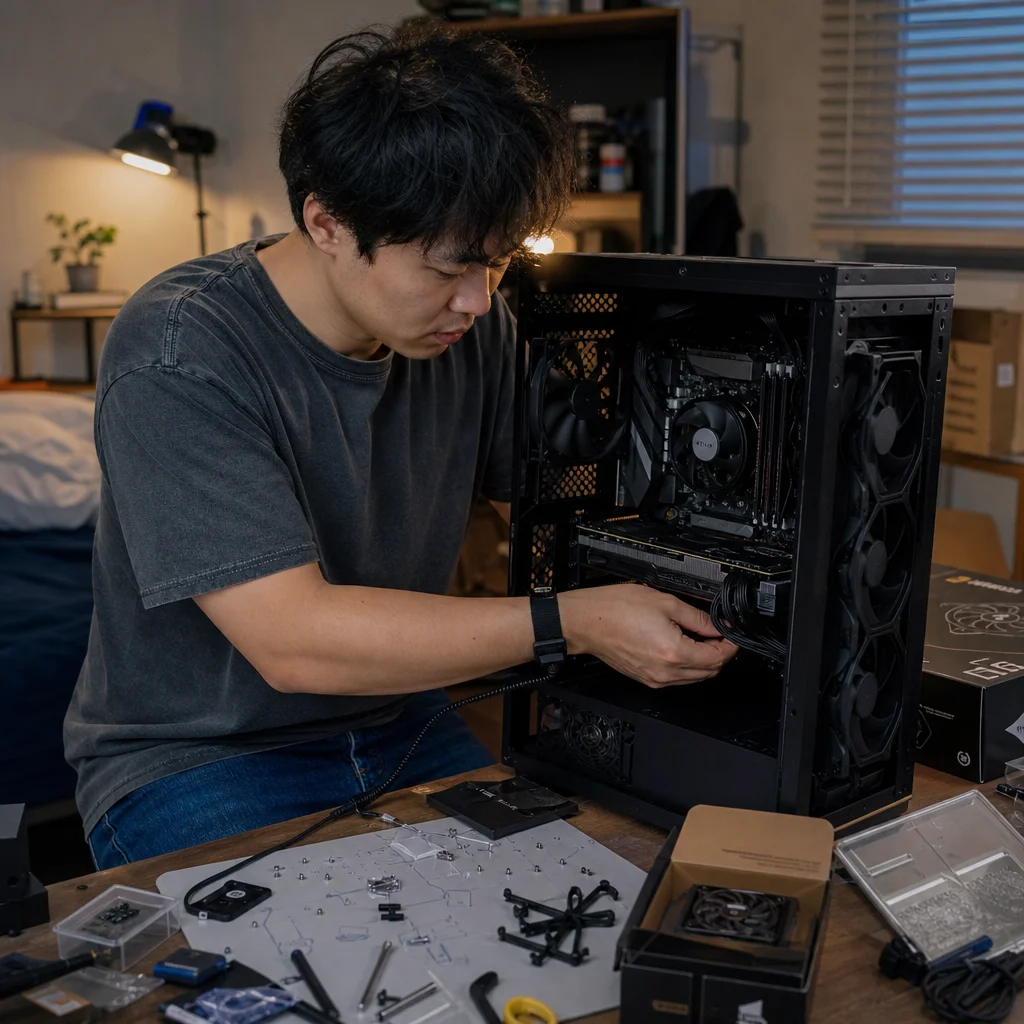
A graphics card can produce excellent benchmark results and still be the wrong choice for your monitor. The mismatch usually isn’t about the card being “too fast” or “too slow”; it’s about paying for performance the display can’t show, missing the bandwidth needed for its highest mode, or choosing a card that doesn’t suit the way you use the screen.
The useful question isn't simply, “How powerful is this GPU?” It’s, “What signal does my monitor need, and what work do I expect the card to do?” Start there, then use benchmark results to compare suitable options.
Match the card to the monitor’s native resolution
A monitor’s native resolution is the pixel grid it is designed to display clearly. Common examples include 1920 × 1080, 2560 × 1440, and 3840 × 2160, but ultrawide displays and newer high-density formats add more variations. The higher the resolution, the more pixels the graphics card must render for every frame.
That workload difference matters more than the monitor’s physical size. A 27-inch 1440p monitor asks the GPU to render substantially more pixels than a 27-inch 1080p monitor, while a 4K display requires roughly twice as many pixels as 1440p. A faster card may be necessary for demanding games at 4K, even if the same card is excessive for a basic 1080p desktop or esports setup.
Using a lower resolution on a fixed-pixel display can also affect image quality. If the selected resolution doesn’t scale cleanly to the panel’s native resolution, the monitor or graphics driver has to enlarge the image. The result may look softer than a native-resolution image. This isn't always a problem—games often offer useful upscaling modes—but it’s worth distinguishing deliberate rendering at a lower internal resolution from simply feeding the monitor an awkward output resolution.
For a sensible baseline, identify the monitor’s native resolution and decide whether you want games rendered at that resolution, rendered internally lower and upscaled, or displayed mainly for work and media. That decision narrows the appropriate graphics-card class before you compare frame-rate charts.
Refresh rate determines how much performance you can use
Refresh rate is the number of times the monitor can update each second. A 60Hz display can show up to 60 updates per second, while 144Hz, 165Hz, 240Hz, and faster panels can show more frequent updates. A graphics card that renders 200 frames per second can't make a 60Hz monitor display 200 distinct refreshes per second, although the extra performance may still provide some input-latency benefits in certain configurations.
The reverse mismatch is just as important. If your monitor runs at 165Hz but the graphics card regularly produces only 45 to 70 frames per second in the games you care about, you aren’t using the display’s full potential. That may be perfectly acceptable for a visually demanding single-player game, but it’s a poor pairing if you bought the monitor primarily for high-refresh competitive play.
Frame rate and refresh rate also don’t have to match constantly. Variable refresh rate, or VRR, allows the monitor to adjust its refresh timing within a supported range to follow the GPU’s frame rate. This can reduce tearing and make uneven performance feel smoother. VRR can improve a mismatched system, but it can't turn a card that renders 50 frames per second into a true 165-fps solution.
Consider the games and applications that matter most. Competitive games at 1080p may reward high, stable frame rates and low latency. A visually demanding game at 4K may make image quality the priority, with a lower but consistent frame rate. Photo editing, coding, office work, and video playback may need very little GPU rendering power but can still depend on the correct resolution, color features, and connector support.
Connector labels are only the beginning
DisplayPort and HDMI are families of standards, not single performance levels. The connector shape alone doesn’t tell you the maximum resolution, refresh rate, color format, HDR capability, or compression support available in a particular setup. The graphics card output, monitor input, cable, and sometimes an adapter all affect the result.
A monitor may offer several inputs with different capabilities. One input could support its full resolution and refresh rate, while another is limited to an older mode. An adapter can introduce another restriction, especially when converting between connector types. Even when a cable fits physically, it may not support the signal mode you want.
Bandwidth is the practical constraint. Higher resolution, higher refresh rate, greater color depth, and certain HDR modes all increase the amount of data sent to the display. Display Stream Compression, often called DSC, can allow some high-resolution and high-refresh combinations within available link limits, but support depends on the specific GPU, monitor, connection, and settings.
Check the complete display path: Before buying a card or cable, compare the monitor’s manual or specifications with the GPU’s output capabilities. Confirm the exact input needed for your target resolution and refresh rate, whether DSC or another feature is involved, and whether an adapter would reduce the available mode. Standards and product specifications change, so verify current details for the exact models rather than relying on the connector name alone.
This is one reason a card can be powerful enough to render a game at 4K but still fail to drive a particular 4K high-refresh monitor at its advertised mode. Rendering performance and display-link capability are related decisions, not the same decision.
Adaptive sync needs a compatible pairing
Adaptive sync is most useful when the GPU’s frame rate varies. Instead of the monitor refreshing on a rigid schedule, the display waits for a completed frame within its supported operating range. That can make motion look cleaner when performance moves between, for example, 70 and 110 frames per second.
The important details are the specific technologies and operating range, not just a badge on the box. A monitor might support a generic adaptive-sync mode, AMD FreeSync, NVIDIA G-SYNC Compatible operation, or a hardware-based G-SYNC implementation. Compatibility can depend on the GPU generation, connection type, driver support, and the monitor’s firmware or on-screen settings.
VRR also has a lower and upper limit. If the frame rate falls below the lower limit, low-framerate compensation may duplicate frames to keep the panel operating smoothly, but its behavior varies by display. If the frame rate exceeds the upper limit, you may need a frame-rate cap to avoid leaving the VRR window. The monitor’s stated range is therefore more informative than the presence of an adaptive-sync logo by itself.
If smoothness is important, check whether the graphics card and monitor are known to work together over the connection you plan to use. Also confirm that the desired refresh rate remains available when HDR, high color depth, or other display features are enabled. Some combinations share bandwidth or change the available modes.
Scaling can hide or expose a mismatch
Scaling describes how an image is resized to fit the monitor. There are two different situations to keep separate. A game can render internally at a lower resolution and upscale to the monitor’s native resolution, or the entire desktop can be set to a non-native output resolution. The first is often a performance feature; the second can make text and interface elements look less sharp.
Modern games may offer spatial or temporal upscaling, dynamic resolution, or a performance mode that renders fewer pixels while preserving an output signal at the monitor’s native resolution. These options can make a midrange card a reasonable match for a high-resolution display, especially when the monitor has a good pixel density and the upscaling implementation is effective. They don’t deliver exactly the same detail as native rendering, however, and results vary by game.
GPU scaling, display scaling, aspect-ratio controls, and integer scaling can produce different results for older games or unusual resolutions. If you want to play a 1080p game on a 1440p or 4K monitor, check whether you prefer a centered image, preserved aspect ratio, or a scaled full-screen image. A small amount of configuration can prevent stretched graphics or blurry text.
This is where minimalist planning helps: don’t buy a much faster card solely to avoid every form of scaling. First decide whether native resolution, a specific upscaler, or a stable frame rate matters most for your games. Then choose enough GPU performance for that target.
Workload matters more than a single benchmark
Benchmark numbers are useful only when they resemble your intended workload. A card that is excellent for 1080p esports testing may be a poor choice for 4K ray-traced games. A card that handles a demanding game well at native 1440p may offer little practical benefit for a 60Hz office monitor. Look for tests at your monitor’s resolution, with settings and features similar to your own use.
Ray tracing, high-resolution texture packs, video encoding, 3D work, and machine-learning applications can create different demands from ordinary rasterized gaming. Video memory capacity can also affect high-resolution games and creative workloads, particularly when texture quality or large projects push beyond what the card can comfortably hold. More memory doesn't automatically make a card faster, but insufficient memory can create stuttering or force lower settings.
Your processor and the rest of the system can limit high frame rates at lower resolutions. At 1080p with a fast monitor, the GPU may finish its work quickly enough that the CPU, game engine, or memory configuration becomes the limiting factor. Buying a much faster graphics card may then produce a smaller improvement than expected unless other settings or components change too.
Noise, power use, case clearance, and the power supply are also part of the fit. A card that technically meets a monitor’s performance target may be a poor practical choice if it requires a larger case, produces more heat, or adds cost for features you won’t use.
A simple way to make the decision
Begin with the monitor’s native resolution and target refresh rate. Next, identify the games or applications that matter and decide whether you prioritize image quality, high frame rates, ray tracing, quiet operation, or a lower purchase cost. Then check benchmarks at that resolution and workload rather than using a general performance ranking.
After that, verify the complete connection: the card’s output, the monitor’s input, the cable, the target color and HDR settings, and adaptive-sync compatibility. Finally, leave some room for the features you expect to keep using over the monitor’s lifetime, but don’t pay for a level of performance the display can't show and your workload doesn't need.
The right graphics card is the one that delivers the desired experience through the entire display chain. Resolution, refresh rate, scaling, connector capability, adaptive sync, and workload fit should establish the shortlist; benchmark numbers should help you choose within it.