How to Choose a Graphics Card for Your Monitor
When your monitor has a high resolution or refresh rate, the right graphics card depends on more than a model name. I’ll show you how to match GPU performance, display features, connectors, power, and system limits without paying for capability your screen can’t use.
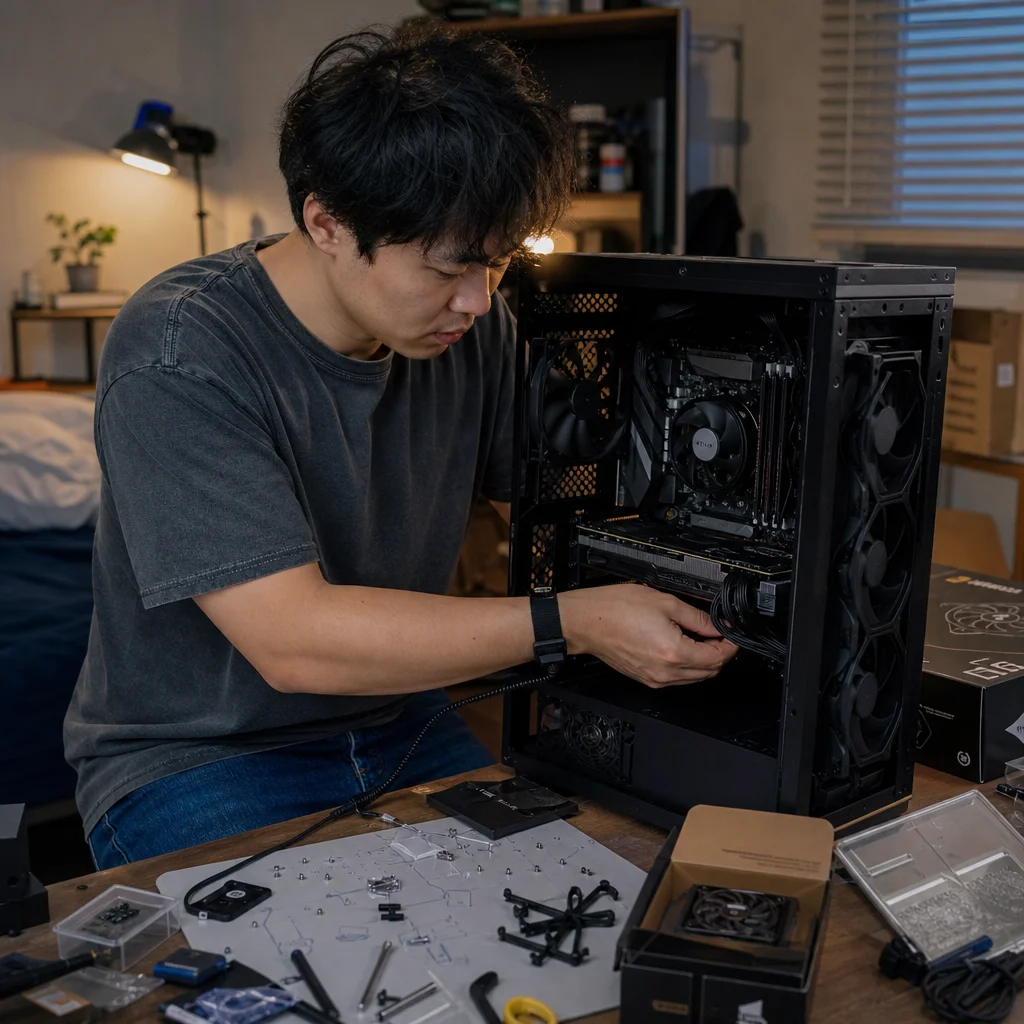
The graphics card you need is determined partly by the monitor you already own—or plan to buy. A card that is excellent for 1080p gaming may be a poor fit for a 4K display, while an expensive high-end model can be wasted if your monitor refreshes slowly and you mostly play undemanding games.
The common mistake is to choose a GPU first and treat the monitor as an afterthought. A better approach is to identify what the display asks the card to deliver, then check whether the rest of the computer can support that choice.
Start with resolution and refresh rate
Resolution determines how many pixels the graphics card must render for each frame. A 1920 × 1080 monitor is commonly called 1080p, 2560 × 1440 is usually called 1440p, and 3840 × 2160 is generally known as 4K. Higher resolutions produce a sharper image, but they also create more work for the GPU.
Refresh rate determines how many times per second the monitor can display a new image. A 60 Hz monitor can display up to 60 refreshes per second, while a 144 Hz or 165 Hz monitor can show substantially more motion updates when the game produces enough frames. A higher refresh rate can make aiming, camera movement, and general desktop use feel smoother, but it doesn’t automatically make every game run at that rate.
Think of resolution as the size of each rendering task and refresh rate as the number of completed tasks you want each second. A 4K 60 Hz monitor has a very different demand from a 1080p 240 Hz monitor. The first emphasizes pixel throughput and image quality; the second emphasizes high frame rates and low latency.
For a first pass, write down these details from the monitor’s specifications or on-screen menu:
- Native resolution
- Maximum refresh rate
- Whether the maximum refresh rate requires a particular connector
- Support for variable refresh rate (VRR)
- HDR support, if that matters to you
- Available HDMI and DisplayPort inputs
A monitor’s native resolution is the one you should normally use for the clearest image. Running a game at a lower resolution can improve performance, but the result may look softer unless the game or GPU provides a suitable upscaling mode.
Match the card to the games you actually play
The same monitor can require very different graphics hardware depending on the games and settings you use. Competitive shooters and other fast-paced games often benefit from high frame rates at moderate settings. Visually demanding single-player games may put more value on resolution, detailed textures, lighting effects, and ray tracing.
Consider the games you play most, not only the most demanding title you might install someday. A modest card may be entirely sensible for esports games at 1080p, especially if you’re comfortable adjusting quality settings. The recommendation changes if you want a steady high refresh rate in newer games with demanding visual effects.
Frame-rate targets are useful, but don’t treat them as universal requirements. For a 60 Hz display, consistently rendering well above 60 frames per second may provide limited visible benefit, although it can sometimes reduce input latency. For a 144 Hz monitor, a card that can regularly produce 140 frames per second is a closer match than one that averages 70. You should also consider frame-time consistency rather than focusing only on the average.
Minimum and recommended system requirements published for a game can help establish a baseline, but they don’t always describe the settings, resolution, or frame rate you want. Look for performance testing that uses your intended resolution and similar quality settings. GPU performance changes with game updates, drivers, and features such as ray tracing, so current results are more useful than an old ranking chart.
Check today’s performance targets: Before buying, compare recent tests for the specific games you play at your monitor’s native resolution, desired settings, and target frame rate. Hardware names and prices change, so an older recommendation may no longer represent good value.
Don’t overlook VRR and image features
Variable refresh rate synchronizes the monitor’s refresh timing with the GPU’s frame delivery. When supported by both devices and configured correctly, VRR can reduce tearing and make fluctuations in frame rate less distracting. It is especially useful when a game can't maintain the monitor’s maximum refresh rate at all times.
Monitor and GPU support must work together. Different displays and graphics cards may use technologies marketed under different names, and support can depend on the connector, driver, operating system, and monitor settings. Check the monitor manufacturer’s compatibility information rather than assuming that any two products will expose every VRR feature.
HDR is another feature that shouldn’t be judged by its label alone. A monitor may accept an HDR signal without delivering the contrast, brightness, or local dimming needed for a convincing HDR image. If HDR matters to you, evaluate the monitor’s actual panel capabilities and reviews. The graphics card still needs to render the game at the chosen resolution and settings, but buying a much faster GPU solely because a monitor says “HDR” isn't automatically justified.
Upscaling and frame-generation features can also change the relationship between a GPU and monitor. They may increase apparent frame rate or make a higher resolution more practical, but they can introduce image-quality compromises or depend on game support. Treat them as useful options rather than a reason to ignore the card’s native rendering performance.
Confirm the connector and bandwidth requirements
A graphics card can be powerful enough for your monitor and still fail to deliver its advertised refresh rate through the wrong port or cable. Check both ends of the connection: the GPU output, the monitor input, and the cable specification.
DisplayPort and HDMI versions support different combinations of resolution, refresh rate, color depth, compression, and HDR. The exact limit depends on the implementation in the monitor and graphics card, not just the version number printed on a product page. Some monitors reach their maximum refresh rate only through DisplayPort; others require a newer HDMI connection for high-resolution, high-refresh operation.
You may not need the newest connector if your monitor’s resolution and refresh rate fit comfortably within an older interface. Conversely, a cable that physically fits may not support the mode you want. Look for the monitor manual’s supported input modes and the GPU manufacturer’s output specifications. If an active adapter or dock is involved, it becomes another possible limitation.
Also check how many displays you intend to connect. Multiple high-resolution monitors can consume several GPU outputs and may affect which ports remain available for a television, capture device, or virtual-reality headset. Port placement is a small detail until you discover that your preferred arrangement requires adapters.
Check the rest of the computer before buying
A graphics card doesn’t work in isolation. Your processor, power supply, case, and motherboard all influence whether the upgrade is practical.
The CPU can limit frame rates, particularly at 1080p with a high-refresh monitor. If the GPU renders frames faster than the processor and game engine can prepare them, installing a more powerful card may produce little improvement. This doesn’t mean every system needs a matching top-tier processor; it means you should avoid paying for GPU performance that your current games and CPU can't use.
Your power supply needs the correct capacity, connectors, and physical cable arrangement for the card. Manufacturer recommendations are useful starting points, but they may assume a particular processor and system configuration. A quality power supply with appropriate headroom is preferable to running a borderline unit continuously near its limits. Don't rely on loose adapters or improvised cable combinations, especially for newer high-power card connectors.
Verify the power and fit details: Check the exact card’s power connector requirements, recommended power supply, length, thickness, and slot clearance against your case and power supply. Product variants of the same GPU can have noticeably different dimensions.
The motherboard usually doesn't need to be from the same generation as the graphics card. A standard PCIe graphics slot is generally designed to maintain compatibility across generations, though the available link speed and platform may affect performance in particular situations. Make sure the card can be installed in the intended full-length slot and that neighboring expansion slots will remain usable if that matters to you.
Case airflow matters as well. A card that fits physically may dump substantial heat into a small enclosure, increasing fan noise or reducing sustained performance. Check the case’s supported GPU length and thickness, front-fan or radiator clearance, and airflow path. A cooler-running model is often easier to live with than a slightly faster card that overwhelms the case.
Avoid paying for the wrong kind of performance
A high-end graphics card isn't automatically the best choice for every monitor. If you use a 1080p 60 Hz display, a premium card may be difficult to justify unless you plan to upgrade the monitor soon or run unusually demanding applications. At 1440p, the middle of the market often offers a more balanced combination of image quality and performance, but the right choice still depends on game settings and current pricing.
At 4K, you’ll usually make more compromises between frame rate, visual settings, upscaling, and ray tracing. A card that handles 4K in one game may struggle in another. If your monitor supports a very high refresh rate at 4K, reaching that rate is a particularly demanding target, and you should confirm real test results rather than relying on the card’s product tier.
Buying a card that leaves some performance unused can be sensible if a monitor upgrade is part of your near-term plan. It is less sensible when the upgrade is indefinite and the extra capability costs money you could use for a better monitor, larger SSD, stronger power supply, or quieter case cooling. Consider the complete system rather than maximizing one component.
A sensible matching process
First, decide whether you care most about resolution, refresh rate, visual settings, or a balance of all three. Then identify the games that will set the highest demand. From there, choose a target frame rate and compare current GPU tests at the monitor’s native resolution.
Next, confirm VRR support and the connection needed to reach the display’s advertised mode. Check CPU balance, power supply requirements, case clearance, cooling, and available outputs before placing an order. If two cards meet your performance target, favor the one that fits your system comfortably and offers the better combination of price, noise, power use, warranty, and features.
The best graphics card for your monitor isn't necessarily the fastest one you can afford. It’s the card that can produce the kind of frames your display can show, in the games you actually play, while fitting safely and sensibly into the rest of your computer.