Choose a Graphics Card for Two Different Workloads on One Monitor
When gaming, rendering, and video work share one monitor, the best graphics card depends on more than frame rates. I’ll help you weigh workload priorities, VRAM, software support, display needs, noise, and power so one GPU remains useful across the whole system.
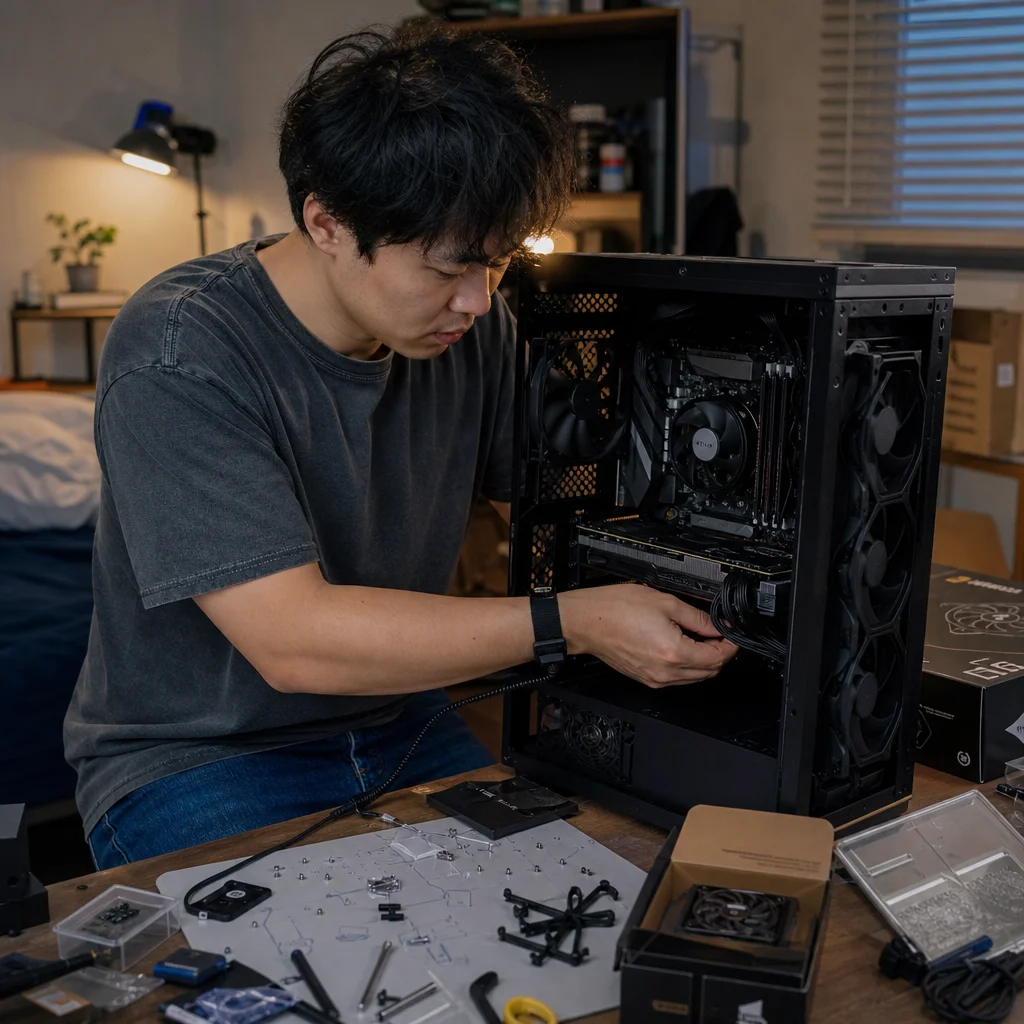
A graphics card is easier to choose when one workload clearly dominates. If you game at night, render during the day, and edit video on the same monitor, however, the “best” card becomes a compromise between speed, memory, software support, image quality, and system noise.
The right approach isn't to average every specification together. Instead, identify which tasks are limited by the GPU, decide which compromises you can tolerate, and then compare cards that meet your practical requirements. A card that produces excellent gaming frame rates may not be the best value for GPU rendering, while a card with strong creator features can be more than you need if most of your time is spent playing games.
Start with the workloads, not the product tier
Write down the applications and games you actually use. “Gaming and content creation” is too broad to guide a purchase. A modern competitive game at 1080p, a demanding ray-traced game at 4K, Blender rendering, DaVinci Resolve effects, and exporting H.264 video all place different demands on a GPU.
For gaming, note your monitor’s resolution, refresh rate, and the settings you want to use. Resolution has a major effect on the amount of rendering work the card must perform. High refresh gaming also places more emphasis on sustained frame rates and latency than on a single maximum frame-rate result. Ray tracing can shift the balance toward cards with stronger ray-tracing hardware and useful upscaling features.
For rendering and video work, identify whether the application uses the GPU for final rendering, viewport performance, effects, encoding, or only selected features. Some tasks benefit from general GPU compute, while others depend heavily on a particular rendering engine, hardware encoder, or software plug-in. A card that looks impressive in a gaming benchmark may therefore be a poor match for your specific project files.
A simple workload split is useful. For example, you might describe your use as 60 percent gaming, 25 percent video editing, and 15 percent 3D rendering. The percentages don’t need to be precise. They help you avoid spending most of your budget optimizing an occasional task while compromising the activity you do every week.
Treat VRAM as a shared limit
Video memory matters across both gaming and creative work, but it becomes especially important when you switch between them. Games use VRAM for textures, geometry, frame buffers, ray-tracing data, and other assets. Rendering applications may need space for complex scenes, high-resolution textures, lighting data, and large output images. Video editors can use it for effects, timelines, color processing, and multiple high-resolution sources.
More VRAM doesn't automatically make a card faster. It does give demanding workloads more room before they begin reducing texture quality, moving data through slower system memory, stuttering, or failing to render a scene. If you’re choosing between otherwise similar cards, additional memory can be a sensible form of long-term flexibility—provided the GPU itself has enough processing power to use it.
Your monitor resolution is only part of the memory equation. A 4K display increases the size of rendered frames, but a heavily modded game, high-resolution texture pack, complex 3D scene, or multi-layer video project can create memory pressure at lower resolutions too. Similarly, a single monitor doesn't mean your projects are small.
Look for application benchmarks and user reports that resemble your own work. Pay attention to whether the comparison measures final render time, timeline playback, export time, or just a convenient preview task. Those results can differ substantially.
Compare software support before raw performance
The graphics processor’s architecture matters, but the software ecosystem around it can matter just as much. Rendering engines and creative applications may offer different levels of support for GPU acceleration, hardware ray tracing, denoising, effects, and video encoding depending on the vendor and application version.
Some programs perform best with a particular compute or rendering framework. Others support several vendors but still show different results because features are implemented unevenly. Video applications may also use the GPU for effects while relying on a separate hardware encoder for export. You should check the exact functions you use rather than assuming that “GPU acceleration” means every part of the program will run faster.
Driver behavior is part of this decision. Gaming-focused driver releases may prioritize new titles, while creator-oriented driver branches may emphasize application testing and stability. The naming and availability of these options vary by vendor and region, and not every application benefits from switching. A card with broad, well-documented support can be easier to live with than one that wins a narrow benchmark but requires workarounds for your main software.
Check your application’s current support: Before choosing between graphics-card families, look up the current GPU acceleration, rendering-engine, encoder, and driver requirements for the exact versions of your games and creative applications. Support and performance can change with software updates, so confirm the features you actually use rather than relying on an old comparison.
Balance gaming features with creator features
For gaming, compare more than the average frame rate. Upscaling, frame-generation features, ray tracing, latency tools, and image-quality modes may affect how enjoyable a card is at your target resolution. Their usefulness depends on the games you play, and some introduce trade-offs in image clarity, latency, or compatibility.
For video work, examine the card’s hardware encoding and decoding capabilities. The formats you record and export—such as H.264, HEVC, or AV1—can influence workflow speed and file size. A capable encoder may reduce export time or make streaming easier, but it won’t replace a strong CPU for every part of an editing workflow. Effects, timeline playback, decoding, and final export may each use different resources.
Rendering has its own balance. If your renderer supports GPU acceleration well, a graphics card can reduce final render times dramatically compared with CPU-only work. But GPU rendering may require scenes to fit in VRAM, and some projects still depend on CPU features, system memory, or plug-ins that don't transfer cleanly to the GPU. If a scene regularly exceeds the card’s available memory, a theoretically faster card may become the less useful choice.
When one card must cover all three areas, broad capability is often more valuable than a specialized advantage you’ll rarely use. That usually means prioritizing sufficient VRAM, strong support in your main applications, and gaming performance appropriate to your monitor before chasing the highest score in a single benchmark.
Let the monitor set the gaming target
A single monitor simplifies the display side of the build. You don’t need to optimize for driving several high-resolution panels, and you can usually focus on one resolution and refresh-rate target. It doesn't, however, make every graphics card equally suitable.
Match the card to the experience you want on that display. A 1440p high-refresh monitor may call for a different balance than a 4K 60 Hz monitor, even if both are used for the same games. If you want high settings with ray tracing, include those conditions in your comparisons. If you mostly play older or competitive titles, a less expensive card may already exceed the monitor’s practical needs.
Check the monitor connection as well. Confirm that the card provides the required DisplayPort or HDMI standard for your resolution, refresh rate, adaptive-sync behavior, and color depth. Display output capabilities can vary between models using the same GPU, particularly among compact or budget-oriented versions.
A single monitor also leaves more of the budget available for GPU memory, cooling, storage, or system reliability. Don’t buy a more expensive card solely because it supports multiple displays if you have no plan to add them.
Account for noise, heat, and power
A card that performs well in a benchmark can still be a poor fit for a quiet workstation and gaming machine. Rendering and video exports can keep the GPU under load for much longer than a typical game session, raising temperatures and fan speed. Consider the cooler’s size, fan behavior, case airflow, and whether the card has a sensible low-load or semi-passive mode.
Cooler quality matters more than a small difference in factory clock speed. A larger heatsink and slower fans may provide a quieter experience, but they can also make the card longer, thicker, or heavier. Check the card’s actual dimensions, slot usage, power connectors, and clearance around the motherboard and case before ordering.
Power planning deserves the same attention. Compare the card manufacturer’s current power recommendation with your complete system, including the CPU, storage, fans, and any future upgrades. Use the correct cables and connectors for the power supply and graphics card, route them without sharp stress at the connector, and make sure the power supply is a reputable unit with suitable capacity. Exact requirements vary by model, not just by GPU family.
Verify the complete fit: Before buying, check the specific card’s length, thickness, power connectors, recommended power supply, display outputs, and cooler clearance against your case and power supply. Board-partner models can differ significantly even when they use the same graphics processor.
Decide where to spend the compromise
There is rarely a card that leads every category at an attractive price. The useful question is which weakness will affect you least.
If gaming is your priority and rendering is occasional, choose a card that meets your target resolution and refresh rate, then confirm that its VRAM and software support are adequate for your creative tasks. If rendering is frequent and directly earns money or saves substantial time, give more weight to application benchmarks, memory capacity, and the rendering ecosystem—even if that means accepting lower gaming performance at extreme settings.
If video editing is the center of your work, encoder support, decoder behavior, application compatibility, and timeline performance may matter more than raw gaming speed. If you work with large projects or high-resolution footage, memory capacity and media-engine support deserve particular attention.
You can also keep the system balanced by choosing a sensible middle tier rather than an extreme flagship or entry-level card. A flagship may offer excellent performance but bring higher cost, power draw, heat, and diminishing returns on a moderate-resolution monitor. An entry-level model may save money but leave too little memory or acceleration headroom for the creative workload you intend to keep for several years.
A sensible selection process
Begin with the monitor target and the applications you use most. Eliminate cards that lack the required display connections, memory, software support, or physical and power compatibility. Then compare independent gaming results at your actual resolution and application benchmarks using similar renderers, codecs, effects, or project complexity.
After that, estimate the cost of the whole solution rather than the card alone. A hotter GPU might require better case airflow or a larger power supply. A card with too little memory may push you toward an upgrade sooner. A modestly slower model with a quieter cooler and broader application support can be the better long-term purchase.
Finally, choose the compromise you can explain clearly: perhaps slightly less ray-traced gaming performance in exchange for more VRAM and better rendering support, or a lower creator benchmark score in exchange for lower cost and excellent performance in the games you actually play. For a two-workload system on one monitor, that deliberate balance is more useful than chasing a universal winner. fel
Before ordering, recheck current application support, encoder and decoder features, card dimensions, power requirements, monitor connections, and prices from the relevant manufacturer and retailer. Those details change more often than the basic decision framework. Once the card meets those requirements, buy the model that gives your primary workload the most headroom without making the secondary workload frustrating or the rest of the system unnecessarily loud.