Choose a Graphics Card for Blender, CAD, or Other GPU Workloads
When a graphics card must handle Blender renders, CAD viewports, or several GPU-accelerated applications, the familiar gaming hierarchy can mislead you. I’ll show you how to weigh software support, VRAM, viewport behavior, rendering speed, displays, power, and long-term reliability.
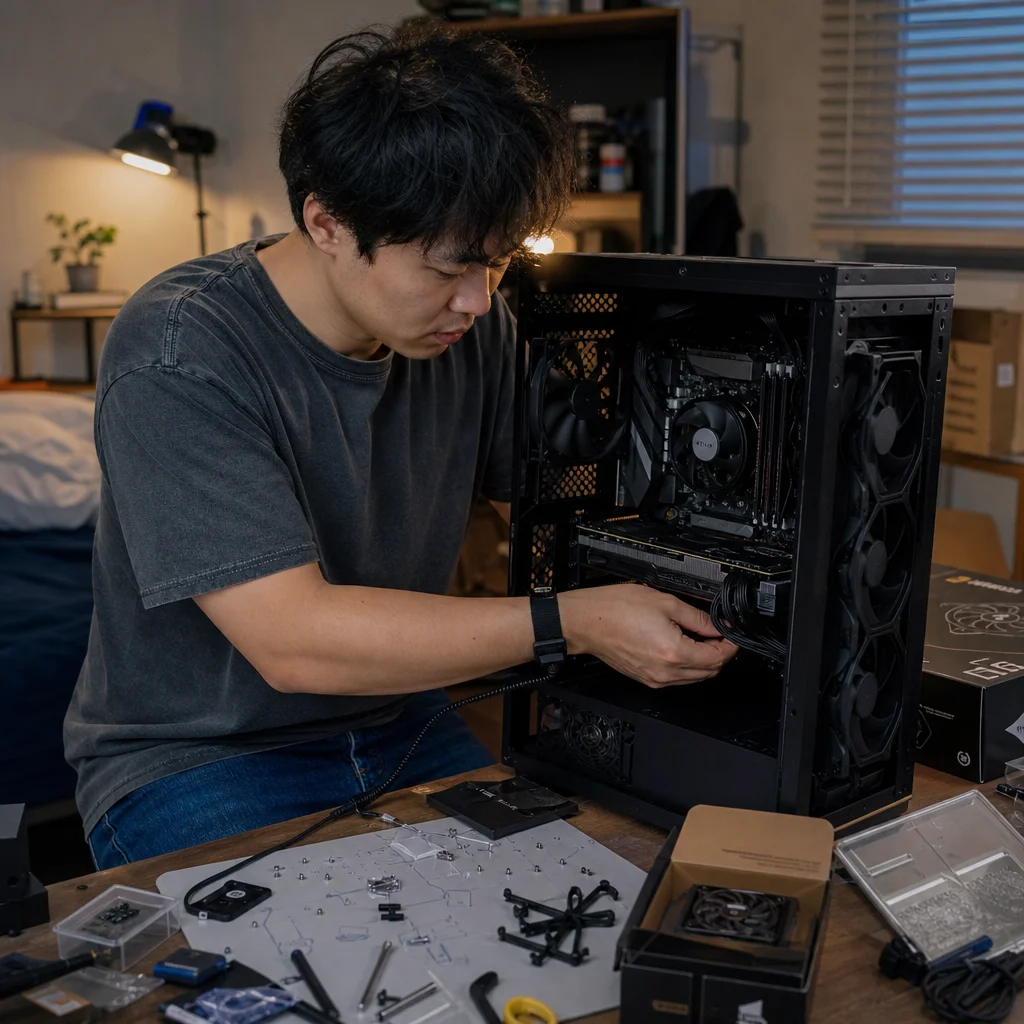
A graphics card that is excellent for games isn’t automatically the right choice for Blender, CAD, simulation, video work, or other GPU-heavy applications. Those workloads can care more about software support, available memory, driver behavior, and sustained cooling than about a single gaming benchmark score.
The safest way to choose is to start with the work you actually do. Identify which applications matter, separate interactive viewport performance from final rendering, and then check the card’s practical fit inside your system. That approach reduces the risk of buying a fast-looking card that lacks enough VRAM, has poor support for your renderer, or can't run reliably in your case.
Start with the software, not the specification sheet
Make a short list of your primary applications and the tasks that consume the most time. “Blender” isn't one workload: modeling, sculpting, texture work, simulation, viewport playback, Eevee rendering, and Cycles rendering can stress different parts of the system. CAD software varies just as much. A simple mechanical assembly, a large architectural scene, and a real-time visualization project may have very different graphics requirements.
Next, determine whether the application uses the GPU for the task you care about. Some features accelerate rendering, effects, viewport display, or AI-assisted operations, while other operations remain primarily CPU-bound. A powerful graphics card won’t make a mostly CPU-limited operation proportionally faster, and more VRAM won’t fix slow simulation steps that never use the GPU.
GPU compute support also matters. Blender Cycles, for example, can use different hardware and software backends depending on the graphics-card platform and the installed Blender version. CAD applications may favor a particular driver branch or maintain certification lists for specific professional cards. Support can change as applications and drivers are updated, so treat compatibility as a current software question rather than a permanent feature of a card.
Check your actual render and driver path: Open the current documentation for each important application and confirm the supported GPU backend, minimum driver requirement, operating-system support, and any certified-card guidance before you buy. If you use a plug-in renderer, verify its requirements separately from the host application.
Match VRAM to the size of the work
Graphics memory, or VRAM, stores assets and data close to the GPU. In Blender, that can include geometry, textures, shaders, render buffers, and scene data. In CAD and visualization work, it can include detailed models, large assemblies, materials, and multiple viewports. When a scene exceeds available VRAM, the application may move data into system memory or fail to render. The result can be a sharp performance drop, an error, or an inability to open the project at all.
More VRAM is therefore valuable, but it isn’t a substitute for a capable GPU. A card with plentiful memory may still render slowly if its compute performance is modest. Conversely, a fast card with too little VRAM can be frustrating because it performs well on small projects and then breaks down when a scene grows.
Think about your largest realistic projects rather than the average file. Consider texture resolution, particle or geometry counts, scene complexity, the number of applications open at once, and whether you use high-resolution displays. If your work is growing, leave headroom instead of choosing a card that only fits today’s typical scene.
VRAM requirements are especially difficult to compare from marketing material because applications don't all report memory use in the same way. A project that fits comfortably in one renderer may exceed the limit in another because of different data structures or texture handling. Your own files, representative samples, and the renderer’s documentation are more useful than a generic “recommended for creators” label.
Separate viewport responsiveness from render speed
Interactive viewport work is about how quickly the scene responds while you orbit, pan, zoom, select, edit, and change visual modes. Responsiveness depends on more than raw shader throughput. Scene complexity, object count, driver behavior, display resolution, application optimization, and sometimes CPU performance all influence the experience.
Final rendering is a different question. A GPU that makes a viewport feel smooth may not provide the best render time for your particular engine. Conversely, a card that renders quickly may offer little benefit during ordinary modeling if the viewport is limited by scene organization, CPU work, or software behavior.
When comparing cards, look for benchmarks that resemble your task. For Blender, distinguish the renderer and settings used, such as Cycles or Eevee, from general Blender scores. For CAD, prioritize tests using the same application and comparable assembly sizes. A benchmark at a lower resolution or with a simple scene may say little about your experience with a dense model on a high-resolution monitor.
If your work is mostly modeling and drafting, a balanced card with adequate VRAM and dependable drivers may be preferable to an expensive render-focused model. If you produce frequent final renders, animation frames, or GPU-accelerated effects, sustained compute performance and memory capacity deserve more weight.
Consider professional drivers and application certification
Consumer and professional graphics cards can share similar underlying GPU technology, but their support packages and validation priorities may differ. Professional cards are often marketed around certified drivers, longer product support, workstation-focused features, and predictable behavior in particular applications. Those advantages can matter when an application vendor officially tests a card and driver combination.
Certification doesn't make a card universally faster, and a professional model isn't automatically the best value for every creative workload. Some applications run very well on consumer cards, especially when the task is GPU rendering rather than precision viewport work. A certified card may nevertheless be worthwhile when stability, vendor support, or a validated configuration is more important than maximum performance per dollar.
Read the certification details carefully. A card may be certified only with a particular driver version, operating-system release, or application version. Certification can also cover specific features rather than every part of a software package. If your income or deadlines depend on the workstation, the cost of a supported configuration can be easier to justify than the cost of troubleshooting an unofficial one.
Check display and connectivity requirements early
Your monitors are part of the graphics-card decision. Count the displays you use now and the ones you may add, then note their resolution, refresh rate, color depth, and connection type. A card must support the required combination at the same time, not merely list each feature separately.
Connector selection matters too. Modern cards may use a mixture of DisplayPort and HDMI, while older monitors may require adapters. Adapters can be perfectly suitable, but active conversion may be needed in some situations, and an adapter can affect available resolution or refresh-rate combinations. If you use a specialized display, pen monitor, color-critical panel, or capture setup, confirm its connection requirements before choosing the card.
Multiple high-resolution displays also increase practical demands on memory and outputs, even when they don’t dramatically change render performance. Make sure the card has enough physical connectors and that adjacent expansion slots won’t block the ports or prevent installation of another device.
Verify power, clearance, and cooling before ordering
A graphics card is a physical and electrical component, not just a performance number. Compare its length, height, thickness, power connectors, and recommended power supply with your case and existing hardware. A card that occupies three or more slots may block expansion cards, interfere with a bottom-mounted radiator, or leave little room for airflow.
Power-supply requirements deserve particular care. Use the card manufacturer’s current specifications as a starting point, but also account for the processor, drives, fans, pumps, and other components. Some high-power cards have brief load spikes that make a marginal power supply a poor match even if its printed wattage appears sufficient. The correct power connectors and properly seated cables are as important as total capacity.
Avoid forcing a new high-power connector around a sharp side-panel bend. Follow the card and power-supply manufacturers’ instructions for cable routing, adapters, and connector engagement. If your power supply uses a modular design, use only cables intended for that exact power-supply model; modular cables aren't universally interchangeable.
Sustained rendering can keep the GPU under load for much longer than a typical game session. A card with an effective cooler can maintain performance more consistently and produce less distracting noise. Check independent reviews for sustained temperatures, noise, and power behavior rather than relying only on the cooler’s size or the number of fans.
Confirm the installation fit: Before purchasing, measure the case’s maximum GPU length with front fans or radiators installed, check the card’s slot thickness, identify the required power connectors, and verify that your power supply can provide them without questionable adapters or cable strain.
Use benchmarks without letting them choose for you
Benchmarks are useful when they answer a specific question. Start by deciding whether you need faster viewport interaction, shorter final renders, larger scenes, quieter operation, or a combination of those benefits. Then compare results from the applications and settings closest to your work.
Pay attention to scaling. Moving up one GPU tier may produce a substantial improvement in a GPU renderer but only a modest change in a CAD viewport. Doubling VRAM may prevent out-of-memory failures without doubling performance. A more expensive card may also consume more power and produce more heat, which can affect noise and long-session consistency.
Reviews that show minimums, averages, and sustained results are more informative than a single headline score. Look for tests involving long renders, complex scenes, large assemblies, or your target resolution. If you can, test a representative project on a similarly configured system. A short benchmark using a small sample scene is useful for comparison, but it can't prove that your largest project will fit in memory or behave well.
Decide whether you need one powerful card or more than one
For many users, one well-matched GPU is the simplest and safest choice. It reduces power, heat, driver, and application-complexity concerns. A single card with enough VRAM is often more useful than two cards whose memory can't be combined for the workload you use.
Multiple GPUs can help in applications and renderers that explicitly support them, but support isn't universal. Adding a second card may increase performance for a compatible batch-rendering task while providing little benefit to a viewport or a feature that uses only one GPU. Each card also needs sufficient power, airflow, physical space, and sometimes separate power cables.
Don't assume that two cards provide twice the usable VRAM. Many workloads must fit the scene into the memory available on each card, rather than pooling the cards’ memory into one larger workspace. Confirm multi-GPU behavior in the documentation for your exact renderer or application before planning around it.
A sensible selection process
Begin with your applications and rank the tasks by importance: viewport work, GPU rendering, simulation, visualization, encoding, or another specific workload. Record the largest project you need to open, the displays you need to drive, and the operating system and driver constraints that apply.
Then set a minimum VRAM target based on those projects, with additional room for growth. Compare cards using workload-specific tests, while also checking sustained noise, power, warranty, physical dimensions, and current software support. If a professional driver or certified configuration is important, include that requirement before comparing prices rather than treating it as an optional extra afterward.
Finally, validate the complete system. Confirm the case fit, power-supply connectors, cooling path, motherboard slot layout, display connections, and any other expansion cards. Install the recommended software and drivers from the appropriate vendors, and keep a known-good driver version when your production workflow depends on stability.
The best graphics card for Blender, CAD, or another GPU workload is the one that reliably supports your software, holds your real projects in memory, responds well in the tasks you perform, and fits the rest of your computer without risky compromises. Start with those requirements, and the specification sheet becomes a way to confirm a decision rather than the thing making it for you.