How to Check PCIe Link Speed When a Graphics Card Underperforms
I’ll compare the quickest software checks with hands-on slot and firmware inspection, then explain how to separate a genuinely restricted PCIe link from normal graphics-card behavior under different workloads.
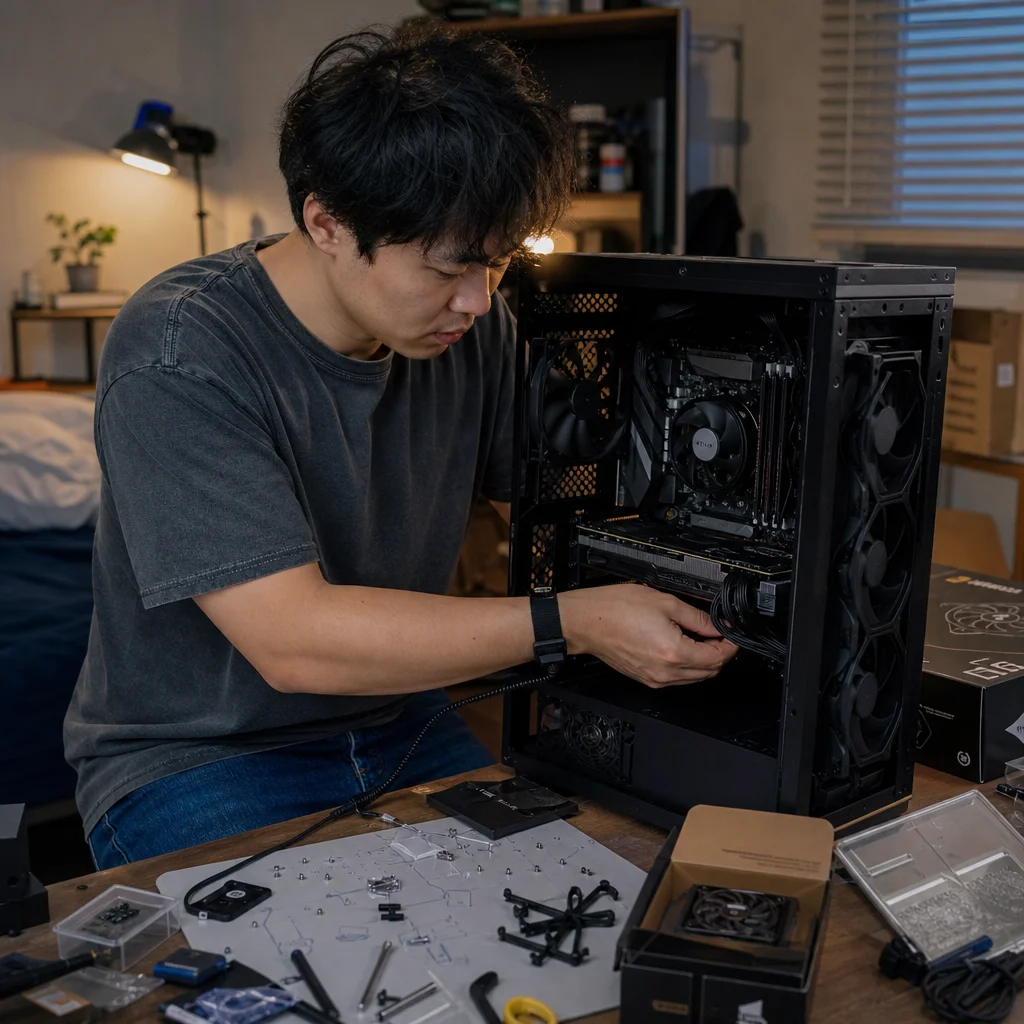
A graphics card can underperform for many reasons, and PCIe link speed is only one of them. Still, a card running at a reduced link width or generation can create a real bottleneck—especially when it is installed in the wrong slot, sharing lanes with another device, or connected through a problematic riser cable.
The useful question isn’t simply whether your card supports PCIe 4.0 or PCIe 5.0. You need to find out what link it negotiated with the motherboard while the card is idle and under load, whether the physical slot can provide that connection, and whether the observed performance loss is large enough to matter.
Start with the negotiated link, not the card’s maximum specification
Graphics cards and motherboards advertise maximum PCIe capabilities, but the active connection is negotiated between the two devices. A PCIe 4.0 graphics card in a PCIe 3.0 motherboard will normally operate at PCIe 3.0 speeds. A card in a slot wired for only eight lanes may show x8, even if the slot is physically long enough for a x16 card.
That negotiated result is usually shown as a generation and a lane width, such as PCIe x16 4.0, PCIe x8 3.0, or PCIe x4 4.0. The generation describes the transfer rate per lane; the width describes how many lanes are active. Both matter, although a lower link doesn't automatically explain every performance problem.
The simplest Windows check is usually GPU-Z. On its Graphics Card tab, look for the Bus Interface field. It may show the card’s current link and its maximum supported link, with a render test button beside it. Other hardware-information tools, including HWiNFO, may show similar information under the PCI Express or GPU section. The exact wording and layout can change between software versions, so look for the active link speed and width rather than relying on a particular screen arrangement.
At the desktop, many cards deliberately enter a low-power PCIe state. GPU-Z might therefore display something like PCIe x16 1.1 while the system is idle, even though the card can negotiate a much faster connection during a game. That reading isn't necessarily a fault.
Check the live connection under load: Start the monitoring tool’s render test, or run a repeatable graphics workload in a window while watching the PCIe link field. Confirm that the reported width and generation rise under load before treating an idle
x1or low-generation reading as a problem.
Confirm that the card is in the right slot
The top full-length slot is commonly the primary graphics slot, but you shouldn't assume every full-length slot is wired the same way. Some secondary slots operate at x4 or x8, and some connect through the chipset rather than directly to the processor. A slot can also be physically x16 while having fewer electrical lanes.
Check the motherboard manual or its support page for the slot’s electrical configuration. Look for terms such as PCIEX16, x16 mode, or a table showing how the slots behave with one or more expansion cards installed. The first slot nearest the processor is often the intended location for a single graphics card, but the manual is the more reliable source—particularly on workstations, compact boards, and platforms with several long slots.
Also inspect the card’s seating. Shut the computer down, switch off the power supply, disconnect the power cable, and allow the system to cool before touching the card. Remove the retaining screw and release the slot latch as needed, then reinstall the card evenly until the latch engages. Make sure the case’s rear bracket isn't pulling the card upward or leaving it slightly tilted. A card that powers on can still be poorly seated.
The power connectors deserve a separate look. A missing or poorly connected auxiliary connector is more likely to cause crashes, power limits, or failure to start than a reduced PCIe link, but troubleshooting both at once is sensible. Use the required connectors from the power supply and avoid placing strain on the socket or cable.
Check BIOS and motherboard lane-sharing settings
Firmware settings can affect both the slot’s mode and the devices competing for motherboard lanes. Most systems leave PCIe link speed on Auto, which is normally appropriate. If a new card or motherboard is negotiating an unexpectedly low generation, you can test a fixed setting such as Gen 3 or Gen 4, provided that mode is supported by both devices. This is a diagnostic step, not automatically an upgrade.
A fixed lower generation can help identify signal-quality or compatibility problems. For example, if Auto produces instability but a lower fixed generation works reliably, the issue may involve the board, card, riser, slot, or signal path rather than graphics drivers alone. Conversely, manually selecting an unsupported or unsuitable generation can prevent a system from booting, so change one setting at a time and know how to restore firmware defaults.
Motherboards frequently share lanes among the primary graphics slot, secondary expansion slots, and M.2 sockets. Installing a drive in a particular M.2 socket may disable a SATA port, reduce a secondary slot, or alter the lane arrangement. The exact behavior varies by platform and motherboard revision. Consult the board’s manual for the lane-sharing diagram instead of assuming that every M.2 socket is interchangeable.
You should also check whether the board offers settings for slot bifurcation, primary display adapter, or above-4G decoding. These are generally relevant to multi-device configurations and platform compatibility, not a routine fix for one underperforming card. Avoid changing unrelated firmware options simply because they mention PCIe.
Verify firmware details before changing them: Compare your board’s slot and lane-sharing table with the current BIOS settings, then record the original values. Firmware menus and supported options differ by manufacturer, so use the motherboard’s documentation for the exact setting names and recovery procedure.
Treat riser cables and adapters as part of the link
A vertical-mount kit, extension cable, or compact-case riser adds another part to the PCIe signal path. If the card works correctly when installed directly in the motherboard but negotiates a lower generation or width through a riser, the riser or its connection becomes a strong suspect.
For testing, power down and install the card directly in the primary slot if your case allows it. If the direct connection restores the expected result, update the riser’s orientation and seating, check whether it is rated for your PCIe generation, and try a lower fixed generation in firmware. A riser that is marginal at PCIe 4.0 may behave consistently at PCIe 3.0, though that is a compromise rather than proof that the cable is healthy.
Adapters and extension hardware should be tested with the same care. A mechanical adapter may change how a card fits without providing the electrical connection you expect. Some external GPU arrangements are limited by their enclosure or host interface regardless of the graphics card’s capabilities.
Compare behavior in a repeatable workload
A lower link reading matters only in context. Record the card’s negotiated link, GPU temperature, clock speed, power draw, utilization, frame rate, and frame-time behavior in the same workload. Repeat the test after changing only one variable, such as moving the card to the primary slot or removing a riser.
The impact of PCIe bandwidth depends on the workload and the card. A graphics-heavy game that keeps most resources in video memory may show little difference between two link configurations. Workloads that stream textures, transfer data frequently between system memory and the card, or exceed available VRAM can be more sensitive. Synthetic benchmarks may also respond differently from games.
A card that is stuck at x1 under load is more concerning than one operating at x8 instead of x16, but neither result tells you the cause by itself. Look for a corresponding performance change. If the card maintains normal clocks and utilization and the frame rate is close to expectations, the negotiated link may not be the main issue.
Remember that an apparently low link can be a symptom of a different problem. A driver issue, unstable overclock, thermal limit, power limit, background process, CPU bottleneck, or game setting can all reduce performance without changing PCIe connectivity. Use a known-good graphics driver and return CPU, GPU, and memory tuning to stock settings while testing.
Use platform tools when a Windows utility isn’t available
On Linux, lspci can show PCIe capabilities and the link currently in use. After identifying the graphics device with lspci, a command such as lspci -vv for that device can display fields commonly labeled LnkCap and LnkSta. LnkCap describes the capability; LnkSta describes the current status. Read the status line while the card is doing real work, because power management can affect an idle reading.
The same principle applies to other operating systems and vendor utilities: distinguish the maximum capability from the negotiated state, then test under load. Tool output can be cryptic, and vendor-specific labels may differ, but the two values you need are still link speed and lane width.
When a reduced link is actually a fault
A reduced link deserves more attention when it persists under load, appears in the primary slot, and conflicts with the motherboard’s documented lane layout. It is also more suspicious if performance drops substantially, the system reports bus errors, the link changes unexpectedly, or the card works normally in another compatible system.
At that point, isolate the variables. Remove unnecessary expansion cards, test without the riser, inspect the slot for debris or damage, update the motherboard firmware and graphics driver using the manufacturer’s current instructions, and test another known-good slot if the board supports one. If the card still negotiates an abnormal link, compare it with another card or test the suspect card in another system.
The result can point to different hardware: a slot problem, motherboard lane configuration, riser failure, card connector issue, or—in less common cases—a graphics card or processor-side PCIe fault. Avoid repeatedly forcing higher generations if doing so causes instability; a reliable lower-generation connection is more useful than a nominally faster link that produces errors.
Start with the software reading, validate it during a real workload, and then work outward through the slot, firmware configuration, lane sharing, and signal path. Once those checks agree, compare performance against a suitable reference. That approach keeps you from replacing a graphics card for a normal power-saving state—or overlooking a real x1 or reduced-generation connection that the system can’t justify.