How to Choose a Graphics Card for a High-Refresh 1080p Display
When a 1080p monitor can refresh faster than your current PC can render, choosing a graphics card becomes a balance of frame rate, settings, processor limits, and longevity. I’ll help you match those factors without paying for performance your display or system can’t use.
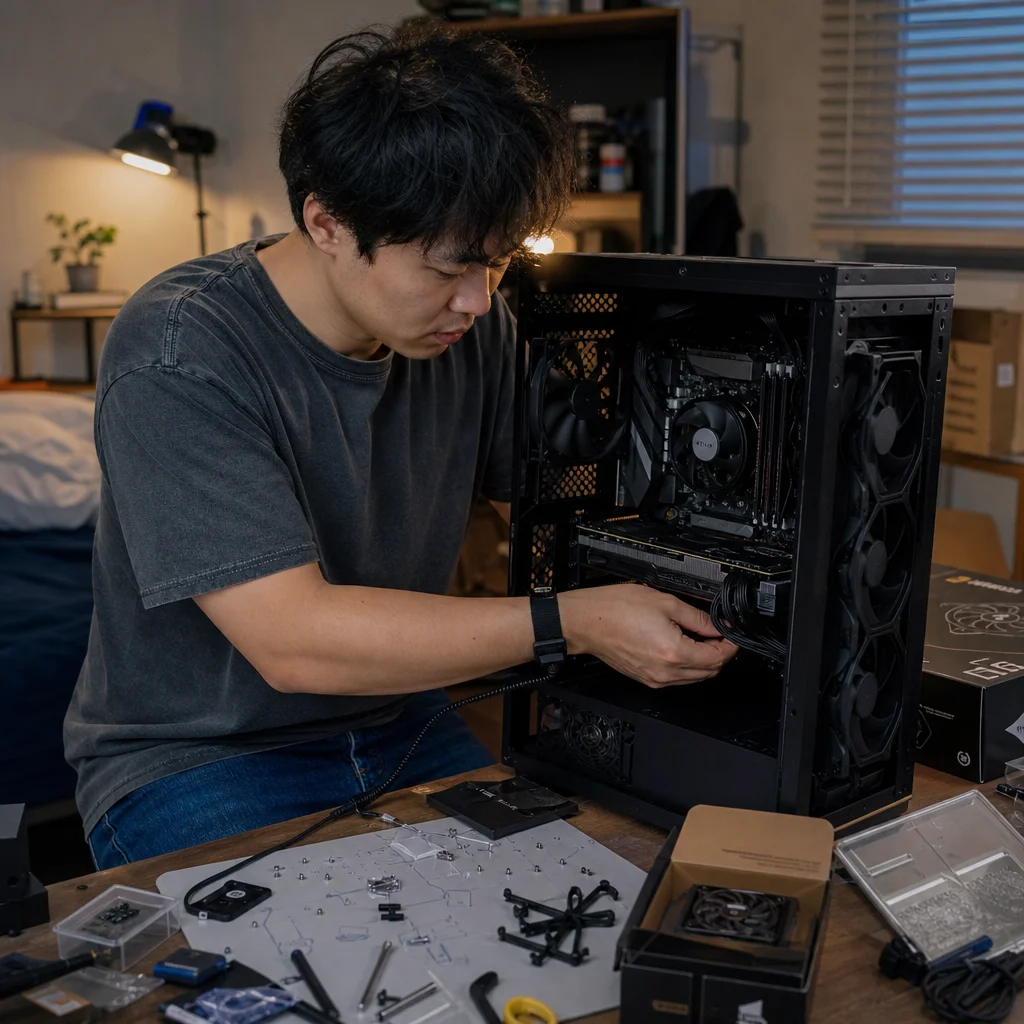
A high-refresh 1080p display changes what you should expect from a graphics card. You’re no longer choosing only for whether a game runs at 60 frames per second; you’re deciding how consistently the card can feed a monitor running at 120Hz, 144Hz, 165Hz, or beyond. That means resolution is only the starting point.
The sensible choice depends on the games you play, the quality settings you want, whether you use ray tracing, how fast your processor is, and how long you expect the card to remain useful. A balanced card that delivers stable frame rates is usually a better fit than an expensive model whose extra performance is hidden by your CPU or display.
Start with the refresh rate you can actually use
A monitor’s refresh rate is its maximum update frequency, measured in hertz. A 144Hz display can show up to 144 updates per second, but your graphics card must render frames quickly enough to take advantage of it. If a game runs at 70 frames per second, a 144Hz monitor can still make motion feel smoother than a 60Hz display, but you aren’t getting the full benefit of its refresh capability.
It helps to think in targets rather than promises. For a 120Hz or 144Hz monitor, you might aim for roughly 100 to 144 frames per second in the games that matter most. For a 165Hz display, a similar target may be reasonable, but you don’t need to chase exactly 165 frames per second in every title. A stable 120 frames per second can be a better experience than a frame rate that swings between 80 and 165.
Higher refresh rates are easiest to use in competitive games with modest graphics demands. Esports titles may reach very high frame rates on midrange hardware, while newer single-player games with detailed lighting and large environments can challenge much faster cards at the same 1080p resolution.
Match the card to your games and settings
Your game library matters more than the label on the graphics card. A card suited to competitive shooters may not be the right choice if you primarily play demanding role-playing games with ultra-quality textures, extensive shadows, or ray-traced effects.
Make a short list of the games you actually play, then separate them into broad groups:
- Competitive games where high and consistent frame rates are the priority.
- Modern demanding games where image quality and visual effects matter more.
- Older or lightly demanding games that most current cards can handle easily.
- New releases you may want to play over the next several years.
For competitive games, prioritize consistent frame delivery, low latency, and enough performance to keep the frame rate above the monitor’s useful range. Maximum texture quality is often less important than responsive controls and clear motion. For demanding cinematic games, you may prefer a card that allows high settings at a steadier frame rate, even if it doesn’t reach the monitor’s maximum refresh rate.
Preset names such as “high” and “ultra” aren’t standardized measures of performance. One game’s ultra preset may add a small visual improvement for a large performance cost, while another game may use the setting to control genuinely important detail. You’ll get better results by treating presets as starting points and adjusting the most expensive settings individually.
Don’t assume 1080p requires a low-end card
1080p is less demanding than 1440p or 4K, but a high-refresh target can make it surprisingly demanding. Rendering 144 frames per second requires the graphics card and processor to complete work far more quickly than they would at 60 frames per second. Visual quality also affects the workload, especially with ray tracing, high-quality shadows, volumetric effects, and advanced reflections.
At the same time, buying the most powerful card you can afford isn’t automatically sensible. At 1080p, a powerful graphics card can run into a processor limit before it reaches its full potential. The card may be capable of producing more frames, but the CPU, game engine, memory latency, or background software may prevent those frames from being prepared in time.
A reasonable starting point is to choose a modern midrange card for a 120Hz or 144Hz monitor, then move up a tier if you play demanding games, want high settings with ray tracing, or plan to keep the card for many years. A faster card makes more sense for a 165Hz display when your games and processor can support that target. The exact model class changes over time, so compare current reviews rather than relying on an old “best card for 1080p” list.
Check current performance before buying: Compare recent reviews using your games, target settings, and desired frame-rate range. Graphics-card names, prices, driver behavior, and support for upscaling or frame-generation features can change, so an older recommendation may no longer represent good value.
Consider the processor as part of the graphics-card choice
A graphics card and processor share responsibility for producing each frame. The GPU handles much of the rendering work, while the CPU prepares game logic, simulation, draw calls, and other tasks. At 1080p with a high frame-rate target, the CPU often becomes more important because the GPU can finish its work quickly and then wait for the next frame from the processor.
If your processor is several generations old or is an entry-level model, pairing it with a high-end graphics card may produce disappointing results. You might see the GPU running below full utilization while the frame rate remains lower than expected. This isn’t necessarily a fault with the card; it can mean the processor is the current limit.
You don’t need a perfectly matched system in every workload. A stronger graphics card can still improve image quality or enable more demanding effects, and a CPU limit may vary from game to game. However, if your main goal is very high frame rates in competitive games, check CPU performance in those games before spending heavily on the GPU.
Watch frame-time behavior rather than average frame rate alone. An average of 144 frames per second can hide frequent drops that make motion feel uneven. Reviewers who report one-percent-low or similar low-percentile results can give you a better idea of consistency, although results still depend on the test system and game settings.
Decide whether advanced features matter to you
Modern graphics cards may support features such as hardware-accelerated ray tracing, image upscaling, frame generation, and latency-reduction technologies. These can be useful, but they should be treated as part of the card’s overall feature set rather than a substitute for basic rendering performance.
Upscaling renders a game internally at a lower resolution and reconstructs the image for your display. At 1080p, aggressive upscaling can make fine details look soft or unstable, particularly on a larger monitor. It may still be useful when a demanding game needs extra performance, but native rendering or a modest quality mode may look better.
Frame generation creates additional displayed frames based on rendered frames. It can make motion appear smoother, but it doesn’t remove the underlying input and processing delay associated with the original frames. It also depends on game support and can introduce visual artifacts in some situations. For a competitive game, strong native performance and low latency may matter more than a higher displayed number.
Ray tracing can substantially increase the workload. If you want to use it regularly, choose a card with enough conventional and ray-traced performance to maintain your target range, and check whether the games you play support the relevant features. If ray tracing doesn’t interest you, you can often spend less on a card that performs better in standard rasterized rendering.
Check the monitor connection and variable refresh support
A high-refresh monitor needs a suitable connection and configuration. DisplayPort and HDMI versions can support different combinations of resolution, refresh rate, color format, and adaptive-sync features. The graphics card, monitor, cable, and driver settings all have to cooperate.
Before buying, check the monitor’s manual or specifications for its supported inputs and the required cable standard. Some displays advertise a high refresh rate only through one input, or require a particular setting in the monitor’s on-screen menu. After installation, you may also need to select the intended refresh rate in your operating system rather than assuming it was enabled automatically.
Variable refresh rate, commonly associated with technologies such as Adaptive-Sync, FreeSync, or G-SYNC-compatible operation, can make fluctuating frame rates look smoother by allowing the monitor to adjust its refresh timing. Confirm that the graphics card and monitor support a compatible mode, and check the supported refresh range. A monitor that operates adaptively only across a limited range may behave differently near the bottom of that range.
Account for power, space, and cooling
A graphics card has to fit the rest of the computer, not just the performance target. Check its length, height, thickness, and power-connector position against the case. A large card can block expansion slots, interfere with front-mounted radiators or drive cages, or make cable routing difficult.
Power requirements deserve the same attention. Compare the card manufacturer’s recommended power supply with your power supply’s capacity, age, quality, and available connectors. A supply that technically has enough wattage may still be a poor match if it lacks the required connector arrangement or is an aging, low-quality unit.
Cooling affects long-term consistency. A card that reaches its temperature or power limits may reduce its clock speed under sustained load. Your case should have a clear path for cool air to enter and warm air to leave, with dust filters and fans kept reasonably clean. Good airflow isn’t only about peak benchmark scores; it can help the system maintain predictable performance during long gaming sessions.
Think about memory and useful lifespan
Graphics memory capacity can influence how comfortable a card feels over time, especially with high-resolution texture packs, complex environments, and new game releases. At 1080p, you may not need the same memory capacity as a 1440p or 4K system, but choosing a card with very limited memory can restrict future settings sooner than the core GPU performance does.
Memory capacity alone doesn’t make a card fast. A card with more memory but a weak processor, narrow performance capability, or poor overall value isn’t automatically the better purchase. Look for reviews that show whether memory limits cause stuttering or forced texture reductions in the games you care about.
For long-term reliability, avoid buying solely for a short-lived peak frame-rate advantage. A slightly less powerful card with adequate memory, sensible temperatures, a suitable power supply, and a warranty from a dependable seller may serve you better than a faster card that strains the rest of the system. Keep the model’s physical dimensions and power draw in mind if you expect to upgrade other components later.
Build the decision around your actual system
Start by writing down your monitor’s refresh rate, input connections, adaptive-sync support, and screen size. Add your processor model, power supply model and wattage, case clearance, and the games you want to play. Then decide whether your priority is competitive responsiveness, high visual quality, ray tracing, quiet operation, or keeping the card useful for several years.
Use current game benchmarks to compare cards at 1080p with settings close to your intended use. Pay attention to frame-time consistency, not just the highest average. If the faster card produces little improvement because your processor is already limiting performance, upgrading the CPU or adjusting the target frame rate may be the more sensible move.
For most beginner builders, the right choice is a balanced current-generation midrange card that can sustain the desired frame-rate range in the games they play, fits the case, works with the monitor’s ports and adaptive-sync features, and leaves reasonable power and thermal headroom. Move to a higher tier when demanding games, ray tracing, longevity, or a higher refresh target justify it. The goal isn’t to make the number on a specification sheet as large as possible; it’s to build a system that remains smooth, compatible, and dependable after the novelty of the new hardware wears off.