What Should You Reuse in an Older PC Build?
I’ll clarify which parts from an older PC build are usually worth reusing, which deserve extra scrutiny, and when replacement is the better value. You’ll get a cost-conscious framework for evaluating your case, power supply, storage, memory, and graphics card before buying new hardware.
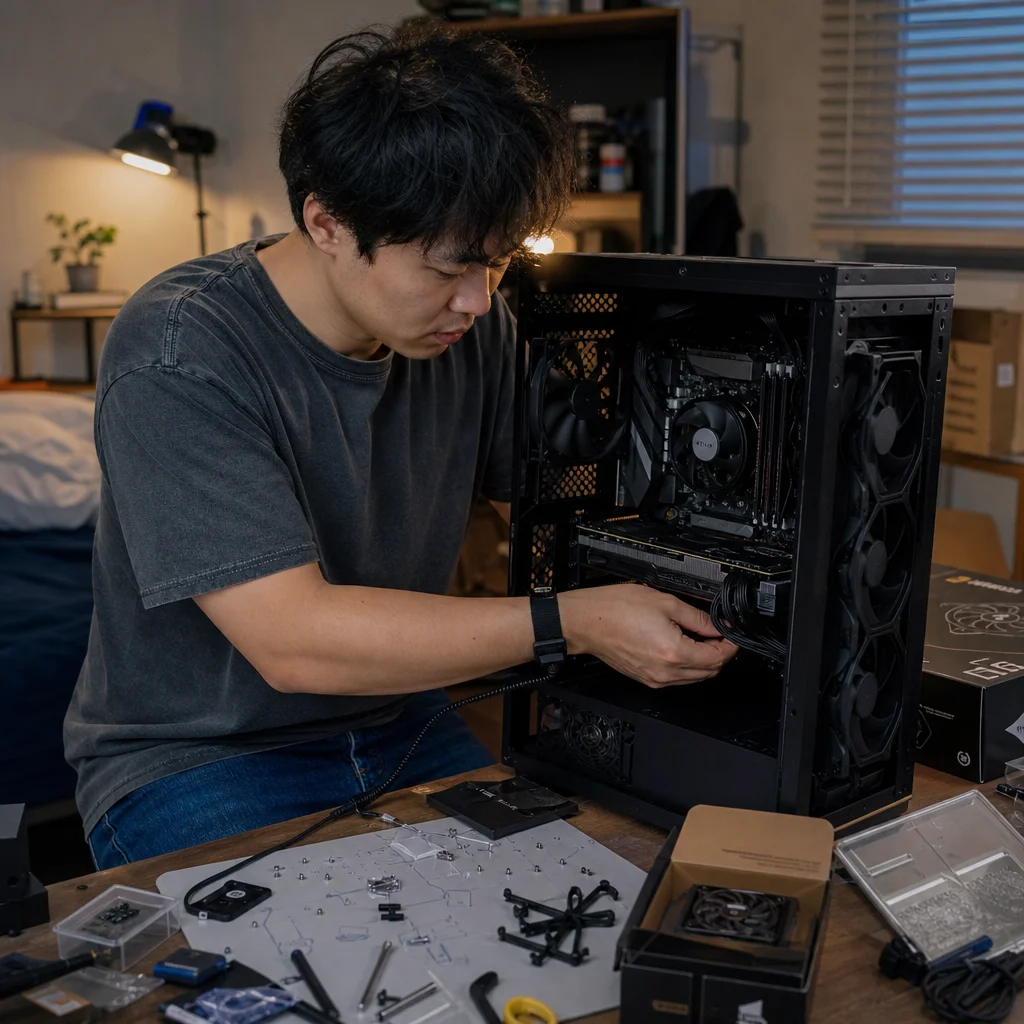
When you’re planning a new PC, reusing parts can make the difference between a manageable upgrade and a budget that quietly gets out of hand. The challenge is that an older component can be perfectly serviceable, limited by newer hardware, or risky in ways that aren’t obvious from its appearance.
The best approach isn’t to ask whether a part is simply “old.” Ask whether it still meets the new system’s requirements, whether its remaining useful life justifies carrying it forward, and whether replacing it now prevents a more expensive problem later. A scratched case may be fine for another build, while a clean-looking power supply may be the part you should treat most cautiously.
Start with the job each part must do
Before deciding what to reuse, list the parts in the proposed system and identify the role each one will play. A component that was adequate in an older, lower-power computer may not be suitable after you add a faster processor, a more demanding graphics card, or several additional drives.
It helps to separate compatibility from quality. Compatibility asks whether the part can physically and electrically work in the new build. Quality asks whether it will provide the performance, reliability, capacity, and convenience you expect. A case can be compatible but difficult to work in. A storage drive can function but be too slow or too small to make sense. A graphics card can still run games but no longer deliver the experience you want.
You should also assign each reused part a condition: keep, keep temporarily, replace, or retire. “Keep temporarily” is useful when a part can get the system running but is likely to be upgraded later, such as an older graphics card in a new productivity machine.
Case: usually reusable, but inspect the details
A case is often one of the safest parts to carry into a new build. It doesn’t become electrically obsolete in the same way a motherboard or power supply can, and cosmetic wear rarely affects its basic function. If it supports the new motherboard size, graphics card length, CPU cooler height, and power supply format, it may have plenty of life left.
Measure rather than relying only on the case’s original specifications. Modern graphics cards can be unusually long, tall, or thick, and their power cables may need more clearance than older cards did. Check the space from the expansion-slot area to the front fans or drive cage. Also check whether the side panel leaves room for the power cable to bend without pressing hard against the connector.
Cooling is another important consideration. Older cases may have restricted front panels, limited fan mounts, or only a single exhaust fan. Those characteristics don’t automatically disqualify a case, but they can make a hotter new system louder and harder to cool. Confirm that you can install at least a sensible intake and exhaust arrangement, and clean dust from filters, fans, and vents before transferring the hardware.
The internal layout matters too. A case with poor cable-routing space can turn assembly into a cramped exercise, particularly when the new power supply has thick cables or the motherboard uses connectors in unfamiliar locations. Reusing it still may be worthwhile, especially if buying a replacement case would force you to sacrifice money needed for the processor, graphics card, or storage. Just treat limited airflow and working room as part of the cost.
Power supply: the part to evaluate most conservatively
A power supply shouldn't be reused merely because the old computer still turned on. Its age, capacity, condition, quality, and available connectors all matter. Capacitors and other internal components can degrade over time, and a newer system may place substantially different demands on the unit.
Find the exact model, not just the wattage printed on the label. A reputable unit with appropriate protections and sufficient capacity is a different proposition from an inexpensive unit of the same rated wattage. Inspect the cables for damage, melted plastic, severe kinks, or loose connectors, and pay attention to any history of shutdowns, electrical smells, unusual fan noise, or instability.
Capacity should be considered with the complete new system in mind. Add the processor, graphics card, drives, fans, and other accessories, then leave reasonable headroom rather than choosing a unit that operates close to its limit. The graphics card’s power requirements and connector arrangement deserve particular attention, because newer cards may use connectors or cable configurations that your older supply doesn’t provide.
If the power supply is very old, has an uncertain history, came from a low-cost prebuilt system, or is only marginally powerful for the planned hardware, replacement is usually the sensible use of your budget. Saving money here can expose every other component to instability or failure. This is one area where “it still works” is a weak test.
Check the power plan before you reuse it: Confirm the exact power-supply model, its age, available connectors, rated capacity, and the new graphics card’s requirements. If any of those details are unknown, price a replacement before finalizing the rest of the build rather than treating the old unit as free.
Never open a power supply to inspect it yourself. Even after it has been unplugged, internal components can retain dangerous electrical charge. External inspection and manufacturer documentation are enough for a reuse decision; otherwise, retire the unit through an appropriate electronics-recycling route.
Storage drives: useful, but don’t confuse capacity with trust
Older storage drives can be valuable as secondary space, a temporary installation drive, or a place to keep files that are backed up elsewhere. They’re less attractive as the only drive in a new system when a newer drive would offer faster loading, better responsiveness, and a cleaner installation.
The most important question is the drive’s condition. Check its health information with a suitable operating-system utility or drive-monitoring tool, and look for warnings, bad sectors, excessive errors, or a history of disappearing from the system. A drive that is making unusual noises, repeatedly disconnecting, or reporting serious health problems shouldn't be trusted with important data.
An older solid-state drive may still be perfectly usable, but its remaining endurance, capacity, and interface can affect the decision. An older hard disk may provide inexpensive bulk storage, yet it will generally be slower and more vulnerable to mechanical wear than a solid-state drive. Neither type should be considered a backup by itself. Important files need another copy on a separate device or service.
A fresh operating-system installation is often preferable when moving a drive into a substantially different platform. Reusing an existing installation can create driver clutter, activation questions, and configuration problems. If the old drive contains irreplaceable files, copy them to a separate location before you begin. Don’t make the migration process your first attempt at creating a backup.
Memory: compatible only when the platform agrees
Memory is tempting to reuse because it’s easy to remove and usually looks unchanged after years of service. The main obstacle is compatibility. The new motherboard and processor must support the memory generation, physical module type, capacity, and speed. Desktop and laptop memory, for example, aren't interchangeable simply because they serve the same general purpose.
Even when the memory generation matches, the new platform may have different preferred speeds, voltage expectations, or capacity limits. A mixed set of modules can work, but it may run at a lower speed or require more troubleshooting than a matched kit. Combining modules with different specifications also makes it harder to identify a faulty stick if instability appears.
Reuse memory when it provides enough capacity for what you do and the new platform supports it without awkward compromises. Replace it when the modules are incompatible, leave you below a comfortable capacity, or force a noticeably poor configuration for the rest of the system. If you do reuse it, test the completed system with a memory diagnostic after installation, especially if you’re combining separate kits.
Memory is usually less risky than an old power supply, but it can produce frustrating intermittent problems. Random application crashes, installation errors, and unexplained freezes are reasons to test it rather than assuming the processor or motherboard is defective.
Graphics card: judge performance, features, and condition separately
An older graphics card can be one of the most useful parts to reuse if your new system is designed around a future graphics upgrade. It may handle everyday work, older games, media playback, or a temporary build while you save for a faster card.
Evaluate it against the software you actually use. Consider the resolution and refresh rate of your monitor, the games or creative applications you run, the card’s video-memory capacity, and support for the features those applications require. A card that remains adequate at 1080p may be a poor fit for high-resolution gaming or newer rendering workloads.
Physical condition matters as well. Check whether the fans spin smoothly, the cooler is clogged with dust, and the card has suffered from excessive heat or repeated crashes. Fan noise, visual artifacts, driver failures, or a history of overheating should lower your confidence. Cleaning the card can help, but it won’t restore a worn fan or repair damaged memory.
A reused graphics card is often a good way to spread upgrade costs over time. Build the rest of the system so it can support your eventual replacement, but make sure the temporary card is still useful enough to justify the new build now. If it barely meets your needs and consumes most of the system’s power budget, replacing it may be more efficient than designing around it.
Don’t overlook the small compatibility costs
Reusing major parts can introduce smaller expenses. You may need a new CPU cooler mounting kit, thermal paste, storage cables, fan splitters, adapters, or a bracket for a different drive size. An older case may need additional fans, while an older power supply may lack the correct graphics-card connections.
These costs don’t necessarily make reuse a bad idea. Add them to your comparison, though, instead of comparing the price of a complete new part with only the purchase price of the replacement hardware. A reused case that needs two fans and several adapters may still be cheaper than a new case, but the difference could be smaller than expected.
Also consider your time and tolerance for troubleshooting. Reusing several uncertain parts makes it harder to isolate a problem. If the system fails to boot, you may need to test the memory, storage, power supply, and graphics card individually. A smaller number of known-good components can be worth more than a theoretical saving.
A sensible reuse strategy
For a budget-conscious build, start by reusing the parts with the clearest value and lowest risk. A suitable case is often first. A healthy storage drive can follow as secondary space, and a compatible memory kit or graphics card may be worthwhile when it still meets your needs. Treat the power supply as a separate decision, not as an automatic part of the old system.
Before buying the new components, record the model and age of every part you intend to carry forward. Confirm physical clearances, connectors, platform compatibility, drive health, and expected performance. Back up important data, clean the reusable hardware, and set aside enough budget for any part whose condition or compatibility is uncertain.
The goal isn’t to preserve as much old hardware as possible. It’s to spend money where it changes the finished computer while avoiding parts that add risk, limitations, or troubleshooting time. Reuse a component when it remains suitable for the job, replace it when its age or constraints undermine the new system, and leave yourself a clear upgrade path when keeping an older part is only a temporary compromise.