Turn a Gaming Performance Goal Into a Parts Priority List
I’ll help you turn target frame rates, resolution, and game types into a sensible parts priority list, so you can spend more on the components that shape your experience and avoid paying for performance your monitor or games can’t use.
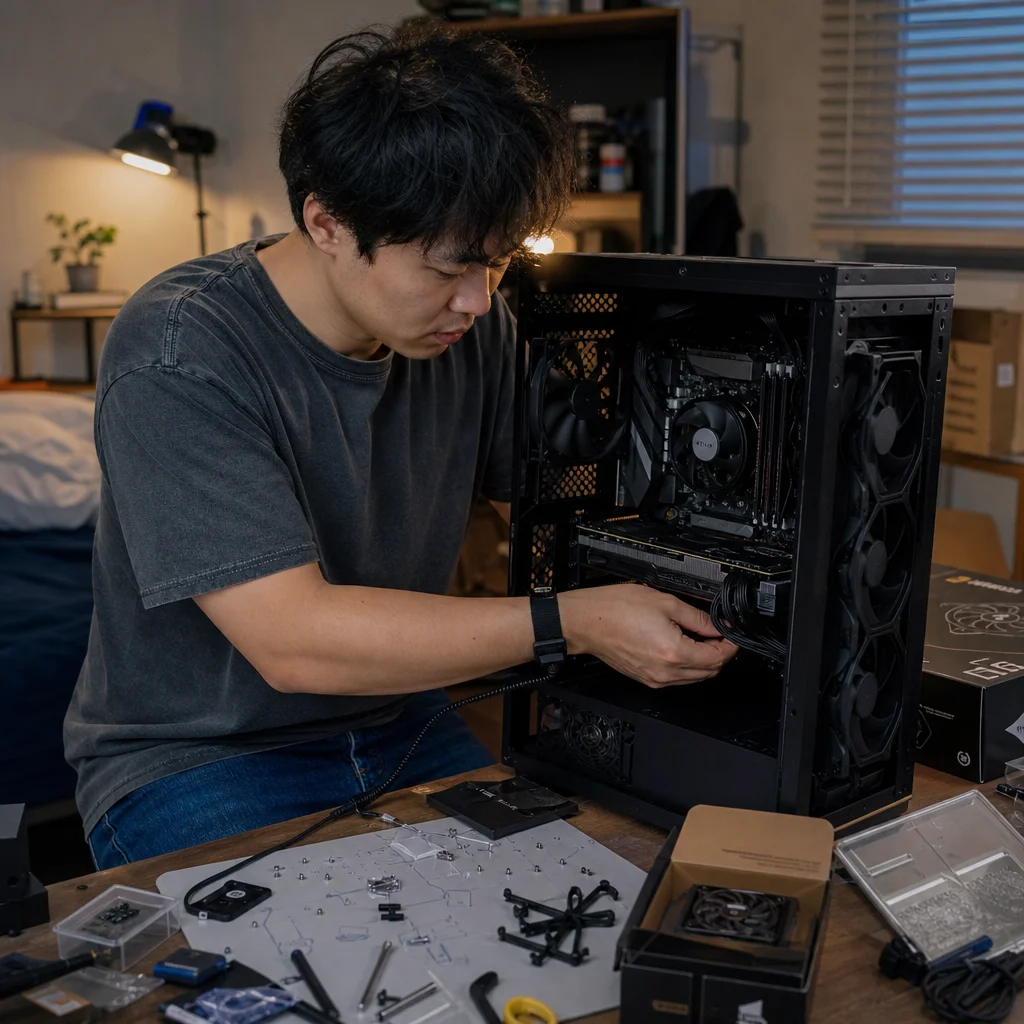
Start with the gaming experience you want, not with a processor or graphics card recommendation. “I want a fast gaming PC” leaves too many decisions unresolved; a target such as “high-refresh 1080p for competitive games” points toward a very different parts list than “visually demanding single-player games at 4K.”
Your goal should define the order in which you evaluate components. Resolution, frame rate, game type, visual settings, and the display you’ll use all affect where your budget matters most. Once those priorities are clear, the rest of the system becomes easier to balance.
Define the gaming target first
Write down four things before comparing parts:
- The resolution you plan to play at.
- The frame rate you want to sustain.
- The games you play most often.
- The monitor’s resolution and refresh rate.
These details are connected, but they aren’t interchangeable. Resolution describes how many pixels the graphics card must render. Frame rate describes how often the system produces new images. Refresh rate describes how often the monitor can display them. A system producing more frames than the display can show may still feel responsive, but the additional performance won’t translate directly into visible refreshes.
It also helps to distinguish between a target and a minimum. You might want a steady frame rate near your monitor’s refresh rate, while accepting occasional dips in especially demanding scenes. That is a more useful goal than choosing a component based on a single maximum frame-rate number.
Put the graphics card in the right place
For most games, the graphics card is the first major priority because it handles much of the work involved in rendering the image. Its importance generally rises with resolution and visual quality. Moving from 1080p to 1440p or 4K increases the number of pixels being rendered, while features such as high-quality shadows, ray tracing, and advanced lighting can add further demands.
If your main goal is visually rich single-player gaming, especially at a higher resolution, begin by allocating the largest part of your performance budget to the graphics card. A modest processor paired with a suitably capable graphics card can often produce a better experience than an expensive processor paired with a card that can't meet your resolution and settings target.
That doesn’t mean you should buy the most powerful graphics card you can afford. The card should match the monitor and the games. A high-end model may be poorly allocated if you’re using a basic 1080p display and primarily play games that already run comfortably. Conversely, choosing a card with barely enough capacity for your target can lead to frequent compromises in image quality or frame rate.
Graphics memory deserves attention as part of this decision. Higher resolutions, detailed textures, large game worlds, and some graphics features can increase memory use. You don’t need to predict the exact memory requirement of every future game, but you should avoid treating graphics memory as an afterthought when choosing a card for high-resolution or heavily modded gaming.
Decide whether the processor is a primary or supporting priority
The processor becomes more important when you want very high frame rates, play CPU-intensive games, or use a graphics card powerful enough that the processor may limit it. Competitive games played at lower resolutions often fall into this category. At 1080p with a high-refresh display, the graphics card may finish its work quickly enough that the processor becomes the factor determining how many frames the system can produce.
Simulation games, strategy games with many active units, large multiplayer environments, and some open-world titles can also place substantial demands on the processor. In these cases, look beyond average frame rate. Processor limits may appear as inconsistent frame pacing, slowdowns in busy scenes, or lower minimum frame rates even when the average looks acceptable.
For a mixed library, you usually don’t need to choose between an extremely powerful processor and a weak graphics card. Instead, identify the most demanding use that matters to you and make sure the processor can support it. A balanced midrange processor is often enough for a system focused on mainstream gaming, while a high-refresh competitive build deserves more deliberate processor planning.
The processor also affects the platform around it. Consider the motherboard socket, memory support, cooling requirements, and upgrade path at the same time. A processor that looks inexpensive on its own may require a more costly platform, while a slightly different choice could let you reuse a cooler or select a less expensive motherboard without losing the performance you need.
Treat memory as a capacity and smoothness decision
Memory is rarely the first place to spend extra money once you’ve chosen an appropriate amount. The priority is having enough capacity for your games, operating system, background applications, and normal multitasking. If you regularly keep a browser, voice chat, streaming software, or creative tools open while gaming, your needs can be higher than those of someone who launches a game and little else.
Insufficient memory can cause stuttering, slow task switching, or reliance on storage as a slower fallback. More memory than your workload can use, however, won’t automatically create higher frame rates. For most builders, a sensible capacity with compatible modules is more valuable than paying a large premium for extreme speeds or very tight timings.
Choose memory as a matched kit rather than combining unrelated modules whenever possible. Confirm that the capacity, module type, speed, and motherboard support align with the platform you’re building. If you expect to upgrade later, check how many memory slots the motherboard has and whether filling them with additional modules could complicate stability or compatibility.
Choose storage for loading and convenience
Storage affects installation space, loading behavior, file transfers, and how easy it is to keep your library available. It usually has less influence on rendered frame rate than the graphics card or processor, so it shouldn't displace those components when gaming performance is the primary goal.
A solid-state drive is generally the sensible starting point for a modern gaming system because it improves general responsiveness and reduces the friction of launching programs and loading games. Capacity matters as much as interface speed. A drive that fills quickly can force you to uninstall games, move files, or manage space constantly.
There’s little value in choosing a very fast drive if doing so requires you to downgrade the graphics card that determines your target frame rate. For many builds, a sufficiently large, reliable drive is the better purchase than a premium model whose advantages are difficult to notice during ordinary gaming. You can add a second drive later if the motherboard, case, and budget make expansion practical.
Select the display before finalizing performance parts
The monitor should be part of the performance plan, not an accessory chosen after the computer. Its resolution and refresh rate establish the experience your components need to deliver. A graphics card selected for high-refresh 1440p gaming may be unnecessary for a lower-refresh 1080p screen, while a card intended for basic 1080p play may leave a high-resolution display underused.
Adaptive sync can help smooth out changes in frame rate, but it doesn’t remove the need to match the system to the display. Consider the games you play, the viewing distance, screen size, panel characteristics, and whether you value image detail or motion clarity more. A display upgrade can sometimes make a larger difference to your experience than a small component upgrade inside the computer.
If your budget includes both the PC and monitor, set aside the display money before assigning the parts budget. Otherwise, it’s easy to spend everything on the tower and discover that the screen can't show the performance you planned to buy.
Build the priority list in order
A useful order for many gaming-focused builds is:
- Define the resolution, frame-rate target, games, and display.
- Choose the graphics card that can meet the visual target.
- Confirm that the processor supports the desired frame rate and game types.
- Select a compatible motherboard and cooling solution.
- Add enough memory for gaming and your background workload.
- Choose storage capacity and speed based on your library and habits.
- Size the power supply and case around the selected hardware.
- Recheck the monitor and decide whether the whole system is balanced.
This is a decision order, not a rule that every part must be purchased in isolation. Power requirements, graphics-card dimensions, cooler height, motherboard features, and case airflow can change which options are practical. The point is to prevent secondary features from consuming money before the main performance goal is secured.
Avoid the most common allocation mistakes
One common mistake is pairing a top-tier processor with an entry-level graphics card because the processor appears to be the “brain” of the computer. Another is buying an expensive graphics card for a monitor that can't display its intended frame rate or resolution. Both choices can be technically functional while still being poor uses of a fixed budget.
It’s also easy to overvalue specifications that don’t address your actual limitation. More memory capacity won’t fix a graphics bottleneck, a faster storage interface won’t replace an inadequate graphics card, and additional cooling won’t make an underpowered processor meet a demanding frame-rate target. Identify what is limiting the experience before paying to improve it.
Finally, leave room for the supporting parts. A graphics card that fits only barely, a power supply without suitable connectors, or a case with poor airflow can turn a promising parts list into a frustrating build. Reliability and compatibility aren’t separate from performance; they determine whether the system can deliver that performance consistently.
Make the final trade-offs deliberately
When the budget is tight, protect the parts that directly control your goal. For a high-resolution visual build, preserve graphics-card capability first, then make sensible compromises in storage speed, cosmetic features, or motherboard extras. For a high-refresh competitive build, protect processor performance and the monitor’s refresh rate while choosing a graphics card appropriate to the games and resolution.
If you play several types of games, prioritize the titles you actually spend time with rather than optimizing for every possible workload. A system that is excellent for your main games and acceptable for occasional exceptions is often a better purchase than one designed expensively around a scenario you rarely use.
Before buying, review the complete list as a system: can the graphics card meet the display target, can the processor keep up in your games, is there enough memory and storage for your habits, and do the case, cooling, and power supply support the selected parts? Once those answers are clear, you can spend with confidence instead of chasing the strongest specification in each category.