How to Plan a Quiet PC for a Shared Home Office
I’ll help you avoid the common mistake of treating raw performance as the only priority, with a measured way to choose components, set expectations, and recover when a shared-office PC turns out louder than planned.
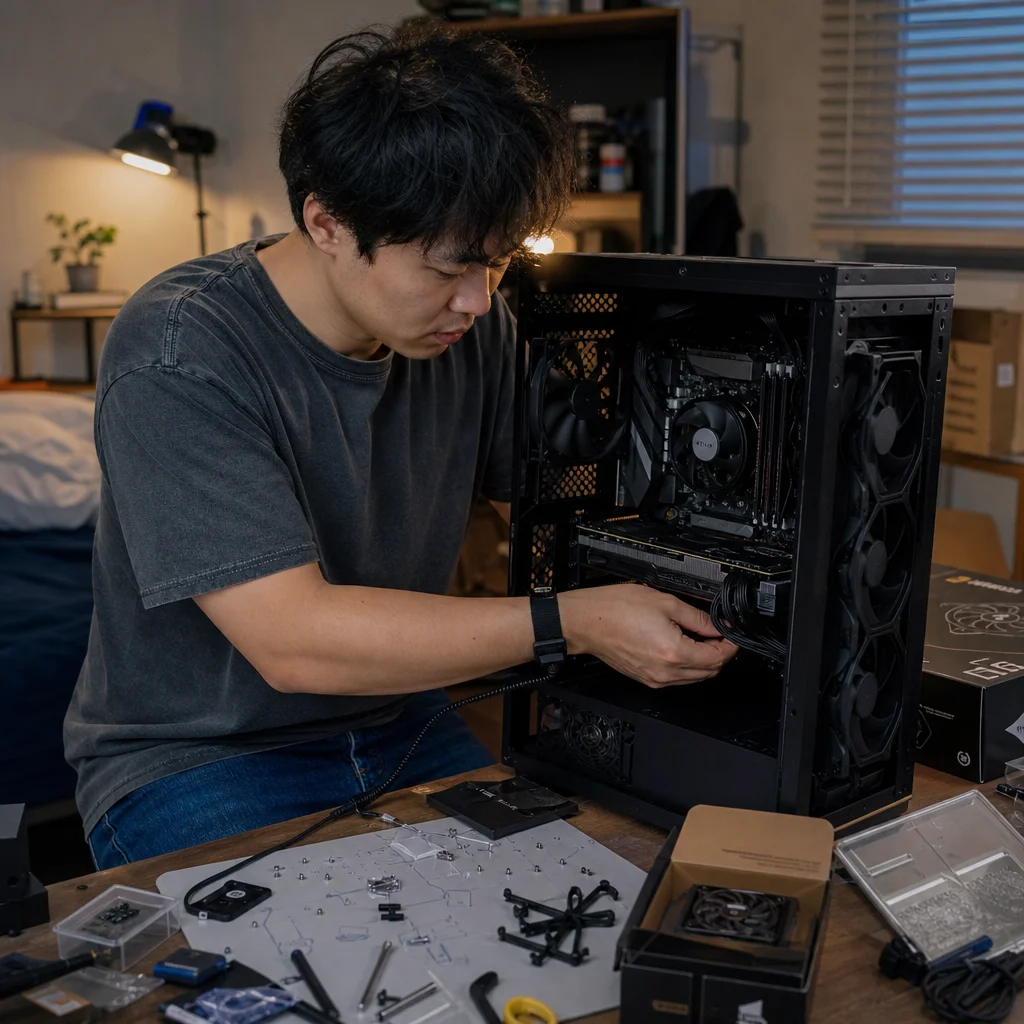
A quiet PC isn't simply a computer with the largest fans or the most expensive case. In a shared home office, the better goal is a system that stays unobtrusive during calls, writing, and ordinary work, then produces noise you can tolerate when heavier tasks begin.
The mistake is often made during planning: choosing parts for peak performance first and assuming noise can be fixed later. Some noise can be reduced with fan curves, airflow adjustments, and sensible settings, but a hot graphics card, a power supply with an aggressive fan profile, or an electrically noisy component may be difficult to quiet after purchase. Planning for recovery means leaving yourself practical ways to diagnose and correct those problems.
Define what “quiet” needs to mean
Start with the situations that matter in your office. A PC that is nearly silent while you read documents but audible during a video call may be a good result for one household and a problem for another. Consider whether the computer will sit beside your monitor, under the desk, near a wall, or farther away. The same system can seem dramatically different depending on its distance and surroundings.
Separate your workload into three levels. Idle and light office work include browsing, documents, email, and music. Sustained work might include compiling software, exporting media, running virtual machines, or processing large files. Short bursts include starting an application or opening a demanding project. You want the fans to remain restrained during the first category, behave predictably during the second, and avoid an unnecessarily sharp ramp during the third.
Also think about sound quality, not only volume. A smooth low fan whoosh is usually easier to ignore than a repeated start-stop cycle, a high-pitched motor tone, or an intermittent rattle. This matters in a shared room because distracting noise can be more disruptive than a steady sound that is technically louder.
Choose a balanced performance target
Excess performance creates unnecessary heat when the computer is doing ordinary work. That doesn't mean you should buy weak components. It means you should identify the performance you actually need and avoid building around the most demanding task you might perform once a month.
A processor with a reasonable power profile can be a better fit than a faster model that regularly reaches high temperatures under routine workloads. The same principle applies to graphics hardware. If you don't play demanding games, render 3D scenes, or use GPU-accelerated applications, a powerful graphics card may add heat, fan noise, cost, and physical bulk without improving your daily experience. Integrated graphics can be sufficient for many office systems, provided your intended displays and applications support them.
Memory and storage are less likely to be major noise sources, but they still influence the overall plan. Adequate memory can prevent excessive disk activity caused by paging, while a solid-state drive avoids the mechanical noise of a hard disk. If you need large archival storage, consider whether it must live inside the office PC or could be placed in another room or used only when needed.
The quietest component is often the component you don't make work harder than necessary. A system that finishes ordinary tasks quickly and returns to a low-power state can be less bothersome than one that runs near its limits all day.
Build around controllable heat
Cooling is where a quiet design becomes practical. Look for a case with a sensible airflow path, room for appropriately sized fans, and filters that can be removed for cleaning. A case doesn't need a solid, sealed front to be quiet. Restricting intake airflow can force fans to spin faster, which may make the computer louder even if the case appears well insulated.
Larger fans can often move the same amount of air at lower speeds than smaller fans, but size alone doesn't guarantee quiet operation. Fan bearings, blade design, mounting, and control range all matter. A case with several slowly rotating fans may be quieter than one small fan working hard, but adding fans indiscriminately can create more motor noise and turbulence.
The processor cooler should match the processor’s sustained heat output rather than only its advertised peak. A capable tower air cooler is often straightforward to maintain and avoids pump noise. An all-in-one liquid cooler can be useful in particular layouts, but its pump operates continuously and introduces another possible sound source. Neither approach is automatically quiet; the important question is whether it can keep temperatures under control without abrupt speed changes.
Graphics cards deserve special attention. Many models stop their fans during light use, but that feature and its behavior vary by design. A graphics card can also produce coil whine: a high-pitched electrical sound that may change with frame rate or workload. It isn't reliably predicted by the card’s cooler, and software settings may reduce it without eliminating it. If noise sensitivity is high, buy from a retailer with a clearly stated return policy and keep expectations realistic.
Power supplies are another part of the acoustic system. A unit with a semi-passive mode may keep its fan off at low loads, but the threshold and fan behavior differ between models. You should select a power supply with enough capacity for the system without choosing an oversized unit solely for its label. Confirm its fan mode, physical dimensions, connector requirements, and manufacturer documentation for the exact model.
Confirm the quiet-mode details: Before ordering, check the exact case, cooler, graphics card, and power-supply specifications rather than relying on a product family name. Verify fan-stop behavior, radiator or cooler clearance, intake space, and the manufacturer’s stated operating limits, since these details can differ between revisions and regional models.
Plan the noise controls before assembly
Fan control works best when it is planned, not used as an emergency attempt to make an overheated system silent. Most modern motherboards allow you to create temperature-based curves in firmware or through operating-system software. Start with a gradual curve that keeps fans at a low stable speed during light work, then increases speed as temperatures rise.
Avoid setting the minimum speed so low that a fan repeatedly stops and starts. That cycling can be more noticeable than continuous low-speed operation. You also need to check whether a fan is controlled by the correct temperature sensor. A case fan reacting directly to a rapidly changing processor temperature may surge unnecessarily, while a fan that ignores graphics-card heat may fail to respond during GPU-heavy work.
The exact firmware menus and available control modes change between motherboard models, so consult the manual for your board after installation. Some fans use four-pin PWM control, while others use three-pin voltage control. Mixing the wrong mode or connecting fans to unsuitable headers can limit control or prevent a fan from behaving as expected.
Software power settings can help as well. An operating system’s balanced mode, application-specific frame-rate limits, and sensible background-process management may reduce heat during ordinary use. These controls should complement adequate cooling, not conceal a cooler that is too small or an airflow path that is obstructed.
Assemble for clean airflow and fewer vibrations
Cable management isn't about making the interior photogenic. Keep large cable bundles away from front intakes, bottom vents, and fan blades, and avoid pressing cables against panels where they can transmit vibration. Make sure every fan has clear space on both sides. A fan pulling air directly against a nearby obstruction can create turbulence and a rougher sound.
Use the supplied anti-vibration mounts or suitable pads where the design provides them, especially for case fans and mechanical drives. Tightening every screw as hard as possible isn't a substitute for secure mounting and can sometimes transfer more vibration into a panel. After assembly, inspect for a loose filter, side panel, bracket, or cable that could rattle when fans speed up.
Placement matters after the build is complete. Don't push the case tightly against a wall or place its intake against carpet, clothing, or stored objects. A small amount of clearance can improve airflow and reduce the need for higher fan speeds. If the computer sits on a desk, a stable surface can prevent vibration from becoming a resonant hum through the furniture.
Recover when the finished PC is too loud
If the system is louder than expected, first identify when the noise occurs. Is it present at idle, tied to processor load, triggered by graphics activity, or caused by a particular fan speed? Listen briefly with the side panel in place, then inspect the system carefully if you need to locate a source. Don't put fingers or objects near moving fans, and shut the computer down before reseating hardware or checking for obstructions.
Use monitoring software to compare temperatures, fan speeds, and workload rather than judging the cause by sound alone. A high temperature with high fan speed suggests a cooling or airflow issue. Normal temperatures with an irritating tone may point to a particular fan, pump, hard drive, or coil-whine source. Sudden noise after several weeks can indicate dust buildup, a loose panel, or a fan bearing beginning to fail.
Correct the simplest causes first. Clean accessible filters, remove obstructions, secure loose panels, and adjust an overly aggressive fan curve. If temperatures remain higher than expected, check that the cooler is mounted correctly and that its fan is connected to the intended header. Replacing a noisy case fan is usually easier than replacing a core component, so isolate the sound before buying parts.
If coil whine or a defective bearing remains, software tuning may not be enough. Limiting frame rates can reduce graphics-card electrical noise in some workloads, while replacing the affected component may be the only dependable solution. Keep packaging and documentation until you are satisfied with the system, and review the seller’s current return and warranty terms before making a purchase.
Set expectations for shared-office use
A quiet PC doesn't need to be inaudible. Your room may have a ventilation system, street noise, keyboard sounds, or other equipment that masks a steady fan sound. The practical target is a computer that remains unobtrusive during conversations and focused work, doesn't produce avoidable rattles or tonal noises, and responds to heavier workloads without sounding distressed.
Plan the system around your normal workload, provide cooling capacity without excessive heat, and make noise sources easy to isolate. After assembly, spend time tuning fan behavior and checking the placement rather than assuming the default settings are ideal. If you have to choose between a small increase in performance and a large improvement in sustained noise, the quieter option is usually the better fit for a shared home office.