Build Around a Fixed Desk, Shelf, or Cabinet Without Trapping Heat
A fixed desk, shelf, or cabinet can turn ordinary PC placement into a heat, noise, and maintenance problem. I’ll help you measure the space, plan airflow and cable routes, and choose a layout that remains safe and serviceable.
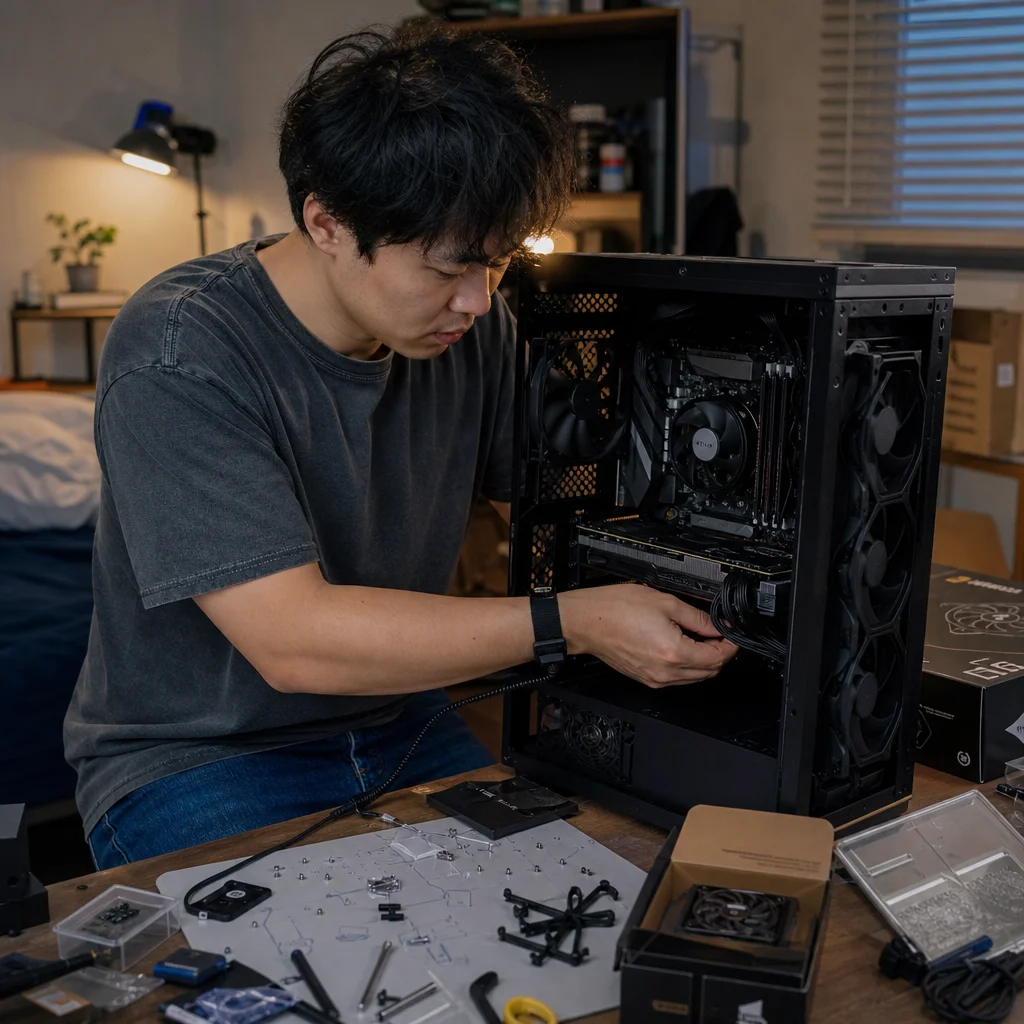
A fixed desk, shelf, or cabinet can make a PC fit neatly into a room while quietly creating problems for cooling and maintenance. Once the furniture is in place, you may have limited room to move the case, reach the rear ports, or remove a dust filter. Heat can also collect around restricted vents, especially in a small home office or apartment where the computer runs close to walls and people.
The safest approach is to plan the installation space before choosing the case or components. You need more than enough room for the computer to slide into position. You need a clear path for air, cables, heat, and your hands.
Measure the complete installation space
Start by measuring the opening where the PC will sit: width, height, and depth. Measure at several points if the furniture has trim, doors, uneven walls, support posts, or a back panel. A space that appears large enough at the front may narrow toward the rear, and a cabinet opening may have a lip that prevents the case from sliding fully into place.
Then measure the case itself, including anything that extends beyond its main chassis. Front-panel controls, feet, handles, side-panel bulges, and rear cable plugs all consume space. A case advertised as a certain depth may require considerably more room once you connect a power cable, display cable, network cable, and USB devices.
Don't treat the dimensions of the case as the dimensions of the installation. Leave room around the areas where air enters and exits, and account for the space needed to remove a side panel or pull out a dust filter. If the case will sit inside a cabinet, measure the opening rather than relying on the cabinet's nominal interior dimensions.
A useful paper test is to mark the case footprint on cardboard and place that shape in the intended location. Mark the rear edge, front edge, and each ventilation zone. This quickly reveals whether the computer would be pressed against a wall, blocked by a shelf support, or positioned where a door would strike its intake.
Plan airflow around the furniture, not just the case
A PC case can have a sensible fan layout and still cool poorly when furniture blocks its vents. Most systems draw air through a front, bottom, or side intake and release warmer air through a rear or top exhaust. Your placement needs to preserve those paths. If the exhaust blows into a shallow enclosed compartment, the computer may draw its own warm air back through the intake.
The exact clearance a system needs varies with the case, fan arrangement, components, and workload. A low-power office computer has different requirements from a system with a power-hungry processor and graphics card. Instead of relying on a universal clearance number, keep the intake and exhaust areas visibly open and avoid placing them directly against a solid surface.
A shelf above the case can be especially troublesome when it sits close to a top exhaust. Warm air has nowhere to rise and may collect beneath the shelf. If the case is designed to exhaust through the top, a different case orientation or a rear-exhaust layout may be more appropriate. Don't assume that turning the case sideways is harmless; it may block a side intake or place the power supply in an unsuitable position.
Cabinet doors and backs deserve particular attention. A closed door can restrict front intake, while a solid back panel can trap rear exhaust. Cutting openings may improve airflow, but the openings must be large enough to matter and mustn't leave sharp edges or weaken the furniture. If you can't create a safe, open airflow path, an exposed shelf or a different location is usually the better solution.
Check the furniture before loading it: Confirm that the shelf, cabinet, or desk can support the computer and accessories, remains stable with doors or drawers open, and has no flammable material or loose obstruction pressed against hot exhaust areas. If modifying the furniture, follow the maker's guidance and protect every new opening from sharp edges.
Keep heat away from people and sensitive items
Good airflow isn't only about processor temperature. A restricted system can raise the temperature of the surrounding compartment, making the entire area uncomfortable and potentially affecting nearby equipment. Avoid directing exhaust toward your legs, a wall-mounted monitor, a stack of papers, or an enclosed space where warm air will linger.
Don't use a cabinet as a storage box for other items around the computer. Books, fabric, packaging, and loose cables can drift toward fan openings or reduce the available space. Keep the top and sides clear enough that routine dusting doesn't require dismantling the installation.
A computer placed under a desk may be exposed to more dust, pet hair, and accidental impacts than one on a shelf. A computer inside a cabinet may be protected from bumps but exposed to warmer air and harder maintenance. These are trade-offs rather than automatic reasons to choose one location. Choose the placement that gives the system a clear air path and gives you a realistic way to inspect it.
If the furniture has a heater, radiator, appliance, or strong sunlight nearby, include that heat source in the plan. A room can be comfortable while the enclosed space around a computer is substantially warmer. Avoid placing the case where warm air from another device is drawn directly into its intake.
Allow room for service and upgrades
A PC that fits isn't necessarily a PC you can maintain. You may need to remove a side panel, reach the rear I/O, disconnect the power cable, release a graphics card, or access a motherboard slot. If the case is wedged between a wall and a fixed support, a simple memory upgrade can become a furniture-removal project.
Leave a practical route for pulling the case out. You don't need a large empty room around it, but you should be able to move the computer far enough to inspect the rear and open the appropriate panel without bending cables or dragging the case across the floor. If the case has a removable front or top panel, check that the panel can come off without hitting the shelf above it.
Think about the components you are likely to replace. Graphics cards can be long and heavy, and their power connectors may need extra bending room. A large air cooler may require access to the top or side of the motherboard. A liquid cooler can add radiator, pump, and tubing constraints. Select a case and component arrangement that leaves service access where you will actually need it, not merely where a specification sheet says the parts fit.
Dust-filter access is part of service access. A front or bottom filter that can't be removed makes regular cleaning less likely, and a neglected filter can reduce airflow. If the case has a bottom intake, check whether the furniture blocks the filter or whether carpet will restrict it. Raising the case slightly may help, but don't use an unstable improvised platform.
Treat cable reach as a placement constraint
Measure the distance from the PC to the wall outlet, display, network connection, and any fixed desk accessories. Cables that barely reach may pull on connectors, prevent the case from moving, or force you to route power and signal cables through an awkward opening.
Plan cable routes before the case goes into its final position. Look for existing grommets and openings, and check whether they are large enough for the plugs rather than only the cable itself. A narrow hole may accept a cable but not allow you to connect it after the computer is installed. You may need to connect some cables first, but leave enough slack to remove the case later.
Keep power cables from being pinched by cabinet doors, drawers, desk legs, or the back edge of a shelf. A cable that is compressed whenever the furniture moves can eventually become damaged. Avoid tight bends at the power supply, graphics card, and monitor connections. Secure excess length so it can't fall into a fan, but don't bundle cables against an exhaust vent.
Power strips and adapters also need a deliberate location. Don't bury them behind a sealed cabinet where you can't inspect them or disconnect them quickly. Keep them away from spills, heat sources, and places where chair wheels or drawers can catch the cord. If the installation involves electrical changes rather than simply plugging in equipment, use appropriate local professional advice.
Choose components for the enclosure you can actually support
A fixed installation should influence component selection before you buy the parts. If airflow is limited, a lower-heat processor or graphics card may be a more sensible choice than a faster component that forces aggressive fan speeds. This isn't about making a system unnecessarily weak; it is about matching performance to the physical environment.
Case choice matters as much as the cooler. A compact case may fit the opening but have smaller fans, fewer intake options, or tighter cable space. A larger case may cool more comfortably but fail the height or depth measurement. Review the case's supported cooler height, graphics-card length, radiator positions, fan locations, and power-supply orientation together rather than checking only one dimension.
Fan noise deserves attention in a home office. A restricted intake often makes fans spin faster, and the resulting noise can be more distracting than the original hardware choice. Larger, slower fans can sometimes provide a quieter airflow path, but only when the furniture leaves their intake and exhaust areas open. Software fan curves can help with ordinary workloads, but they can't compensate for a cabinet that traps heat.
For a system that will run for long periods, monitor temperatures and fan behavior after installation. Test an ordinary workload and the demanding applications you expect to use. If temperatures climb steadily, fans remain loud, or the exhaust area becomes noticeably hot, stop treating it as a tuning problem and inspect the physical airflow path first.
Build the layout around future problems
Before final placement, make a short access test. Can you reach the power button? Can you disconnect the power cable? Can you remove the dust filter? Can you see the rear ports well enough to identify a cable? Can you pull the case out without unplugging half the room? If the answer to several of these questions is no, the installation is too restrictive even if temperatures initially look acceptable.
Consider what happens during a fault. A loose cable, failed fan, unusual smell, or repeated shutdown should be easy to investigate. Don't place the case where you would need to dismantle a fixed desk or empty a tall cabinet before you can reach it. Convenient access reduces the chance that a small problem will be ignored until it becomes a larger one.
The most reliable arrangement is usually the simplest one that preserves open airflow, keeps heat away from people and materials, and allows the computer to move for service. Measure the furniture, mark the case and cable envelope, then select components that fit that physical plan rather than trying to force a preferred case into an unsuitable opening. A few extra inches of clearance and a clear route to the rear can matter more than a decorative built-in appearance.