How to Choose Between a Small, Quiet PC and a Faster Expandable One
Small quiet PCs simplify placement and can reduce dust, noise, and power use, while larger expandable systems make future repairs and upgrades easier. I’ll help you weigh those priorities so your choice remains reliable after the initial build.
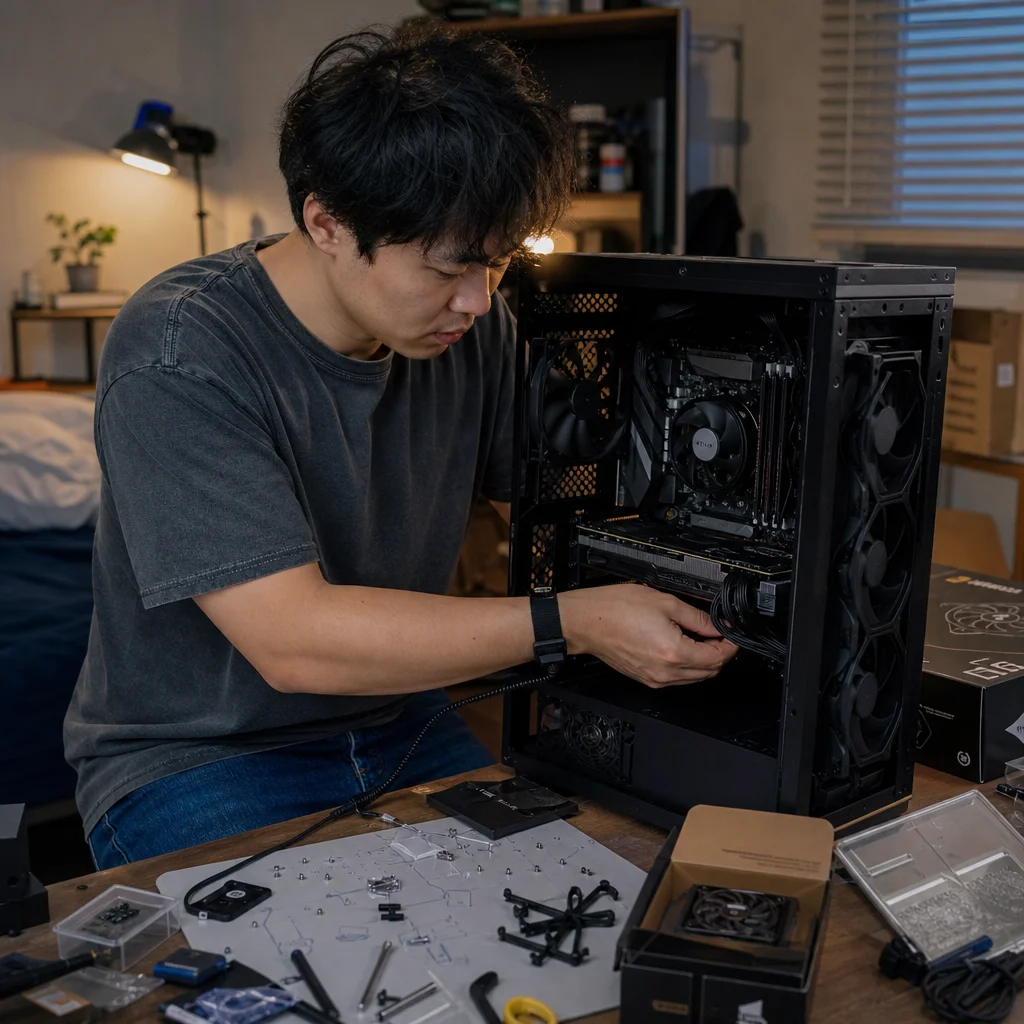
The smallest PC isn’t automatically the quietest, and the fastest PC isn’t automatically the better long-term purchase. Your choice affects where the computer can sit, which components you can install, how easily you can clean it, and whether a modest upgrade becomes a simple repair or a complete rebuild.
For a beginner, the most useful question isn’t “Which case is better?” It’s “Which limitations will bother me most over the next few years?” A compact system can be an excellent fit for a bedroom, living room, or crowded desk. A larger system usually gives you more cooling capacity, storage options, replacement choices, and room to solve problems without replacing several parts at once.
Start with the space and the work the PC must do
Measure the place where the computer will actually live, not just the space available on paper. Leave room for power and display cables, airflow around the case, access to front or rear ports, and enough clearance to remove a side panel. A case that technically fits inside a shelf may become frustrating if you have to move it every time you clean a filter or connect a device.
Also consider the environment. A small PC on an open desk may be easy to reach but more noticeable acoustically. One placed inside a cabinet may look tidy while restricting airflow and trapping heat. Neither size category solves poor placement. A quiet, well-ventilated larger case can be less intrusive than a compact case whose fans must spin quickly to remove heat.
Think about your workload rather than choosing based only on component labels. Office work, web browsing, media playback, and moderate gaming often fit comfortably in a small system. Long rendering jobs, high-end gaming, large local storage, virtual machines, or frequent expansion make the additional space of a larger case more valuable.
Check the fit before ordering parts
Compare the case’s published internal clearances with the exact graphics card length and thickness, CPU cooler height, power-supply format, motherboard size, and radiator dimensions you intend to use. Treat these measurements as a compatibility checklist, not as general guidance.
What a small PC does well
A compact build can reduce the amount of space your computer occupies and may use fewer fans, cables, and drive mounts. That makes it attractive when the system needs to share a desk or blend into a living area. Smaller cases can also encourage disciplined part selection: you buy only the storage, expansion cards, and cooling hardware you genuinely need.
This simplicity can help reliability when the configuration is carefully planned. There are fewer unused cables obstructing airflow, fewer components to install incorrectly, and less temptation to add hardware that provides little benefit. A compact computer can be particularly sensible if you expect to use it for one clearly defined purpose for several years.
The trade-off is that compact hardware has less tolerance for mistakes. A graphics card that fits on paper may leave little room for power connectors. A cooler that works well in a spacious case may be too tall, too wide, or difficult to install in a small one. Cable routing can become cramped, and a part that fails may be harder to reach without removing other components.
Small cases also vary considerably in their internal layout. Two cases with similar external volume can offer very different access to filters, fans, storage, and motherboard connections. The name “small form factor” tells you less than the actual dimensions and component support.
Why quiet operation depends on more than case size
Noise comes from moving air and moving parts. Fans, mechanical drives, pump motors, and some power-supply designs can all contribute. Heat is the main factor that makes fans increase their speed, so a case with better airflow can often operate more quietly than a smaller case with restricted intake and exhaust paths.
A compact PC can still be quiet if its components are efficient, its cooling is appropriately sized, and its fan curves are configured sensibly. The opposite is also true: a large case can be noisy if it contains power-hungry hardware, high-speed fans, or a poorly tuned cooling setup. Quietness is a system-level result rather than a direct reward for choosing a particular case size.
Larger cases generally give you more options for achieving low noise. You can use larger fans that move air at lower speeds, space components farther apart, and choose a CPU cooler with a larger heatsink. There is also more room to separate hot-air paths from intake paths. These advantages don’t guarantee silence, but they give you more ways to reach a comfortable noise level.
If low noise is a priority, pay attention to the sound profile you can tolerate. A steady, low fan hum may be less distracting than a small fan repeatedly accelerating and slowing. Avoid choosing components solely by their peak performance; a part that runs cooler during your normal workload may produce a better everyday experience even if its maximum benchmark result is lower.
What an expandable PC gives you later
The main advantage of a larger system isn't just the ability to install a faster processor or graphics card today. It’s the ability to make one change at a time later. You may be able to add memory, another storage drive, a network card, or a replacement cooler without redesigning the entire computer.
That flexibility improves maintenance. Dust filters and fans are usually easier to access, cables are less likely to be tightly folded around sensitive connectors, and a failed component can often be removed without dismantling half the system. If you expect to keep the computer for a long time, easier service can matter more than a small difference in initial size.
Expansion also provides room for changing requirements. A computer used mainly for games might later become a workstation with additional storage. A basic system might need a capture card, faster networking, or more memory. You don’t have to predict every future use, but leaving a reasonable amount of space can prevent a minor change from becoming an expensive rebuild.
There are limits, however. A large case doesn’t make every future upgrade possible. The motherboard still determines processor and memory support, the power supply still has a finite capacity, and older platforms may not support newer parts. Expansion room is useful only when the rest of the platform can support the upgrades you’re likely to make.
Compare the costs hidden behind each approach
A small PC may require more careful part selection and sometimes more expensive specialized components. Compact power supplies, low-profile coolers, or unusually sized motherboards can reduce your choice of replacements. If one of those parts fails, finding a direct substitute may take more effort than replacing a standard component in a larger build.
A larger system may cost more in case space, fans, and unused capacity. You could end up buying room you never use. A case with several drive bays and support for multiple large graphics cards has little practical value if your workload needs one drive and an integrated graphics processor.
Compare the total system rather than the case price. Include the cooling required to keep the chosen processor comfortable, the power supply appropriate for the graphics card, storage expansion you might realistically use, and any adapters or special cables. A cheap small case can become poor value if it forces compromises elsewhere. A large case can be wasteful if its extra features never serve a purpose.
Long-term reliability is also a cost consideration. Easier cleaning and simpler access can reduce the likelihood that you postpone maintenance. A build that is technically excellent but difficult to open may receive less attention, allowing dust buildup, loose cables, or failing fans to go unnoticed.
Use your upgrade plans to set the boundary
If you expect the computer to remain mostly unchanged, choose the smallest case that comfortably supports the parts you need and provides sensible airflow. Prioritize accessible filters, standard or readily replaceable components, and enough clearance that installation isn’t unnecessarily delicate. Compact doesn’t have to mean extreme.
If you expect regular upgrades, start with the components most likely to change. A larger case is especially useful when you may add storage, install a more powerful graphics card, or replace the cooling system. It’s also the safer choice when you’re still learning what hardware you’ll need, because it leaves room for corrections and experimentation.
You don’t need to fill every expansion slot to justify a larger case. The value may be in easier troubleshooting and maintenance. Being able to see the motherboard, reach a fan header, or remove a drive without disturbing the graphics card can save time throughout the system’s life.
A sensible decision for a first build
Choose a small, quiet PC when limited space is a firm requirement, your workload is predictable, and you’re willing to verify every component dimension before buying. Favor moderate power consumption, straightforward cooling, and parts with reasonable replacement availability. The best compact build isn't the one with the most impressive hardware squeezed inside; it’s the one that remains cool, serviceable, and quiet enough for its role.
Choose a faster expandable PC when you value upgrade freedom, plan to keep the system for many years, or expect your workload to grow. Give priority to accessible interiors, good airflow, standard components, and enough power and cooling headroom for the changes you can realistically imagine. Avoid paying for extreme expansion that doesn’t match your needs.
Before ordering, write down your intended workload, the space measurements, the components you may upgrade, and the maintenance you’re prepared to perform. Then compare complete build plans rather than isolated case specifications. If compactness is a convenience but serviceability is a lasting priority, a modestly sized mainstream case is often the useful middle ground: small enough to place easily, but spacious enough to keep cool, clean, and repair without turning every upgrade into a puzzle.