The Best First Upgrade for an Aging Gaming PC
When an older gaming PC still runs some games well but struggles in others, the right first upgrade depends on where performance is actually being lost. I’ll show you how to identify that limit and compare GPU, memory, storage, processor, and display upgrades before spending your budget.
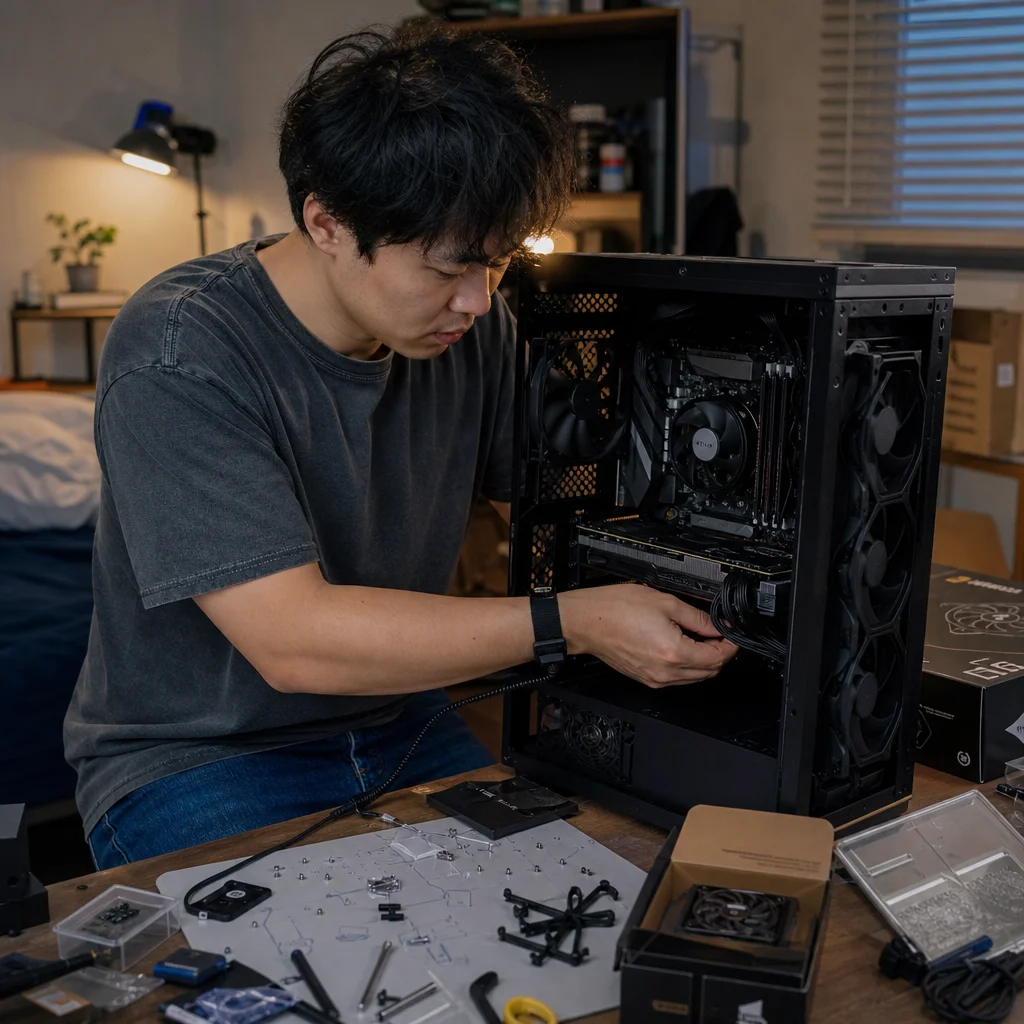
An aging gaming PC rarely needs every major component replaced at once. More often, one part is limiting the experience while the others still have useful life left. The difficult part is identifying that part before you spend money on an upgrade that produces little visible improvement.
The best first upgrade is usually the component responsible for the problem you can actually observe: low frame rates, stutter, long loading times, insufficient image quality, or a display that makes your current performance look worse than it is. That means there isn’t one universal answer. A graphics card is often the strongest gaming upgrade, but not if your processor is already holding it back, your memory is constantly full, or your power supply and case can't support the replacement.
Start with the symptom, not the component
Before looking at product listings, describe what feels wrong. “My PC is old” isn't specific enough to guide an upgrade. Ask whether games are running at low average frame rates, pausing briefly during play, taking too long to load, or failing to deliver the resolution and refresh rate you want.
Low average frame rates usually point toward the graphics card or processor. Stutter can come from insufficient memory, shader compilation, background programs, storage problems, thermal throttling, or an uneven game engine. Long loading times are more likely to involve storage and game-specific behavior than raw graphics performance. A blurry image at a high frame rate may be a resolution, settings, or display issue rather than a need for a faster GPU.
Use an overlay or monitoring tool while playing a demanding game and watch several things at the same time: GPU utilization, CPU utilization by individual core, memory usage, frame rate, frame-time consistency, temperatures, and clock speeds. The exact menus differ between tools and operating systems, so verify current software instructions if you need to set one up. You’re looking for a pattern rather than a single number.
If the GPU is close to full utilization while the processor has room and lowering graphics settings raises frame rates, the GPU is a strong upgrade candidate. If one or more CPU cores are heavily loaded while GPU utilization falls well below its potential, the processor or platform may be the limit. If memory usage reaches capacity and the system starts relying heavily on the storage drive, adding memory may improve stutter and responsiveness more than replacing either main processor.
Check your current limits: Test the games you actually play at the resolution and settings you normally use. Record the result in at least one demanding title, one competitive or high-frame-rate title, and one game that already runs acceptably.
When a graphics card should come first
A graphics card is often the best first upgrade when your main complaint is insufficient frame rate or image quality in graphically demanding games. It has the most direct effect on rendering resolution, visual settings, ray-tracing workloads, and many forms of upscaling. If your current GPU is several generations old, a newer model may also provide features your system lacks, although the value depends on the games you play and the resolution of your display.
A GPU upgrade makes the most sense when monitoring shows that the graphics processor is consistently busy during the moments you want to improve. You should also compare performance at different settings. If lowering shadows, textures, or effects produces a useful frame-rate increase, the GPU is probably doing most of the work. If lowering the resolution barely changes performance, the processor may be limiting the game instead.
There are important edge cases. A faster graphics card can expose a CPU bottleneck, particularly at 1080p with a high-refresh display or in simulation, strategy, and competitive games. It can also increase power consumption, heat, fan noise, and physical demands on the case. Check the card’s dimensions, required power connectors, recommended power supply capacity, available expansion-slot space, and cooling clearance against your actual system rather than assuming the new card will fit.
Graphics-card prices, availability, power requirements, and feature support change frequently. Check the manufacturer’s current specifications and independent testing for the exact model you’re considering. Don’t treat a product label or a retailer’s comparison chart as a complete performance estimate.
When memory is the sensible first move
Memory is a strong first upgrade when your PC has too little capacity for your games and normal background use. This is especially likely if you play with a browser, voice chat, recording software, launchers, or other programs open, or if your system spends noticeable time swapping data to storage. The symptoms can include hitching, sluggish tab switching, and inconsistent frame times rather than simply a low average frame rate.
Adding memory won’t normally turn a graphics-limited game into a much faster one. It can, however, remove a capacity problem that makes an otherwise adequate system feel erratic. Check actual memory usage during a problem session before buying. A machine that rarely approaches its capacity may gain little from more RAM.
Compatibility matters more than many upgrade guides suggest. Confirm the memory generation supported by your motherboard and processor, the number of occupied and available slots, the module capacity, and the system’s current configuration. Mixing modules can work, but different kits may not operate at their advertised settings together. On some platforms, installing a matched kit is simpler and more reliable than adding one unrelated stick.
Also distinguish capacity from speed. A higher-rated kit may require a firmware setting to reach its advertised speed, and the achievable result depends on the motherboard and processor’s memory support. Check your motherboard manual and current firmware documentation before changing settings. If your existing memory is already sufficient and stable, buying faster memory may be a lower-impact choice than addressing the actual graphics or processor limit.
When storage is worth prioritizing
A solid-state drive is the most noticeable upgrade when your PC still uses a hard disk for the operating system or frequently played games. It can make startup, application launches, game loading, and file operations feel substantially more responsive. It won’t generally raise the frame rate once a game is running, but it can reduce the waiting that makes an older system feel slow.
Storage can also affect stutter when a game streams assets while you move through a world, although the game engine, memory capacity, and graphics settings remain important. Installing a game on an SSD isn't a guaranteed fix for every hitch. If the problem continues with adequate free space and memory, investigate the CPU, GPU, thermals, and software load instead.
Check the interfaces your motherboard supports before choosing a drive. A newer storage standard may not operate at its full potential in an older slot, and some compact systems have limited mounting space or require a particular cable. Confirm the drive’s physical format, available connectors, firmware requirements, and the amount of free capacity you’ll retain after installation. Prices and endurance ratings vary by model and market, so current specifications are worth checking rather than relying on an old recommendation.
When the processor or platform should come first
A processor upgrade is appropriate when the CPU is limiting frame rates in the games you play, especially at lower resolutions or high refresh rates. It can also help with simulation-heavy games, large multiplayer sessions, strategy titles, emulation, and other workloads that place sustained demand on one or more CPU cores.
The complication is that a processor is rarely an isolated purchase. Your motherboard may support only a limited range of processors, and a newer CPU may require a different socket, memory type, firmware version, cooler, or power delivery capability. A processor that fits physically may still be unsupported until the board’s firmware is updated. In some cases, moving to a meaningfully faster CPU means replacing the motherboard and memory as well.
Watch temperatures and clock speeds during a sustained workload. A CPU that appears slow because it is overheating or losing boost speed may need cleaning, improved airflow, a properly mounted cooler, or replacement thermal material before it needs to be replaced. Those maintenance steps are cheaper, but follow current manufacturer guidance and avoid working inside the system while it is powered.
A platform upgrade can be sensible when your current board has no worthwhile processor path, lacks modern connectivity you need, or makes a balanced graphics-card upgrade impossible. It is less attractive when your only issue is game loading or storage capacity.
Don’t overlook the display
A display upgrade can be the best first upgrade when the PC already delivers the performance you want but the experience is constrained by an old panel. A higher refresh rate can make supported games feel more responsive, while greater resolution or improved contrast can change how you use a sufficiently powerful graphics card.
The display and GPU need to be considered together. A higher-resolution monitor increases rendering demands, and a high-refresh display is useful only if your system can produce frames consistently enough to take advantage of it. Adaptive-sync support, connection standards, scaling behavior, and the monitor’s actual response characteristics also matter. Specifications alone may not describe motion performance accurately, so check current reviews of the exact model.
If your current display is limited to a lower refresh rate, you may perceive a large improvement from a monitor even though the PC’s frame rate hasn't changed. Conversely, buying a very demanding display before upgrading the graphics card can make the system feel less capable.
A simple way to rank the candidates
Once you’ve measured the problem, rank each possible upgrade using four questions. First, will it address the symptom you care about? Second, can the rest of the system support it without creating a new bottleneck or compatibility problem? Third, what additional costs will it create, such as a power supply, cooler, motherboard, cables, or display? Finally, does it improve the games and applications you actually use rather than a benchmark you’re unlikely to run?
For many budget-conscious gamers, that process produces one of four outcomes: a graphics card for consistently low GPU-limited frame rates, memory for capacity-related stutter, an SSD for a hard-drive-based system, or a processor and platform upgrade for CPU-limited games. Maintenance may come first if temperatures, dust, or failing storage are distorting the diagnosis. A display should lead when the computer already meets your performance target but the panel is holding back the experience.
Do the least expensive corrective work before replacing hardware. Close unnecessary background applications, check free storage space, confirm that the monitor cable is connected to the graphics card rather than the motherboard when appropriate, and inspect temperatures under load. These checks won’t solve every problem, but they can prevent you from buying an upgrade for a fault that was elsewhere.
The best first upgrade is therefore the one that removes the largest measured limitation while preserving the parts that still do their jobs. Test your current system, account for compatibility and supporting costs, and choose the smallest change that produces the improvement you actually want. That approach may lead to a new GPU, but it may just as reasonably lead to more memory, faster storage, a processor-platform change, or no purchase until the evidence points to one.