The Best Way to Upgrade a PC Used for Local AI Tools
Local AI workloads usually benefit more from usable graphics memory than from a faster processor alone. I’ll compare VRAM, system memory, storage, CPU performance, and power or cooling upgrades so you can spend where model capacity and responsiveness improve most.
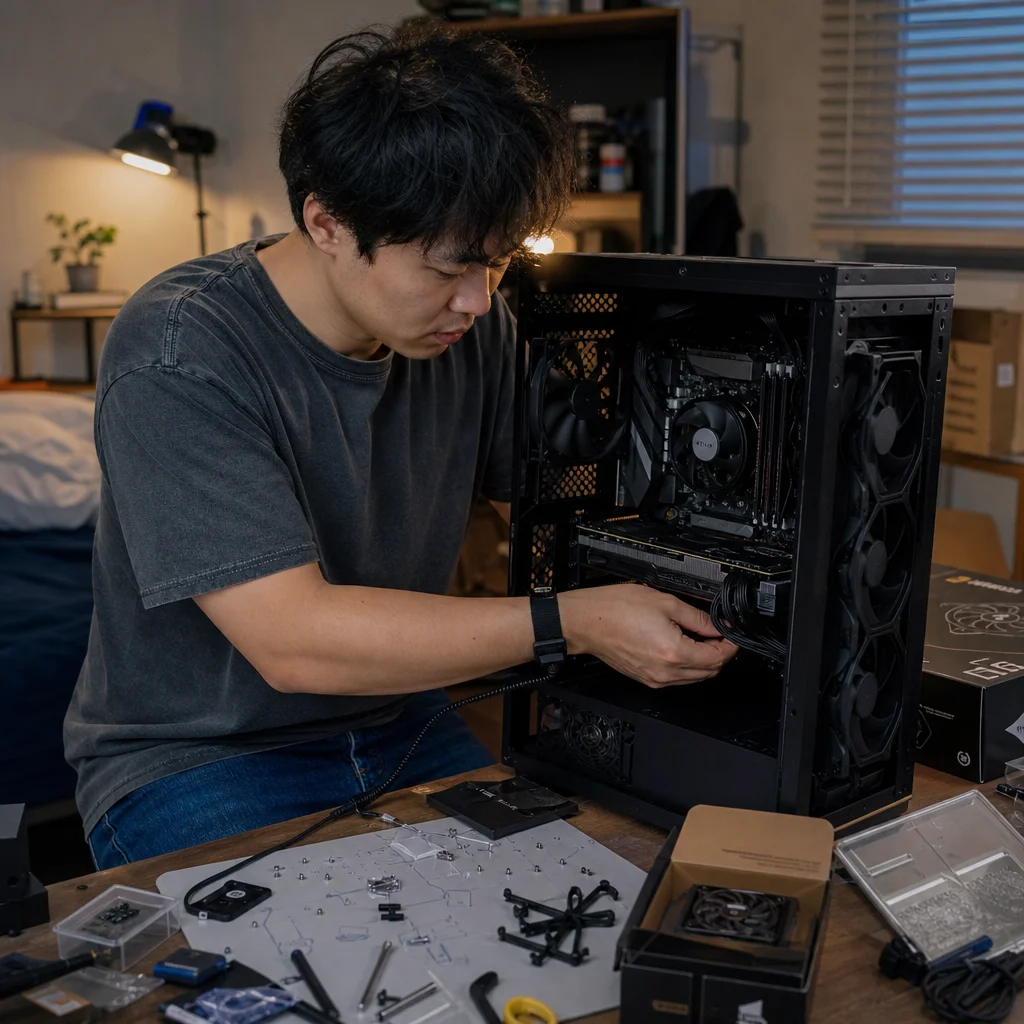
Local AI workloads often make a PC feel undersized in a different way than games do. A system can have a fast processor and plenty of general-purpose memory yet struggle because its graphics card can't hold the model, context, or working buffers needed for a smooth run. The best upgrade is usually the one that removes the most restrictive bottleneck, not the one with the highest specification on a product page.
For most discrete-GPU systems, that means prioritizing usable VRAM first, then checking whether system memory, storage, power delivery, and cooling can support the intended workload. CPU performance matters, particularly for CPU-only inference, preprocessing, training, and data work, but it is often a secondary upgrade when a capable GPU is already present.
Start with the workload, not the component
“Local AI tools” covers several very different tasks. Running a quantized language model, generating images, fine-tuning a model, transcribing audio, embedding documents, and serving multiple users place different demands on the computer. Before choosing hardware, identify whether you care most about model size, generation speed, batch throughput, context length, or the ability to run several workloads at once.
A local language-model setup may fail to load a model because it doesn't fit in available VRAM, or it may load successfully while moving part of the model into system memory. The second case can work, but transfers across the PCIe connection are much slower than keeping the active data on the GPU. Image-generation tools may be more forgiving for a small batch, while larger image sizes, higher batch counts, video workflows, or advanced conditioning can increase memory use sharply.
Fine-tuning and training are more demanding than ordinary inference. The model weights are only part of the memory requirement; gradients, optimizer state, activations, and temporary buffers can dominate. Techniques such as quantization, parameter-efficient fine-tuning, gradient checkpointing, and smaller batch sizes can reduce the requirement, but they don’t make memory capacity irrelevant.
Write down the models and workflows you actually intend to run. A realistic target is more useful than a vague goal such as “local AI.” The right upgrade for occasional seven-billion-parameter inference may be wasteful for a developer who mainly needs embeddings and code assistance, while it may be inadequate for larger models or experimentation with long contexts.
Check your model’s current footprint: Before buying hardware, consult the documentation for your chosen runtime and model, then test the workload with the intended context length, resolution, batch size, and quantization. Requirements and supported acceleration backends change as tools and model releases change.
Prioritize VRAM when the GPU is the bottleneck
For GPU-accelerated inference, VRAM is often the most valuable upgrade because it determines what can remain on the graphics card. More capacity can let you run a larger model, use a less aggressive quantization level, increase context length, raise an image-generation resolution, or avoid partial CPU offload. Those benefits can be more noticeable than a moderate increase in shader or tensor performance.
Capacity and speed are separate considerations. A card with more VRAM may run a model that a faster card can't load, while a card with faster memory may produce results sooner once both cards can hold the same workload. If your current card is constantly offloading or failing at allocation, capacity should take priority. If the workload already fits comfortably, compute performance, memory bandwidth, and software support become more important.
Avoid treating advertised VRAM as entirely available to your model. The operating system, display output, runtime, graphics driver, model framework, and temporary allocations all consume some memory. Leave headroom for the context window and intermediate buffers rather than targeting a fit so tight that a small change causes an out-of-memory error.
A multi-GPU setup can help, but it isn’t automatically equivalent to one card with a larger memory pool. Whether memory can be combined efficiently depends on the runtime, model architecture, communication overhead, motherboard layout, and the specific workload. Some applications split layers across cards; others gain little or require additional configuration. Two cards also bring higher power use, more heat, more noise, and possible PCIe bandwidth limitations.
For developers comparing a new GPU with a used one, check more than capacity and benchmark results. Confirm current driver support, the runtime’s supported backend, physical dimensions, connector requirements, warranty situation, and whether the card has enough memory for the models you plan to use. A cheaper card that forces constant offload may cost less initially but waste time every time you run it.
Add system memory when the whole workload needs room
System RAM becomes the next priority when models are loaded on the CPU, partially offloaded from the GPU, shared with other tools, or used in development workflows that involve datasets, containers, browsers, and local services. Insufficient RAM can cause swapping, long pauses, failed loads, and an unpleasantly fragile workflow even when VRAM is adequate.
More system memory can't substitute for missing VRAM at the same speed, but it can expand what is possible. CPU inference depends heavily on RAM capacity and bandwidth, and GPU runtimes may use system memory for model storage or offload. Developers working with retrieval-augmented generation may also keep indexes, document-processing jobs, databases, and development environments active alongside inference.
Capacity should match the number and size of concurrent tasks. If your machine regularly approaches its physical memory limit, adding RAM is usually a more sensible upgrade than replacing the processor. Check the motherboard’s supported capacity, memory type, slot population guidance, and stable speeds. Mixing kits can work, but it can also limit settings or reduce stability, so a matched kit is preferable when replacing memory rather than simply adding a small amount.
Memory speed is worth considering after capacity is sufficient. It can influence CPU inference and data-processing performance, but it rarely solves a workload that is fundamentally constrained by GPU memory. Monitor actual RAM use, swap activity, and GPU offload behavior during the models you care about before paying a premium for marginal memory timings.
Treat storage as a workflow and capacity upgrade
Fast storage doesn’t usually make each generated token dramatically faster once the model is loaded. It does make model downloads, installations, cache creation, checkpoint switching, dataset preparation, and startup noticeably less painful. Large models and their alternate quantizations can consume substantial space, and AI tools often create caches that are easy to underestimate.
An SSD is a sensible baseline for active models and projects. NVMe storage can improve load and transfer times, especially for large files and concurrent data work, but the benefit depends on the rest of the system. A faster drive won’t compensate for a GPU that can't hold the model or a processor that is saturated during preprocessing.
Capacity and sustained behavior matter more than headline sequential speed in many local setups. Leave free space for the operating system, temporary files, model conversions, vector indexes, and checkpoints. Consumer SSD performance can fall when a drive is nearly full or heavily written, so avoid planning a library that leaves no working room. Separate project data from the boot drive if that makes backups and maintenance easier, but don’t add drives merely to create a more complicated layout.
Use storage for resilience as well as speed. Models can be downloaded again, but datasets, prompt libraries, fine-tuning outputs, and configuration files may not be replaceable. A backup plan is more valuable than a small difference between two otherwise suitable SSDs.
Upgrade the CPU for CPU-bound work
A processor upgrade makes sense when monitoring shows that the CPU is the limiting factor. This is common with CPU-only inference, tokenization, document conversion, audio preprocessing, data loading, compiling software, and workloads where the GPU spends much of its time waiting for input. More cores can improve throughput for parallel jobs, while stronger per-core performance can improve responsiveness and some lightly threaded tasks.
CPU-only inference is also highly sensitive to memory bandwidth and capacity. A new processor on an old platform may require a motherboard and memory change, turning a nominal CPU upgrade into a platform rebuild. Compare the full cost with adding a GPU that supports your runtime. For a developer who needs predictable local inference without a discrete graphics card, a platform upgrade can still be reasonable, but it should be chosen deliberately rather than assumed to be the universal answer.
A faster CPU can also increase total system power and heat. Confirm socket compatibility, firmware support, cooler capacity, and motherboard power delivery before buying. If the workload is already GPU-bound, a high-end processor may add little practical value while consuming budget that would buy more VRAM or system memory.
Don’t overlook power, cooling, and physical constraints
A more capable GPU can change the rest of the system’s requirements. Check the power supply’s continuous output, available connectors, physical clearance, case airflow, and cooling arrangement. AI workloads may sustain high utilization for much longer than a typical short burst, exposing weaknesses in airflow, fan curves, cable routing, or power delivery.
Power-supply guidance varies by graphics card, processor, transient behavior, regional electrical standards, and the rest of the system. Use the current manufacturer and board-partner requirements for the exact card, and choose a quality unit with suitable connectors and reasonable headroom rather than relying on a generic wattage estimate. If a new GPU requires an adapter, follow the card and power-supply maker’s installation guidance and avoid sharply bending the cable near the connector.
Verify the upgrade around the exact card: Check the current GPU specification, power-supply recommendation, connector type, case clearance, slot spacing, motherboard support, and cooling requirements before ordering. These details vary by model and revision, and a card that fits the budget may not fit the case or power budget.
Cooling improvements can be worthwhile even without replacing a major component. Cleaning dust, improving intake and exhaust, replacing a poorly mounted cooler, and setting a sensible fan curve may prevent thermal throttling during sustained inference. A cooler environment can improve consistency, but it won’t turn an undersized GPU into a larger one. Keep noise, room temperature, and long-duration operation in mind when comparing performance figures.
A sensible upgrade order
For many discrete-GPU systems, begin by measuring whether the current workload is failing because of VRAM capacity or slowing because of compute. If models don't fit, upgrade to a GPU with more usable VRAM before chasing a faster CPU. If they fit but run slowly, compare GPU compute performance and software support. If the GPU is frequently waiting on data or the system becomes unresponsive, investigate RAM, CPU load, storage, and cooling.
A practical sequence is to establish a model-and-workload target, measure VRAM and RAM use during a representative run, and then remove the most restrictive bottleneck. Add system memory when the machine swaps or can't keep the rest of the workflow resident. Add storage when model management and data work are constrained by capacity or slow loading. Upgrade the CPU when profiling shows sustained CPU saturation or when your work is primarily CPU-bound.
The most cost-efficient build isn't necessarily the one with the newest processor or the largest overall specification. It is the system that keeps the models you need in the fastest appropriate memory, has enough room for the surrounding workflow, and remains stable under sustained load. Spend first on the constraint that prevents the workload from running well; improve secondary components only after measurements show they are holding you back.