Planning a PC Build Around One Non-Negotiable Workload
A single demanding workload should determine the parts you protect with budget, while everything else supports it without unnecessary excess. I’ll show you how to prioritize performance, cooling, compatibility, and long-term reliability around the task your PC must handle well.
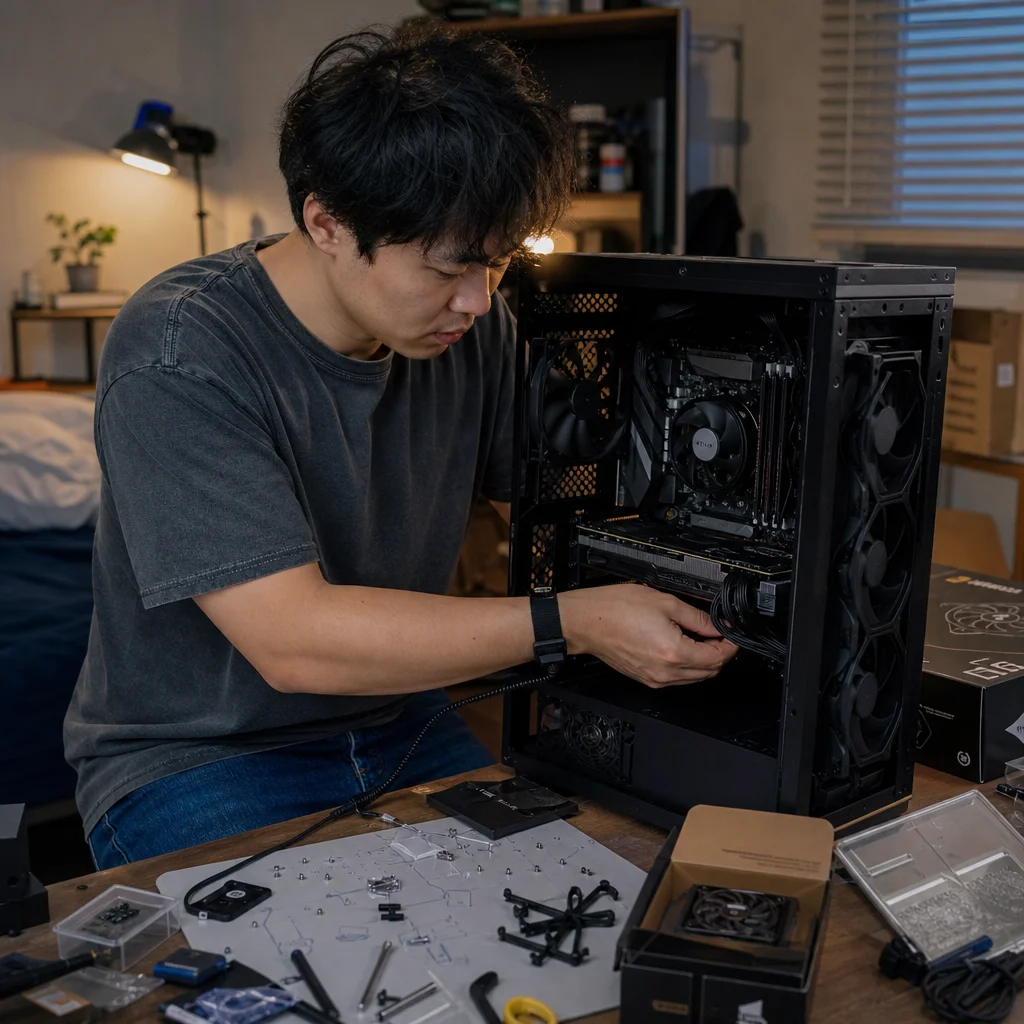
When one workload matters more than everything else, a balanced-looking parts list can be the wrong starting point. A PC intended for competitive gaming, music production, software development, or 3D rendering should be designed around the demands that can't be compromised—not around a generic idea of an “even” build.
That doesn’t mean every other component is unimportant. It means you decide where performance, capacity, cooling, and upgrade flexibility genuinely protect your main task, then avoid spending heavily on improvements that task won’t use. The result should be more than a fast system on day one. It should remain dependable when projects become larger, software changes, and the workload keeps the system busy for hours.
Define what “non-negotiable” means
Start by describing the workload in terms of what the computer must do, not just the application name. “Video editing” could mean occasional 1080p cuts, multicamera 4K work, or effects-heavy projects with frequent exports. “Software development” could mean editing and compiling a small application, or running several virtual machines and containers at once. The hardware priorities can be very different.
Write down the task you need to protect and the conditions in which you perform it. Consider the size of your typical projects, how long a session lasts, whether you work with several applications open, and whether responsiveness or completion time matters more. A music producer may care about stable low-latency monitoring while recording, whereas a person mixing completed tracks may benefit more from sustained processing and memory capacity.
It also helps to separate requirements from preferences. A requirement might be that a render completes within a certain time, a game maintains a particular frame rate, or a development environment can run several services simultaneously. A preference might be quieter operation, a smaller case, or a particular brand. Preferences deserve consideration, but they shouldn’t consume money needed to meet the actual workload requirement.
Identify the resource that limits the work
Most demanding tasks lean hardest on one or two resources. The useful question isn't “Which processor is best?” but “What is likely to prevent this workload from meeting its goal?” Depending on the task, that limiting resource may be processor throughput, graphics performance, memory capacity, storage behavior, network access, or latency.
Competitive gaming commonly places unusual importance on consistent frame delivery, low input latency, and a graphics card capable of reaching the desired frame rate at the chosen resolution. A powerful processor can matter, particularly at high refresh rates, but buying an expensive processor while using a graphics card that can't meet the target isn't a sensible priority. Conversely, a graphics card upgrade may have little effect if the game is already limited by processor performance.
3D rendering needs closer examination because different renderers use different hardware paths. Some workloads favor many processor cores, while others can use a graphics card effectively. Large scenes may also expose memory-capacity limits or storage bottlenecks when assets are loaded and cached. Software development can be processor-heavy during compilation, memory-heavy with virtual machines, and storage-sensitive when handling large codebases or many dependencies. Music production often combines moderate processor demand with demanding real-time latency requirements, where a stable system and appropriate audio configuration can matter more than headline benchmark scores.
If you can, measure the workload on your current computer before buying parts. Watch processor utilization, graphics utilization, memory use, storage activity, temperatures, and clock behavior during the slow or difficult part of the task. A single snapshot can mislead you, so observe a complete export, build, session, or game scenario. The goal isn’t to collect perfect laboratory data; it’s to discover which limitation you repeatedly encounter.
Spend first where the workload benefits
Once you understand the limiting resource, assign the largest part of the budget to it. This is the central discipline of a workload-first build. You’re not trying to make every component equally impressive. You’re trying to make the complete system capable of doing its main job without creating a new limitation elsewhere.
That second part matters. A high-end graphics card paired with insufficient memory can still produce a frustrating experience. A many-core processor in a poorly ventilated case may lose sustained performance to heat. A fast system drive with no room for active projects can force you to work from a slower, less convenient location. Prioritization isn't permission to neglect supporting components; it’s a way to give them the capacity they need without confusing luxury with necessity.
Set a performance target before selecting a part. For example, you might want a particular frame-rate range, a maximum acceptable export time, the ability to run a defined number of virtual machines, or enough simultaneous audio tracks and effects at a chosen buffer size. The exact target will depend on your work, but stating it gives you a stopping point. Without one, it’s easy to keep moving up a product range because the next model appears safer, even when the improvement won’t change your experience.
Build around sustained performance, not just peak specifications
A workload that lasts several minutes or hours places different demands on a system than a short benchmark. Cooling, power delivery, acoustics, and case airflow become part of performance because they affect how consistently the hardware can operate.
Choose a cooler that can handle the processor’s sustained output without constantly running at its limit. That could mean a capable air cooler or a liquid cooler selected for a genuine space, noise, or thermal requirement—not simply because it looks more advanced. Confirm that the cooler fits the case, clears the memory modules, and includes the mounting hardware required by the processor socket. A cooling solution that is difficult to service or depends on a fragile installation can become a reliability concern over time.
Case airflow should be planned as a path for fresh air to reach the components and warm air to leave them. More fans aren't automatically better if they add noise, dust entry, or awkward cable routing. Use a case with sensible intake and exhaust positions, enough room for the graphics card and cooler, and filters you can remove for cleaning. A build that is easy to open and maintain is more likely to stay in good condition.
The power supply should have adequate capacity for the selected components, suitable connectors, and a reputation for dependable operation. Avoid treating the wattage printed on the label as the only consideration. Leave reasonable headroom for transient demands and future upgrades, while recognizing that an oversized supply may add cost without improving your workload. If the graphics card or processor has specific power and connector requirements, check those against the exact model rather than relying on a general family name.
Protect the parts that affect recovery
Long-term reliability is also about what happens when something goes wrong. A system built around one critical workload should be easy to diagnose and recover, especially if losing access to it interrupts paid work or an important project.
Use memory in a configuration supported by the motherboard and processor, and test it before trusting the system with important work. If you install a large memory kit, confirm that the board’s firmware and memory support are appropriate for that capacity and speed. Rated memory settings may require enabling a profile in firmware, and aggressive settings can reduce stability even when they appear in a product specification. If reliability matters more than a small performance gain, a slightly more conservative setting can be the better choice.
Give storage a clear role. A fast drive for the operating system and applications can keep the system responsive, while a separate project or working drive may make capacity and organization easier. That separation isn’t a substitute for backups, but it can simplify troubleshooting and reduce the chance that a full system drive disrupts every task at once. Leave free space on active drives, particularly when your software creates caches, scratch files, or temporary exports.
Back up irreplaceable work using a method that covers both accidental deletion and hardware failure. A second copy in the same PC isn't enough, and a backup that has never been tested is only an assumption. Your backup approach should match the workload: source code may need version control and remote copies, while audio, scene, or project files may require scheduled file backups plus archived media. Keep the recovery process understandable enough that you can use it under pressure.
Choose the platform for the next sensible upgrade
A workload-first build shouldn’t be replaced every time one component becomes limiting. Before buying the motherboard and case, consider what you’re likely to improve later. You may need more memory, additional storage, a faster graphics card, a quieter cooler, or extra expansion connectivity.
This doesn’t mean paying for every possible feature. It means avoiding constraints that are expensive or difficult to correct. Check the number and type of memory slots, storage connections, expansion slots, rear ports, internal clearances, and fan or radiator mounts. Make sure the case can accept the components you might realistically add, not every theoretical future part.
The motherboard should provide the connections and firmware support your workload requires without becoming the most expensive component by default. If your main task uses specialized connectivity—such as several high-speed storage devices, professional audio equipment, or multiple displays—confirm the complete connection plan. Some ports share bandwidth or become unavailable when certain expansion slots or storage sockets are populated, so read the board documentation before finalizing the layout.
Plan the upgrade in terms of the bottleneck you expect to encounter first. If the graphics card is the likely future limit, provide enough power and physical clearance. If memory capacity is the likely limit, avoid filling every slot with small modules unless that is the best-supported configuration. If storage will grow quickly, make sure additional drives can be installed without sacrificing airflow or making maintenance unpleasant.
Confirm the parts’ working relationship: Before ordering, check the exact processor, motherboard, memory kit, cooler, graphics card, power supply, and case together. Verify socket support, firmware requirements, dimensions, power connectors, storage sharing, and clearance rather than assuming that parts from the same product generation automatically fit.
Avoid paying for unused performance
Once the main constraint is addressed, diminishing returns become important. A more expensive part can be worthwhile if it shortens your workday, prevents a known limitation, or provides useful capacity for several years. It is harder to justify when it only improves a benchmark that doesn’t represent your workload.
Overspending is especially common in areas that are easy to compare by specification. More processor cores may not help a latency-sensitive task. Faster memory may have little effect on a graphics-limited game. A premium motherboard may offer features you will never connect. Extremely high-capacity storage can be wasteful if your projects are archived elsewhere, while too little storage can be disruptive if the workload generates large temporary files.
Use the saved budget where it improves the system as a whole: a better case layout, dependable cooling, additional memory capacity, a larger working drive, a calibrated display, a suitable audio interface, or a backup device. These choices may look less exciting on a parts list, but they often make the computer easier to live with and less likely to need an early rebuild.
Validate the build before making it your work machine
After assembly, test the computer in stages. Confirm that it starts reliably, recognizes all memory and storage, reports reasonable temperatures, and has the expected firmware settings before installing everything. Then run a memory test and a sustained workload representative of your real use. Watch for crashes, errors, unusual fan behavior, thermal throttling, and storage problems.
Test the complete workflow, not just individual components. Compile the project, open the virtual machines, render a representative scene, record and monitor audio, or play the games and settings you actually care about. A system can pass a short synthetic test and still reveal problems when software, drivers, background tasks, and peripherals interact.
Keep installation media, firmware information, driver details, and a simple record of stable settings somewhere accessible. Don’t change several variables at once when troubleshooting. If instability appears, return settings to their defaults and isolate memory, cooling, drivers, storage, or power one at a time. This makes recovery less mysterious and reduces the temptation to replace working parts prematurely.
Make the workload the anchor, not the whole identity of the build
The best workload-focused PC isn't the one with the most expensive primary component. It’s the one that meets a defined target, supports that component with appropriate cooling and power, provides enough memory and storage, and remains serviceable when the system gets older.
Begin with the task that must work, measure where your current system falls short, and spend in that order. Then check the supporting parts for compatibility, sustained operation, recovery, and realistic upgrades. If a component doesn’t improve the workload, reliability, or maintenance of the computer, it should have to justify its place in the budget. That approach leaves you with a system designed for the work you actually do—and fewer reasons to rebuild it when the novelty wears off.