Choosing a Motherboard When You Need More USB and Networking Later
Rear-panel ports, internal headers, expansion lanes, and networking options shape how easily a PC can grow. I’ll show you how to weigh built-in connectivity against add-in cards when choosing a motherboard for a home office or creator system in Australia or New Zealand.
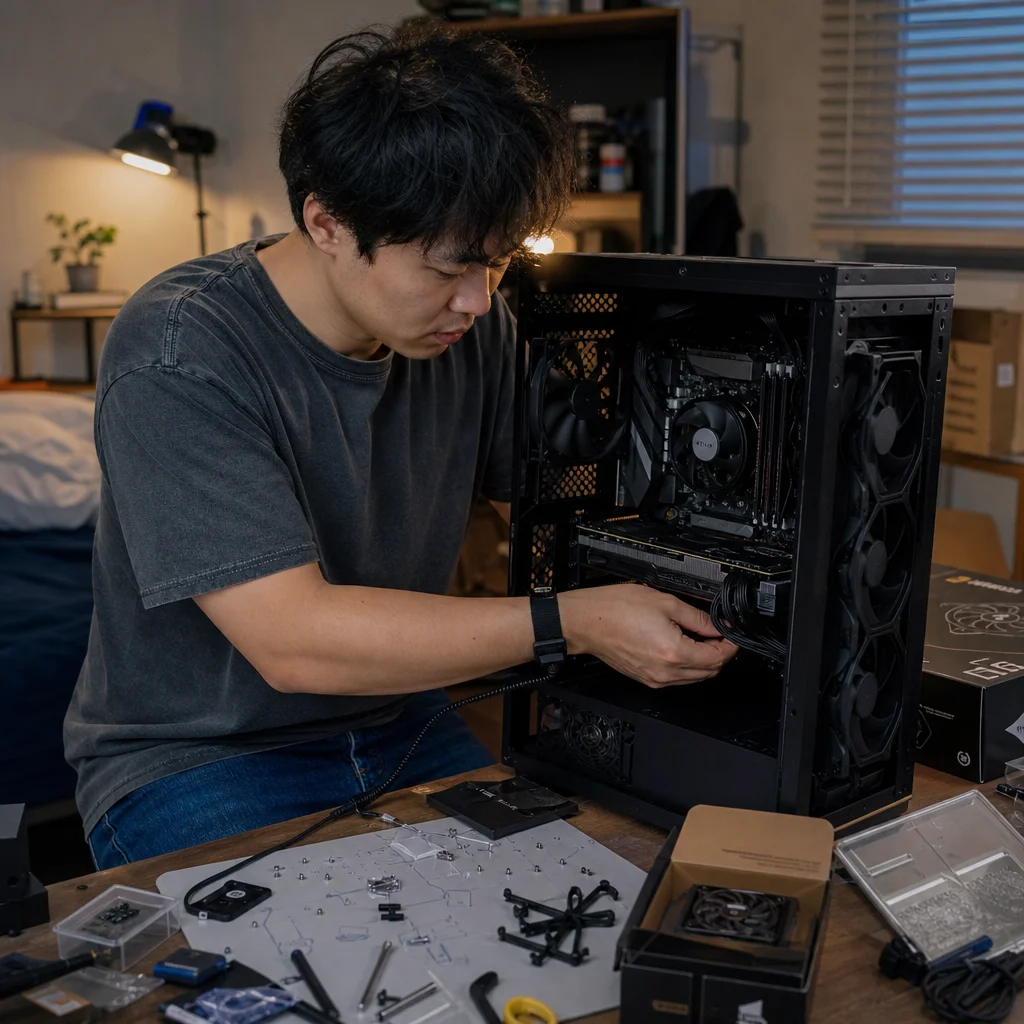
A motherboard with plenty of USB ports and networking options can save you from replacing the whole platform when your desk changes. The difficulty is deciding which connections need to be built in, which can be added later, and which specifications matter more than a long port list.
For a home office or creator PC, the sensible choice usually isn’t the board with the most impressive rear panel. It’s the board that gives you enough convenient connectivity now, leaves a realistic upgrade path, and doesn’t force you to pay for expansion you’re unlikely to use.
Start with the devices you expect to add
Before comparing motherboards, list the devices you use now and the ones you might reasonably add. A keyboard, mouse, webcam, printer, USB microphone, external storage, card reader, drawing tablet, audio interface, and backup drive can consume ports quickly. Creator workloads often involve several of these at once, while a home office may add a docking station, scanner, or conference headset.
Count connections by type, not just by device. Some USB devices need high transfer speeds; others only need a basic connection for input or power. An external SSD, camera, or fast card reader benefits more from a suitable high-speed USB connection than a keyboard does. You may also want a conveniently placed front-panel port so you don’t have to reach behind the computer every time you connect removable storage.
Then consider how often devices will be connected simultaneously. If you regularly move files between two external drives, connect a camera, and use a USB audio interface, a board with only a few fast ports may feel restrictive even if its total USB count looks adequate. A powered hub can solve some of this, but it adds another object, cable, and power adapter to manage.
Rear USB ports and internal headers solve different problems
The rear I/O panel provides connections that are available as soon as the computer is assembled. These are useful for permanent devices such as a printer, wired network connection, keyboard, mouse, or audio equipment. A board with a mixture of USB-A and USB-C ports is generally more flexible than one that offers only a single connector style, especially as newer peripherals increasingly include USB-C cables.
The printed labels and manufacturer specifications matter. USB-C describes the connector shape, not necessarily the speed, display capability, or charging behavior. Two USB-C ports can have very different capabilities. A specification may identify their transfer rate, whether they support video output, and whether they provide enhanced charging. Don’t assume that every USB-C port can perform every USB-C function.
Internal USB headers connect to the case’s front-panel ports or to accessories such as an internal card reader. A motherboard may include conventional internal headers for front USB-A ports and a separate header for a front USB-C connector. If your case has front USB-C, make sure the motherboard has the appropriate internal header, or budget for an adapter with its own limitations.
Headers are also shared resources. A board may have enough physical connectors for your case and accessories, but its manual can explain whether certain headers are disabled when particular expansion slots or storage connections are used. This is one reason the motherboard manual is more useful than a retailer’s summary table.
Check the ports you’ll actually use: Before choosing a board, compare its rear I/O diagram and internal-header layout with your case, front-panel connectors, external drives, audio equipment, and planned accessories. Confirm the advertised USB-C features in the full specification rather than relying on the connector shape alone.
Built-in networking is convenient, but not always decisive
Most modern motherboards include wired Ethernet, and that is often the simplest networking choice for a fixed desktop. A wired connection can be useful for large project files, backups, cloud synchronisation, and low-latency work. Check the Ethernet speed listed by the manufacturer and compare it with your router, switch, and internet service. A faster network interface won’t make an older router or network cable operate at that speed by itself.
Wireless networking is more situational. A board with built-in Wi-Fi can be convenient when the computer can't be connected directly to the router. It may also include Bluetooth for peripherals. However, the result depends on antenna placement, the distance and construction of your home, the router’s capabilities, and local interference. The external antenna supplied with the board isn’t decorative; attaching it and positioning it sensibly can affect reception.
If you’re building a desktop that will stay near a network outlet, wired Ethernet may be the more dependable baseline. If the computer needs to move rooms or you don’t want to run a cable, integrated Wi-Fi may justify a small premium. You can also add wireless networking later, but the available expansion slot and antenna arrangement should be considered before you treat that as an easy fallback.
For Australia and New Zealand, check the exact wireless and Ethernet capabilities of the motherboard and your existing network equipment rather than assuming that a model name guarantees a particular regional configuration. Firmware, bundled accessories, and support can vary by board revision or market.
Expansion slots are your networking escape route
A motherboard with a suitable PCIe slot can accept a wired network card, Wi-Fi adapter, capture card, USB expansion card, or other specialist hardware later. This makes expansion slots an important part of a connectivity plan, even if you don’t intend to install an add-in card today.
The key question is whether a future card will physically fit and still have access to the resources it needs. A compact Wi-Fi card may need a short slot and room for its antenna brackets. A multi-port networking card may need a longer slot. A USB expansion card may use a longer connector even though it doesn’t need all the physical length. Refer to the card and motherboard documentation rather than judging by appearance alone.
Graphics cards complicate this decision. A large graphics card can cover one or more short expansion slots, particularly on boards with tightly spaced layouts. If you’re building a creator system with a substantial graphics card, inspect the slot spacing and plan where a future network or USB card would go. A second full-length slot may be electrically slower than the main one, but that can still be perfectly adequate for many expansion cards.
There can also be resource sharing between PCIe slots, M.2 storage slots, SATA ports, and onboard controllers. Installing an M.2 drive might disable a SATA port or reduce the lanes available to another slot on some boards. These arrangements aren’t necessarily a problem, but you should know them before planning a future card around a slot that may not operate as expected after an upgrade.
Compare a premium board with an add-in-card strategy
Paying more for a motherboard with generous connectivity offers simplicity. The ports are integrated, the rear panel is tidy, and you don’t need to occupy an expansion slot later. Built-in networking can also be useful if your graphics card blocks the most convenient spare slot. This approach makes sense when you already know you’ll use the extra connections or when opening the case for upgrades would be inconvenient.
The drawback is that premium connectivity can be expensive insurance. You may pay for faster Ethernet, extra USB controllers, or wireless features that your router and peripherals can’t use. Some built-in ports may also be placed awkwardly for your case or workflow. A board with fewer but better-positioned ports can be more useful than one with a crowded specification sheet.
Choosing a more modest motherboard and adding a card later can be efficient. Network cards and USB expansion cards let you buy the capability when you need it, and a failed add-in card can be replaced without changing the motherboard. This approach is less attractive if the available slots are likely to be blocked by the graphics card, shared with other devices, or needed for a capture card or audio hardware.
A hub is another option for adding USB connections, particularly for low-bandwidth peripherals. It isn't a complete substitute for motherboard connectivity: devices share the hub’s upstream connection, and the hub may not provide enough power or speed for every combination of drive and accessory. Use a hub for convenience, not as an assumption that any number of demanding devices will behave like independent motherboard ports.
Look beyond the rear-panel count
A useful comparison includes four layers of connectivity:
- Rear I/O: the ports available immediately, including USB types, Ethernet, Wi-Fi antenna connections, and display outputs where relevant.
- Internal headers: the connections required by your case’s front ports and any internal accessories.
- Expansion slots: the physical and electrical options for future networking, USB, capture, storage, or other cards.
- Shared resources: the combinations of M.2 slots, SATA ports, PCIe slots, and onboard controllers that may affect one another.
Also check the physical layout. A rear port count doesn’t tell you whether the graphics card will obstruct a useful expansion slot, whether front-panel cables can reach their headers, or whether a large cooler makes an add-in card difficult to install. A well-planned board can be easier to live with than one with more theoretical capability.
For a creator PC, pay particular attention to the connection used by your fastest external storage and any camera, capture, or audio hardware. For a home office system, prioritise reliable Ethernet or suitable Wi-Fi, enough accessible USB ports, and a front-panel arrangement that matches how you connect occasional devices. These priorities are more useful than choosing based on the highest number printed in a product title.
Make the upgrade path realistic
Future-proofing has limits. USB standards, wireless generations, storage interfaces, and networking equipment continue to change, so no motherboard can guarantee that every future device will run at its maximum capability. The goal is to avoid obvious constraints, not to predict every peripheral you might buy.
Choose a board with enough rear USB variety for your current setup, the internal headers your case requires, and at least one expansion route that remains usable after installing your planned graphics card and storage. If built-in Wi-Fi is important, confirm that the board includes the features and antenna hardware you need. If wired networking matters, match the Ethernet capability to the rest of your local network instead of paying automatically for a faster interface.
Before ordering, download the exact motherboard manual and check the block diagram, I/O specification, and expansion-slot notes. Confirm the case’s front connectors, the graphics card’s width, the location of M.2 drives, and any lane-sharing rules. That short check can reveal whether “more USB later” means adding a simple card, replacing a hub, or discovering that the only usable slot disappeared under the graphics card.
The best motherboard for this purpose balances built-in convenience with an upgrade path you can actually use. Buy extra connectivity when it directly supports your work, preserve a clear expansion slot when your future needs are uncertain, and treat every port as part of a wider system of headers, lanes, cables, and network equipment. That approach gives you room to grow without turning the motherboard into an expensive collection of unused specifications.