Air Cooling or Liquid Cooling for a Mainstream PC?
I compare air and liquid cooling for mainstream gaming and productivity PCs, focusing on installation, noise, maintenance, failure risks, cost, clearance, and real-world performance so you can choose without paying for complexity you won’t use.
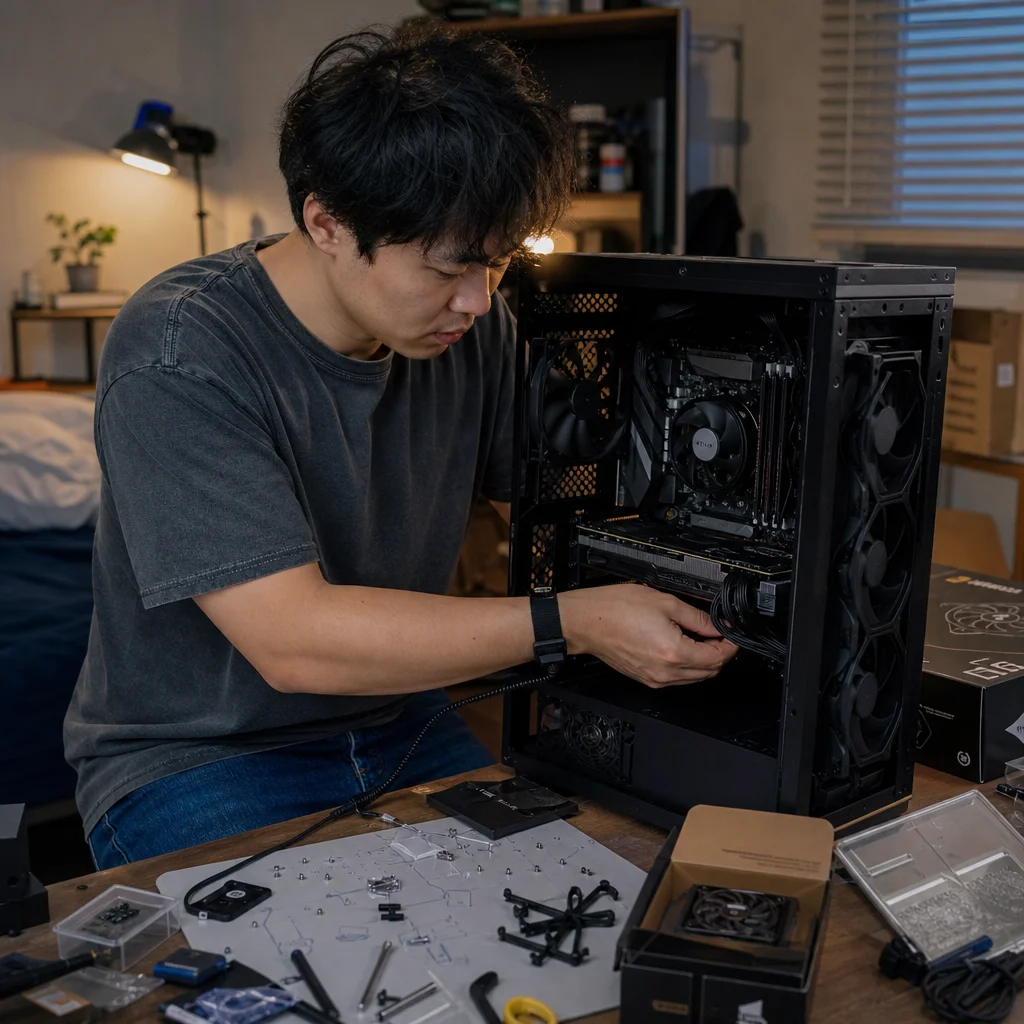
For a mainstream PC, the choice between air cooling and liquid cooling is rarely a simple contest between “better” and “worse.” Both can keep a modern processor within its intended operating range, but they make different demands on your case, budget, installation process, and tolerance for future maintenance.
Air cooling uses a metal heatsink and one or more fans mounted directly over the processor. Liquid cooling, usually in the form of a closed-loop or all-in-one (AIO) cooler, moves heat through a pump, tubing, and radiator before fans release it into the case. The important question isn't which technology sounds more advanced. It’s which set of trade-offs suits your particular system.
Start with the workload, not the cooler type
For ordinary gaming, a capable tower air cooler is often enough for a mainstream processor. Games commonly place a changing load on the CPU rather than sustaining every core at maximum power for long periods. A good air cooler can handle those bursts while remaining relatively simple and inexpensive.
Productivity workloads can change the decision. Video encoding, software compilation, 3D rendering, simulation, and other sustained multi-core tasks may keep the processor near its power and temperature limits for much longer. A larger air cooler can still work well, but a larger radiator may provide more thermal capacity or help the CPU maintain higher sustained boost clocks, depending on the processor and its power settings.
That last qualification matters. Cooling doesn’t automatically make a processor faster. It gives the processor more thermal headroom. The actual benefit depends on whether the CPU is temperature-limited, power-limited, or limited by the motherboard’s firmware settings. If the processor is already operating at its intended performance, an expensive cooler may produce little measurable improvement beyond lower temperatures or reduced fan noise.
How air and liquid cooling move heat
An air cooler transfers heat from the processor into a copper contact plate or heatpipes, then into a fin stack. A fan pushes air through the fins and toward an exhaust path in the case. The design is straightforward: fewer parts are involved, and the cooler’s performance is easy to understand from its size, fan configuration, and airflow direction.
An AIO cooler transfers heat into a cold plate, circulates coolant through a sealed loop, and disperses that heat through a radiator. The radiator can be mounted at the front, top, or occasionally another supported location in the case. This separates the processor’s heatsink from the main fin stack, which can improve access around the CPU socket and create a different airflow layout.
Neither approach makes heat disappear. The case still has to exhaust warm air, and both types rely on fans. A liquid cooler adds a pump and sealed tubing to the system; it doesn’t eliminate the need for airflow through the case.
Installation and compatibility differences
Air cooling is usually the simpler installation. You mount a backplate or bracket, apply thermal compound if the cooler doesn’t already have it, secure the heatsink, and connect the fan. The main complication is physical clearance. Large tower coolers can interfere with tall memory modules, motherboard heatsinks, or the side panel. Their weight also makes the motherboard area feel crowded during installation.
An AIO often leaves more open space immediately around the processor socket, but the installation is spread across more of the case. You must mount the pump block, position the radiator, route the tubes, and install the radiator fans. A radiator that fits by width may still conflict with the motherboard, memory, graphics card, or front-panel hardware. Tube orientation and pump placement also deserve attention rather than being treated as purely cosmetic details.
Case compatibility is therefore a different kind of problem for each option. An air cooler needs enough CPU-cooler height and clearance around the socket. An AIO needs a compatible radiator mount, sufficient radiator thickness clearance, and enough room for the pump and tubing. A compact case may support one approach much better than the other, even if both coolers are marketed for the same processor socket.
Confirm the fit before ordering: Check the case’s maximum CPU-cooler height, supported radiator sizes, radiator thickness limits, motherboard and memory clearance, and the cooler’s current socket hardware. Manufacturer specifications can change between revisions, so verify the exact case and cooler models rather than relying on a retailer’s abbreviated table.
Noise: the answer depends on the whole system
Liquid cooling is often assumed to be quieter, but that isn’t guaranteed. An AIO has radiator fans and a pump. At low loads, the pump may be audible even when the fans are nearly silent. Under sustained load, radiator fans may need to spin quickly because the radiator’s fins and airflow resistance are different from those of a large tower heatsink.
An air cooler has no pump, so its noise floor can be lower when the fan is stopped or running slowly. A large heatsink can also absorb short temperature spikes without immediately forcing the fan to accelerate. However, a small air cooler working near its limit may become louder than a larger AIO or a larger air cooler.
Your case fans, graphics card, motherboard fan curve, and room temperature often matter as much as the CPU cooler. A quiet cooler in a poorly ventilated case may produce more noise than a modest cooler in a well-arranged case. For a quiet system, look at the complete airflow plan: front or bottom intake, rear or top exhaust, sensible fan curves, and unobstructed filters.
Maintenance and failure modes
Air cooling has relatively little to maintain. Dust can collect on the heatsink and fan, and a fan can eventually wear out or fail. If the fan stops, the processor may reduce its speed or shut the system down to protect itself, assuming the motherboard and processor protections function as expected. Replacing the fan is usually straightforward, and the heatsink itself can remain usable for many years if its mounting hardware supports a future socket.
An AIO requires similar dust cleaning for its radiator and fans, but it also contains a pump and sealed fluid loop. The pump can wear out, stall, or become noisy. AIOs can also develop fluid loss or other failures over time, although a properly functioning sealed unit doesn’t require routine coolant refilling. A failed pump can cause temperatures to rise rapidly, particularly under sustained load.
Leak risk is the failure mode people remember most, but it shouldn’t be the only one considered. Modern sealed coolers are designed to prevent leaks, yet no mechanical product has zero failure risk. A pump failure is often more relevant to long-term reliability than the possibility of a leak. With air cooling, the usual failure is simpler: a fan becomes noisy or stops, and replacing that fan can restore the cooler.
Don't open or refill a sealed AIO unless the manufacturer explicitly designs it for that service. If an AIO shows signs of leakage, unusual pump noise, or rapidly abnormal temperatures, shut the system down and follow the manufacturer’s support and warranty process rather than continuing to test it under load.
Cost and value for mainstream systems
Air coolers generally offer more cooling hardware for the money because you’re paying for a heatsink and fan rather than a pump, radiator, tubing, and additional mounting parts. Their lower cost can be especially useful when the rest of the build still needs a stronger power supply, more storage, or a better graphics card.
AIO pricing spans a wide range. A basic model may be competitive with a large air cooler, while a larger radiator, quieter fans, display-equipped pump block, or premium design can add substantially to the price. Those features may be worthwhile for appearance, installation preferences, or a particularly demanding processor, but they don’t automatically improve a mainstream system’s gaming experience.
There’s also a replacement-cost difference. An air cooler may need only a new fan, and many models can be moved into a later build if compatible brackets are available. An AIO is generally replaced as a complete unit when its pump or loop reaches the end of its useful life. That doesn’t make liquid cooling poor value; it means the purchase should account for its service life and warranty terms, not just its initial temperature results.
Check the current support details: Before choosing an AIO, confirm the warranty length, what parts it covers, the process for handling a leak or pump failure, and whether replacement socket brackets are available. Prices, included mounting hardware, and warranty policies vary by region and product revision.
When liquid cooling has a meaningful advantage
Liquid cooling becomes easier to justify when the processor has high sustained power consumption, the case supports a large radiator with good airflow, or the build needs to keep the area around the CPU socket clear. It can also make sense when you prefer the appearance of a radiator and pump block, or when a particular case’s layout favors a front or top radiator over a large tower heatsink.
A larger radiator can provide more surface area than a compact air cooler, but radiator size alone doesn’t determine results. Fans, pump behavior, mounting pressure, thermal compound, case airflow, room temperature, and the processor’s power limits all contribute. A poorly positioned radiator can also warm the air available to another component or restrict intake airflow.
Liquid cooling may be useful for overclocking or aggressive power tuning, but those activities increase the importance of temperature monitoring and stable settings. If you aren’t planning to run sustained workloads or adjust power limits, the extra capacity may remain unused.
When air cooling is the more sensible choice
Choose air cooling when you want a straightforward build, low long-term complexity, and predictable maintenance. It’s particularly attractive for mainstream gaming PCs, office systems, general-purpose workstations, and upgrades where the case has limited radiator support. A well-sized tower cooler can provide strong performance without adding a pump or sealed fluid loop.
Air cooling is also a good fit when reliability and repairability matter more than a clean view around the socket. A fan is easy to monitor and replace, and a heatsink can continue working even if its fan briefly develops a problem, provided the system is shut down before overheating becomes severe. The processor’s built-in protections aren't a substitute for fixing the fault, but they reduce the chance that a single fan failure immediately destroys the CPU.
The main reasons not to choose air cooling are usually physical rather than thermal. A very large heatsink may block memory access, conflict with the side panel, or be awkward in a narrow case. Some compact builds also have better radiator mounting options than CPU-cooler height clearance.
Edge cases that can change the decision
A compact case deserves extra scrutiny. Some small cases are designed around low-profile air coolers, while others use a radiator as part of their intended layout. Don’t assume that “liquid” means smaller overall: the radiator and fans still occupy space, and the pump block may require tube routing that a compact chassis can't accommodate comfortably.
Memory with tall heat spreaders, motherboard-mounted M.2 heatsinks, and graphics cards near the top PCIe slot can all affect radiator placement. A top-mounted radiator may collide with the upper edge of the motherboard, while a front-mounted radiator may reduce graphics-card clearance or alter intake temperatures.
System orientation matters too. An AIO radiator should be installed in a position that avoids placing the pump as the highest point in the loop when the case layout allows another option. The goal is to keep air from collecting at the pump. Follow the cooler manufacturer’s installation guidance for the specific radiator position; there is no universal placement rule that fits every case.
For a workstation that must run unattended for long periods, the simpler failure profile of air cooling may be valuable. For a visible showcase build, liquid cooling may earn its place through appearance and layout even if its temperatures are only moderately better. Those are legitimate priorities, as long as you recognize them as priorities rather than assuming the most elaborate cooler is automatically the most effective one.
A practical decision
For most mainstream gaming and productivity PCs, start by selecting a cooler that is appropriately sized for the processor and compatible with the case. If a reasonably priced air cooler meets those requirements, it is usually the sensible default: simple to install, easy to maintain, and less dependent on a pump that can fail.
Consider an AIO when sustained CPU workloads, case layout, socket clearance, noise goals, or appearance give it a clear purpose. Check the complete fitment diagram, not just the listed radiator size, and account for warranty support and eventual replacement. Whichever approach you choose, pair it with sensible case airflow, a controlled fan curve, and temperature testing under the workloads you actually use.
The best mainstream cooling choice is the one that keeps the processor within its intended limits without adding unnecessary cost or complexity. Air cooling usually wins that calculation; liquid cooling becomes the better answer when its capacity or layout advantages solve a specific problem in your build.