Choose a Power Supply Cable Set Without Mixing Incompatible Cables
I’ll show you how to identify modular PSU cable families, label spare leads, and compare replacement options so you don’t assume matching connector shapes mean compatibility. The goal is to avoid damaged hardware while choosing a sensible cable set for your build.
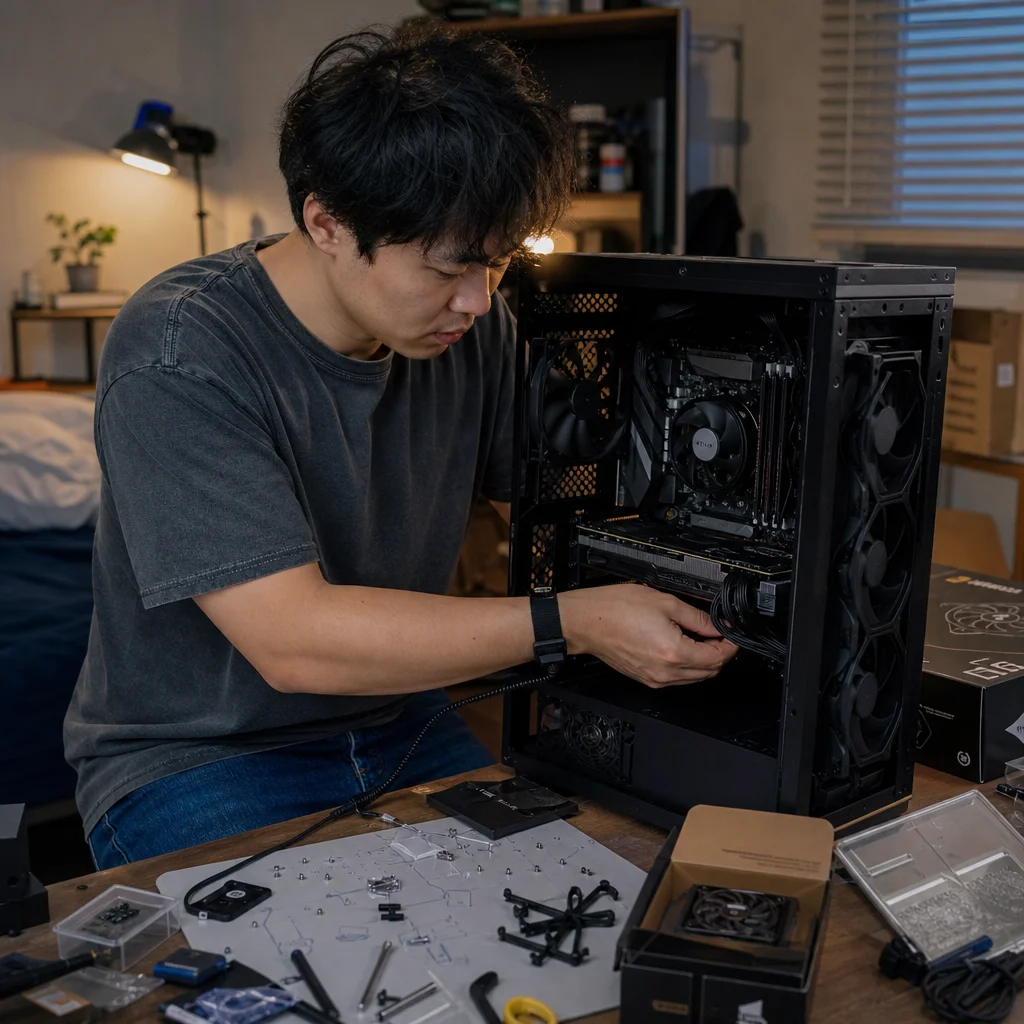
A modular power supply makes cable management easier, but it also creates a mistake that can damage components: treating a spare modular cable as a universal replacement. The connector at the power supply may fit even when its pinout—the arrangement of electrical contacts—is different. A cable can slide into place and still send power where it doesn’t belong.
The safest approach is to treat every modular cable as part of a specific power supply family unless the manufacturer explicitly confirms otherwise. That rule matters whether you’re reusing cables from an older build, buying sleeved replacements, or combining a new PSU with a cable kit you already own.
Start with the PSU, not the connector
The power supply is the source of the cable’s compatibility requirements. Before choosing a cable set, record the exact manufacturer, model, wattage, and revision of your PSU. The model name printed on the side may not be enough if a product has several generations or regional variants.
Look for the label on the PSU itself, the original box, and the manufacturer’s product page or support documentation. A model family can include units with similar names but different modular sockets and pin assignments. Even two units from the same brand aren’t automatically compatible, and the wattage rating doesn't determine cable compatibility.
This is why the phrase “it fits my power supply” isn’t a useful test by itself. Modular PSU-side connectors aren't governed by one universal pinout. Manufacturers may use different wiring arrangements for the same broad cable type, and some product lines change their wiring between revisions.
Confirm your exact PSU family: Before ordering replacement cables, check the manufacturer’s compatibility chart for the precise model and revision. If the documentation is unclear, ask the cable manufacturer or PSU maker rather than relying on connector shape, wattage, or brand name alone.
Understand the main cable families
Most desktop builds use a small group of cable types. Knowing what each one powers helps you identify a loose lead, but it doesn’t make a cable interchangeable with another type.
The 24-pin ATX cable connects the PSU to the motherboard’s main power socket. It usually has a large motherboard-side connector and one or more PSU-side connectors on modular supplies. Because it carries several voltage rails and control signals, its wiring must match the specific PSU design.
The CPU or EPS cable powers the processor through a four- or eight-pin socket near the top of the motherboard. A full eight-pin EPS connector may be labeled CPU, EPS, or CPU_PWR. Some cables split into a 4+4 plug so they can fit boards with either four- or eight-pin CPU power sockets.
The PCIe cable powers graphics cards and some expansion hardware. It commonly ends in a 6+2 connector, which can be used as a six-pin or eight-pin PCIe plug. PCIe and EPS connectors can look deceptively similar at the PSU end, but their wiring and intended loads differ. Never use a CPU/EPS cable for a graphics card or a PCIe cable for the motherboard’s CPU power socket unless the PSU manufacturer specifically designed and labeled the cable for both uses.
SATA power cables supply storage drives, fan hubs, lighting controllers, and other accessories. Peripheral or Molex cables use older four-pin connectors and may still be needed for pumps, fan controllers, or legacy hardware. These cables often have multiple device-side plugs, but the PSU-side wiring remains specific to the power supply.
Newer graphics cards may use a 12VHPWR or 12V-2x6 cable, sometimes called a 16-pin high-power cable. These connectors have particular insertion, bending, and seating requirements. Whether you use a native cable from the PSU or an adapter supplied with the graphics card, follow the instructions for that exact hardware rather than treating the connector as just another PCIe plug.
Why matching shapes can be dangerous
A connector’s plastic housing only tells you that the physical interface may accept it. It doesn’t tell you which pins carry ground, 12-volt power, sensing signals, or other connections. Two cables can have compatible-looking ends while routing those functions differently.
If the wrong cable sends voltage to a pin intended for ground or a signal, the result can range from a failed boot to damaged drives, a graphics card, a motherboard, or the power supply itself. The danger isn’t limited to cheap or poorly made cables; a correctly manufactured cable for one PSU can be the wrong cable for another.
The same warning applies to cables from the same manufacturer. Brands often source units from multiple original equipment manufacturers, and a company’s cable compatibility can vary by series. A replacement set advertised for “Brand X” without a detailed model list deserves caution.
Cable extensions are a different category. An extension connects to the component-side end of your original PSU cable and generally doesn’t change the PSU-side pinout. That can make an extension simpler to match, but it still needs to be correctly wired, properly rated, and fully seated. An extension isn't the same as a replacement cable that plugs directly into the modular PSU.
Compare your options before buying
You’ll usually choose among original replacement cables, a third-party cable kit, an extension set, or the cables included with another PSU. Each option has a different balance of convenience, appearance, cost, and risk.
Original or manufacturer-approved cables are usually the easiest choice when they’re available for your exact PSU. They may cost more or be less visually customizable, but the compatibility question is clearer. Check whether the manufacturer sells cables for a model family or only for a particular series; don’t infer compatibility from the brand logo alone.
Third-party replacement sets can offer better sleeving, shorter lengths, combs, and more connector choices. Their main requirement is exact matching. Use the seller’s compatibility list and confirm that it includes your PSU model, not merely the manufacturer. A reputable cable maker should provide enough information to distinguish direct replacement cables from extensions and should identify any model-specific limitations.
Extensions can be useful when your existing cables are compatible but too short, too stiff, or unattractive. They add another connection and more cable length, so plan the routing carefully. Avoid hiding unnecessary slack behind a tight side panel, and make sure the original modular cable remains connected to the PSU.
Cables from another PSU are the riskiest option because they’re easy to mistake for a compatible spare. Don’t use them just because both power supplies have the same wattage, use the same brand, or came from the same product line. Keep them in a labeled bag with the PSU they belong to, or dispose of them if you can no longer identify them.
Build a simple identification system
When you unpack a modular PSU, label the cables before they get mixed into a parts box. A small tag can identify the PSU model and cable type: for example, “RM850x CPU,” “PCIe,” or “SATA.” Keep the original manual and cable diagram with the set.
If you’re sorting an existing collection, separate cables by known PSU first, then by function. Don’t try to identify an unknown cable solely from its appearance. The component-side plug may reveal whether it’s intended for CPU, PCIe, SATA, or peripheral power, but it may not reveal the correct modular-side pinout.
Photographs can help preserve your records. Take a picture of the PSU label, the modular socket labels, and the cable ends before putting everything away. If a cable has model-specific markings, record those too. This takes less time than trying to reconstruct the cable’s origin after several upgrades.
Avoid cutting, repinning, or combining modular cables unless you have the technical knowledge, tools, and verified pinout information to do it safely. A cable that looks tidy after modification can still have a wiring error hidden inside the connector. For most builders, buying a correctly specified cable is the more sensible trade-off.
Install and inspect the set carefully
With the compatible cables identified, connect only the leads your build needs. Start at the PSU and component ends without forcing any plug. Many connectors are keyed, but a keyed connector can still be inserted incompletely or damaged by excessive pressure.
The 24-pin motherboard connection may require firm, even pressure because its latch can be tight. CPU and PCIe plugs should click into place, and the latch should align with the corresponding tab. For SATA power, avoid bending the connector sharply at the drive. Route cables so that the side panel doesn’t press hard against connectors or put sideways tension on them.
For high-power graphics cards using a 16-pin connector, insert the plug completely until it is fully seated. Follow the PSU and graphics-card guidance for bend radius and cable routing, and don’t force a sharp bend immediately at the connector. If an adapter is supplied, use every required plug and connect each one to a separate, appropriate PSU cable when the instructions call for that arrangement.
Before switching on the system, compare each connection with the motherboard, graphics-card, drive, and PSU documentation. Check that no modular socket has been left with a loose half-inserted plug and that unused cables aren't being used as substitutes for missing ones. If the system fails to start after a cable change, turn it off and disconnect AC power before investigating; don’t repeatedly test a setup that may be wired incorrectly.
The safest decision is the traceable one
Choosing a cable set is less about finding a connector that fits and more about preserving a known electrical path from your exact PSU to each component. Original cables provide the simplest traceability, third-party sets can be a good option when their compatibility list is precise, and extensions are useful when you want to keep the original PSU-side connections.
For your next build or upgrade, write the PSU model on every spare-cable bag and keep replacement cables separate from other hardware. Verify the cable family before connecting it, especially when working with EPS, PCIe, or high-power graphics-card cables. If you can’t establish where a modular cable came from and which PSU it supports, leaving it unused is cheaper than finding out after a component stops working.