How to Choose a Power Supply Without Guessing at Wattage
When a parts list shows several possible wattage recommendations, I’ll help you estimate real system demand, allow sensible headroom, check the right connectors, and judge PSU quality without treating the number on the label as the whole decision.
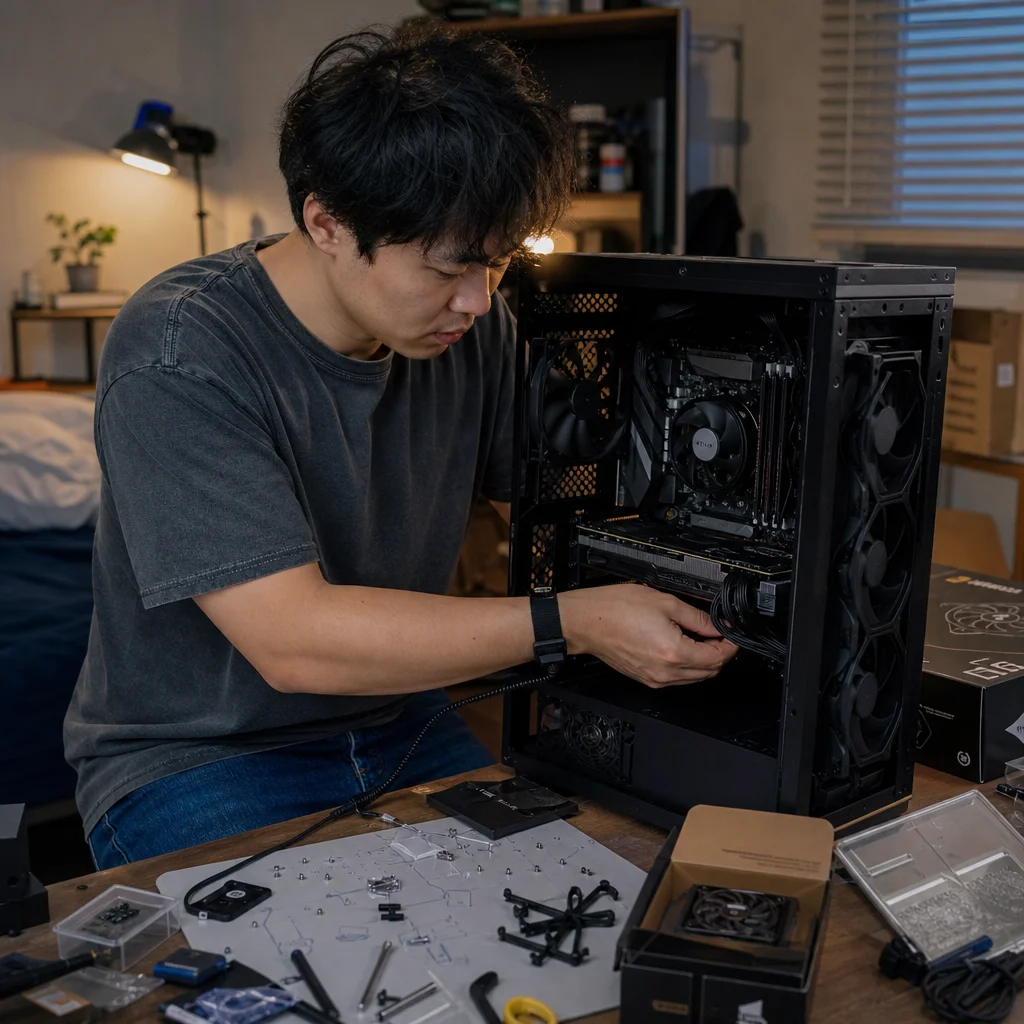
Choosing a power supply can feel like a guessing game. A graphics card may list one recommendation, a processor may have several power limits, and online calculators may produce different totals for the same parts. The safe answer isn’t simply “buy the biggest PSU you can afford.” It’s to estimate demand, account for short power spikes, confirm connections, and choose a unit with credible protection and build quality.
Start with the parts that matter most
The graphics card and processor usually determine most of a system’s power requirement. Begin with their published board power, total graphics power, or processor power figures, depending on the terminology used by the manufacturer. These figures aren’t always directly comparable, but they give you a useful starting point.
For the graphics card, look for the typical board power and the manufacturer’s recommended power supply rating. The recommendation often includes allowance for a broad range of processors and less efficient systems, so it shouldn’t automatically be treated as the card’s own consumption. For the processor, look beyond the marketing name and check its actual power limits or platform requirements. Some CPUs can draw considerably more than their nominal thermal design power when motherboard settings allow extended boost behavior.
Add the other components rather than ignoring them. A motherboard, memory, storage drives, case fans, USB devices, pumps, and expansion cards all consume power. They usually contribute much less than a modern graphics card, but a high-end workstation with several drives or add-in cards can make the smaller numbers relevant.
A simple first estimate looks like this:
Graphics card maximum or typical board power + processor sustained power + the rest of the system + headroom
You don’t need laboratory precision. You need a reasonable estimate that won’t leave the supply operating at its limit during demanding work.
Use wattage estimates as a range, not a magic number
Suppose your graphics card is expected to use 300 watts under a demanding load, your processor can draw 150 watts, and the rest of the system may use roughly 75 watts. That gives you an estimated component demand of 525 watts. A 650-watt unit might run the system, but it leaves less room for transient spikes, component changes, overclocking, or additional drives. A quality 750-watt model gives you a more comfortable margin without requiring an unnecessarily large purchase.
For many mainstream systems, adding roughly 20–30 percent to a sensible maximum-load estimate is a reasonable starting point. Systems with powerful graphics cards, aggressive processor power settings, substantial overclocking, or known transient behavior may deserve more room. The right margin depends on the parts and the quality of the supply, not on a universal percentage that applies to every build.
Headroom serves several purposes. It helps the PSU handle short bursts of demand, leaves capacity for additional storage or fans, and avoids running continuously at its upper limit. It can also give you flexibility if you replace the graphics card later. On the other hand, excessive capacity doesn’t automatically improve safety or efficiency. A very large supply can cost more, may operate farther from its most efficient range during light use, and can be a poor value if the rest of the unit is mediocre.
Your goal is enough capacity for the intended system, plus a deliberate margin. You’re not trying to predict the exact number of watts the computer will draw every second.
Understand what the label does and doesn’t tell you
A PSU’s headline wattage is its maximum rated output under specified conditions. It doesn’t tell you how well the unit handles heat, voltage regulation, protection events, or sudden changes in load. Two 750-watt supplies can have very different electrical designs and reliability records.
Check whether most of the rated capacity is available on the 12-volt rail. Modern processors and graphics cards draw the majority of their power from 12 V, and a unit with an unusually low 12-volt rating may not be a good match despite its total wattage. Reputable manufacturers normally publish a clear output table on the label or product page.
Efficiency certification is useful, but it has limits. An efficiency level such as 80 PLUS describes how much input power is converted into output power at particular loads and conditions. It doesn’t certify every aspect of the design and isn’t a substitute for independent testing. A high-efficiency label can coexist with poor voltage behavior, limited protections, or an unsuitable platform.
Look for evidence about the unit’s electrical performance, including voltage regulation, ripple, hold-up behavior, fan operation, and performance under changing loads. Independent reviews that test the exact model are much more useful than reviews of a different product from the same brand. Product families can contain several platforms with different internal designs.
Useful protection features commonly include over-voltage protection, under-voltage protection, over-current protection, over-power protection, short-circuit protection, and over-temperature protection. Their names alone aren’t proof that a supply performs well, but a reputable model should document appropriate protections and be supported by credible testing.
Check connectors before you buy
A PSU can have enough wattage and still be incompatible with your build. Compare the supply’s included connectors with the motherboard, graphics card, storage devices, and accessories you plan to install.
The motherboard generally needs its main 24-pin connection and a CPU power connection near the processor socket. Some boards include additional CPU power sockets. Those extra connections may be useful for certain high-power processors or overclocking, while others are optional for ordinary operation; consult the motherboard manual rather than assuming every socket must be filled.
Graphics cards may use one or more traditional PCIe power connectors or a newer high-power connector. Don’t assume that an adapter is automatically the best solution. If the graphics card supports a newer connector, a PSU with the appropriate native cable can provide a cleaner installation and reduce reliance on adapter arrangements. Make sure the cable is fully inserted and follows the graphics card and PSU manufacturer’s routing guidance.
Modular cables deserve special care. “Modular” doesn’t mean cables are interchangeable between brands, or even between product families from the same brand. The PSU-side wiring can use different pinouts. Use only the cables supplied for that exact PSU model unless the manufacturer explicitly confirms compatibility. Reusing a modular cable from an old supply can damage drives, the motherboard, or the graphics card.
Also consider physical details. Confirm that the PSU fits the case’s form factor and length limits, and check whether the included cables are long enough to reach the motherboard and graphics card without awkward tension. A unit that technically fits but leaves the main power cable stretched across the case isn't a good practical choice.
Check the current connector guidance
Before ordering, compare the exact graphics-card connector requirement with the exact PSU product page and manuals. Connector standards, included cables, and manufacturer recommendations can change between product revisions, so verify the model-specific information rather than relying on an older shopping list.
Decide how much headroom your build really needs
A modest gaming PC with a midrange graphics card and a mainstream processor usually doesn’t need the same capacity as a system built around a power-hungry flagship card. Start with the actual parts you’re buying, not an imagined future system. If a future upgrade is likely, estimate the likely replacement card’s demand and connector needs; otherwise, buying substantially more capacity now may waste money.
Consider how the computer will be used. A gaming system may experience heavy but intermittent graphics loads. A workstation rendering, compiling, simulating, or processing video for long periods may place sustained demand on both the processor and graphics card. A system that runs close to its estimated maximum for hours benefits from a generous, well-tested supply and good case airflow.
Overclocking and unrestricted motherboard power settings change the calculation. If you intend to tune the processor or graphics card, use the higher possible power figures rather than the default specifications. If you’re building for simplicity and reliability, leaving those settings at sensible defaults makes PSU sizing easier and reduces heat as well as power demand.
A power-supply calculator can be a useful second opinion, especially when it accounts for specific graphics cards, processors, drives, and fans. Treat its result as an estimate, not an authority. Compare it with the manufacturers’ recommendations and the power figures from reputable hardware testing. A calculator that asks for every fan but ignores a graphics card’s transient behavior isn’t giving you the whole picture.
Avoid the cheapest path to a high number
A suspiciously cheap high-wattage unit isn't a bargain if its ratings, protections, or internal design are unclear. Look for a clear model name, complete specifications, a traceable warranty, and independent testing of that exact unit. Be cautious when a listing emphasizes a dramatic wattage number but provides little information about the 12-volt output, connectors, protections, or operating conditions.
A longer warranty can be a helpful signal of the manufacturer’s confidence, but it isn’t a guarantee of excellent performance. Likewise, a familiar brand name doesn’t make every model equally good. Judge the specific unit and platform.
When comparing two suitable supplies, prioritize a proven design, appropriate connectors, reasonable acoustic behavior, and enough capacity over a flashy efficiency badge or an oversized wattage rating. Spending slightly more on a dependable PSU can be sensible because it is connected to every other component in the computer, but you still don’t need to buy the most expensive model available.
Make the choice deliberately
Write down the graphics card’s expected demand, the processor’s realistic maximum, and a reasonable allowance for the rest of the system. Add headroom based on the load pattern and any planned tuning, then choose a reputable PSU whose 12-volt output, connectors, physical size, and protections match the build.
Before installing it, confirm the model and cables one more time. Connect the motherboard and CPU power leads securely, route graphics power cables without sharp strain, and never open the PSU enclosure; internal components can retain dangerous electrical charge. If the resulting choice has a sensible margin and credible testing behind it, you’ve done the important work. The number on the label is only the starting point, not the decision itself.