What Motherboard Features Still Matter After You Ignore Overclocking
When overclocking is off the table, a motherboard still determines compatibility, connectivity, recovery options, and upgrade room. I’ll help you separate features that reduce real ownership problems from specifications that mostly add cost for a beginner or intermediate build.
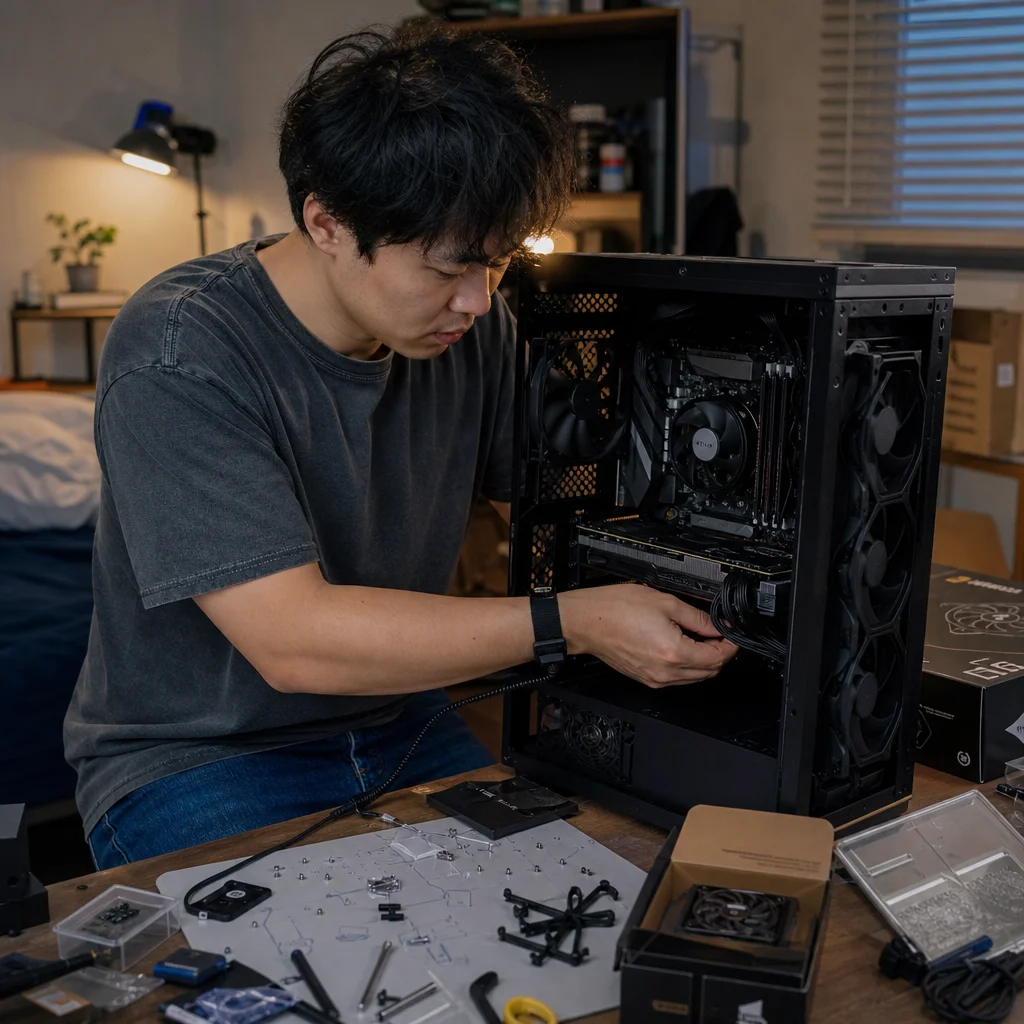
Choosing a motherboard without overclocking can seem simple: find the right socket, select a reasonable chipset, and avoid paying for oversized power delivery. That approach is better than shopping by premium branding, but it misses several features that affect whether the finished PC is easy to assemble, diagnose, expand, and live with.
You don’t need every enthusiast feature. You do need the features that protect you from compatibility mistakes, awkward upgrades, difficult troubleshooting, and inconvenient limitations. The best value is usually found in a board with appropriate support and useful connections—not necessarily the one with the most elaborate heatsinks or the longest specification list.
Start with compatibility, not the feature list
The motherboard must support your processor generation, memory type, storage devices, and case dimensions. Socket compatibility alone isn’t enough: processors using the same socket may require a particular chipset, firmware version, or power-delivery capability. Likewise, a board designed for DDR5 memory won’t accept DDR4 modules, even if the processor platform offers both memory options across different boards.
Check the manufacturer’s CPU support list and the board’s memory support information before buying. Pay attention to the exact processor model, not just the processor family. A board may support a chip only after a firmware update, and some firmware updates may require an already-supported processor unless the board includes a recovery feature.
Confirm your platform before ordering: Compare the motherboard’s CPU support list, required firmware version, memory type, and physical form factor with the exact parts you plan to use. These details change across sockets and product revisions, so rely on the current manufacturer documentation rather than a retailer’s short summary.
A sensible board also matches your case and power supply plan. ATX, microATX, and Mini-ITX boards differ in expansion slots, connector placement, and available headers. A compact board can work perfectly well in a larger case, but it may leave you with fewer expansion options. A large board may not fit a compact case at all, even when the socket and processor are correct.
Power delivery still matters at stock settings
Ignoring overclocking doesn’t make the motherboard’s voltage regulation irrelevant. The processor still needs stable power, and the board’s power circuitry must handle the processor’s normal boost behavior and sustained workloads. This matters particularly for higher-power desktop CPUs, which can draw substantially more power than an entry-level chip even when you never change a frequency setting.
You don’t need to judge a board solely by the number of VRM phases or the size of its heatsinks. Those specifications are difficult to compare consistently between manufacturers. Look instead for credible testing, a suitable CPU support list, adequate VRM cooling, and a board that isn’t positioned as a low-cost match for a processor known to run hot under prolonged loads.
For a modest processor, an inexpensive mainstream board is often sufficient. For a high-core-count processor used for rendering, compiling, or other sustained work, a stronger board can reduce heat and power-delivery concerns even at default settings. The goal is reliability under the workload you’ll actually run, not an elaborate board that exists mainly to support extreme tuning.
The main CPU power connector is worth checking as well. Make sure your power supply has the required connector, and route it before installing a large air cooler if access will be difficult. A board can have excellent specifications and still be frustrating to assemble if its connectors are blocked by the case or cooler.
Firmware recovery is one of the most valuable safety features
A motherboard with a firmware recovery or flashback function can be easier to rescue when a firmware update fails or when the board ships with a version that doesn’t support your processor. The exact name varies by manufacturer. Some implementations let you update from a USB drive without installing a processor or memory, while others require a working system or use a different recovery process.
This feature doesn’t eliminate risk. You still need the correct firmware file, the correct USB port, and the manufacturer’s stated naming and formatting procedure. Interrupting power during an update can create problems. However, a dedicated recovery method gives you a much better path forward than a board that can only be updated after it successfully boots with a compatible CPU.
Diagnostic features help after the system is assembled. A two-digit debug display can identify broad startup stages, while small status LEDs may indicate a CPU, memory, graphics, or boot-device problem. These indicators don’t replace testing, and their codes vary by model, but they can quickly tell you where to start instead of leaving you with a completely blank screen.
For a first build, firmware flashback and useful diagnostics may be more valuable than decorative lighting, premium audio branding, or an extra group of rear USB ports. They reduce the consequences of an otherwise ordinary compatibility or assembly mistake.
Expansion slots and PCIe layout determine upgrade flexibility
Look beyond the number of slots. Their physical size, generation, spacing, and electrical connection all matter. A full-length PCIe slot may operate at fewer lanes than its appearance suggests, and installing a large graphics card can cover neighboring slots or block access to a small expansion card.
Consider what you might add later: a capture card, sound card, high-speed network adapter, storage controller, or additional graphics hardware. Most users need only one graphics slot, but the second slot can still be useful for an expansion card if it remains accessible and has an appropriate connection.
The primary graphics slot should have a direct and suitable connection to the processor on the platform. Additional slots may share bandwidth with M.2 sockets or other devices. Sharing isn’t automatically a problem; it becomes a problem when a storage or expansion choice disables a connector you expected to use. The motherboard manual’s lane-sharing table is often more informative than the product page.
Physical clearance matters as much as electrical capability. Check the thickness of your graphics card, the position of M.2 heatsinks, and whether installing a second card would obstruct airflow. A feature that can't be used alongside your main components isn't meaningful expansion room.
M.2 storage is convenient, but the layout deserves attention
At least one suitable M.2 slot is useful for a modern system drive. Additional slots can simplify future upgrades and reduce the need for cables, but they may share lanes with SATA ports or expansion slots. Some slots also support only a particular drive size or interface, so confirm whether each one accepts the NVMe drive you intend to install.
M.2 heatsinks can help manage temperatures, especially for fast drives under sustained transfers, but they aren’t automatically necessary for every system. More important is whether the heatsink can be removed easily, whether its thermal pad has protective film that must be removed, and whether it interferes with a drive’s own heatsink. An incorrectly installed pad can be less useful than no extra cover at all.
If you plan to reuse older SATA drives, count the SATA ports and check whether any are disabled when particular M.2 slots are occupied. This is a common example of a specification that looks generous until the board’s connection rules are applied to the actual build.
Rear I/O should match the devices you use
USB quantity is less important than USB variety, placement, and speed. Count the ports you’ll use for a keyboard, mouse, headset receiver, external storage, printer, controller, and occasional troubleshooting devices. A front-panel USB-C port is useful only if the motherboard has the appropriate internal header and the case includes the matching cable.
The names used for USB speeds have changed over time and can be confusing. If a fast external drive matters to you, compare the stated transfer rate and connector type rather than assuming that every USB-C port has the same capability. A USB-C connector describes the shape, not necessarily the speed, power delivery, or display support.
Video outputs on the motherboard work only when the installed processor provides integrated graphics, and even then they may have limitations. They can be useful for troubleshooting or for a system that doesn’t use a separate graphics card. If you’ll install a dedicated GPU, they’re less important for everyday display output but can still provide another diagnostic option.
Network connectivity should also fit your environment. Wired Ethernet is valuable for a stationary desktop, while built-in Wi-Fi avoids the need for an add-in card or USB adapter. If a board includes Wi-Fi, check whether its antenna is included and whether the wireless standard and Bluetooth support suit your router and peripherals. Wireless capabilities and networking features vary by exact board model, not just by chipset family.
Audio quality is usually adequate on mainstream boards for ordinary speakers and headphones. Pay closer attention if you use high-impedance headphones, analog recording equipment, or several powered audio devices. In those cases, the codec, output arrangement, and electrical isolation may matter more than a marketing label.
Internal headers affect assembly and everyday convenience
A motherboard can have excellent rear-panel connections and still be inconvenient if it lacks the internal headers your case requires. Check for front-panel USB-A and USB-C headers, front audio, fan headers, pump headers if you need one, and appropriate lighting headers only if you plan to use them.
Fan headers are especially practical. Confirm that you have enough for the case fans and CPU cooler, or plan to use a splitter or hub rated for the combined load. A board with fan-control options can keep a system quieter by adjusting behavior based on temperature rather than running every fan at a fixed speed.
Connector location matters too. Headers along the board’s edges are generally easier to route than connectors trapped beneath a graphics card or beside a large CPU cooler. This isn't a headline feature, but it can make the difference between a tidy installation and a cable-routing session that tests your vocabulary.
Memory support is more than the advertised maximum
The board needs the correct memory generation, but capacity and layout are also important. Two memory modules are often easier to run at their rated settings than four, although the result depends on the processor’s memory controller, the modules, and the motherboard firmware. If you expect to add memory later, choose a board with enough slots and buy a capacity plan that won’t make an upgrade unnecessarily awkward.
Memory speeds listed on a product page may describe profiles that require enabling a firmware setting such as XMP or EXPO, depending on the platform. Those profiles aren't guaranteed to work identically on every processor and board combination. A stable system at a slightly lower speed is generally preferable to a system that needs repeated troubleshooting for a small benchmark difference.
Use the motherboard’s qualified memory list as a useful reference, not an absolute list of compatible modules. It can't cover every kit, but it can reduce uncertainty when you’re choosing higher-capacity or faster memory.
Features that are often optional
Several motherboard features can be nice without being essential. Extra lighting headers, elaborate onboard buttons, bundled accessories, premium audio sections, and multiple reinforced slots may be worthwhile if they solve a specific problem in your build. They shouldn’t be treated as proof that the board is more reliable for a normal stock-speed system.
Likewise, an unusually large number of PCIe lanes, multiple high-speed network ports, or several top-tier M.2 slots may be wasted if you’ll install one graphics card, one or two drives, and ordinary peripherals. Paying for unused capability can take money away from a better power supply, more storage, a quieter cooler, or a larger memory capacity—parts that may improve the experience more directly.
The useful question isn't whether a board is feature-rich. It’s whether its features remain available together in the configuration you intend to build, and whether they reduce a real limitation or risk.
Make the decision around ownership, not the product page
For a non-overclocked build, prioritize confirmed CPU and memory support, suitable power delivery for the processor, firmware recovery, diagnostic aids, the right storage and expansion layout, and the connections you’ll actually use. Then check the physical details: case compatibility, graphics-card clearance, M.2 placement, fan headers, and cable access.
Before buying, download the current manual if one is available. Read the block diagrams and lane-sharing notes, not just the feature summary. Confirm firmware procedures from the manufacturer’s support page, particularly if you’re pairing a newly released processor with an older board. Product names and chipset descriptions can remain similar while the practical details differ between revisions.
Once those requirements are satisfied, choose the less expensive board that still gives you the recovery options and expansion room you value. With overclocking removed from the decision, a motherboard’s best features are often the quiet ones: it supports the parts correctly, makes mistakes easier to diagnose, provides sensible connections, and leaves you a straightforward path when the system needs an upgrade or repair.