When You Need an ESD Mat, and When You Mainly Need Better Habits
I’ll explain when an ESD mat meaningfully reduces risk during a PC build, when careful handling is enough, and which everyday habits protect components better than buying another piece of equipment.
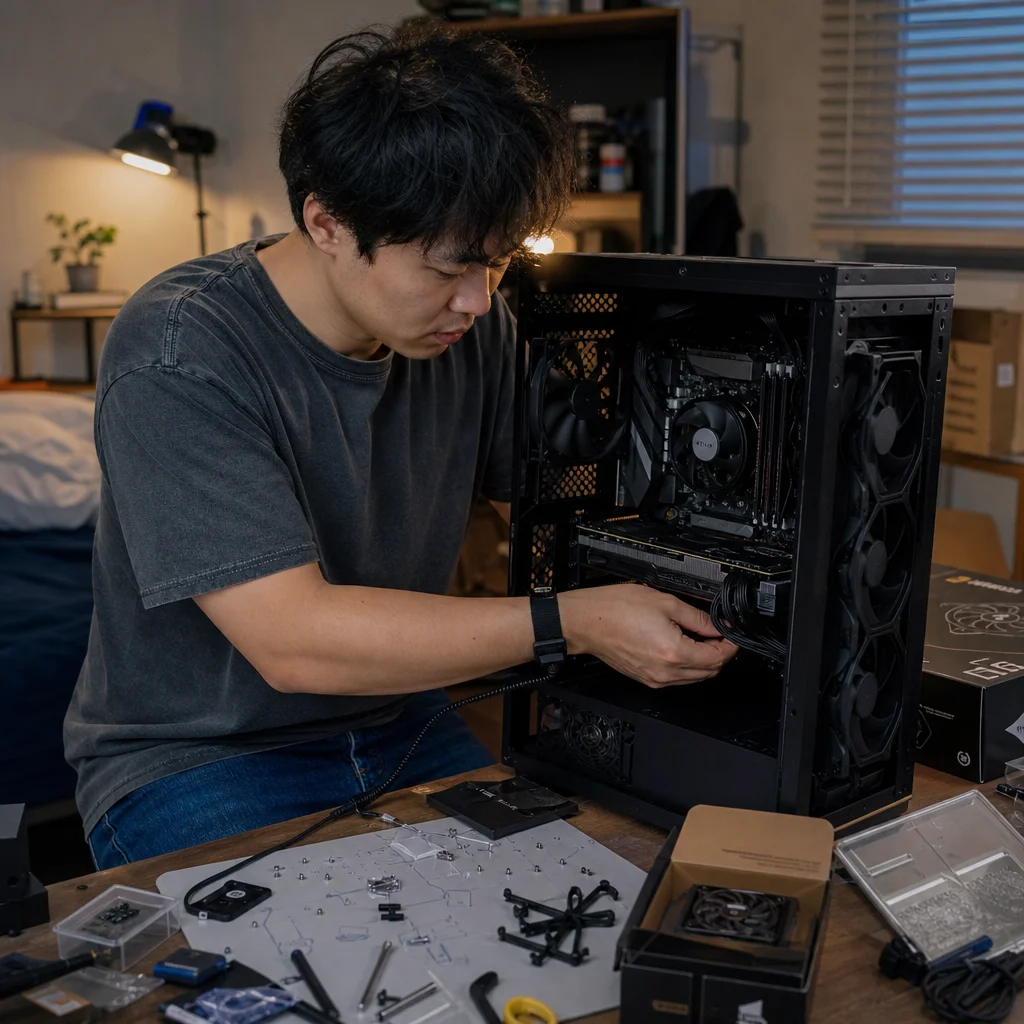
Electrostatic discharge is easy to overthink when you’re building your first PC. You may picture a tiny spark destroying an expensive processor or graphics card, then wonder whether you need a special mat, wrist strap, grounding cord, and carefully controlled workspace before opening a box.
The risk is real, but the solution usually starts with behavior rather than equipment. A clean, stable work surface, sensible clothing, and a habit of touching grounded metal before handling parts will prevent many avoidable problems. An ESD mat becomes more useful when your workspace, flooring, clothing, climate, or repair routine makes those habits difficult to maintain consistently.
What ESD protection is trying to prevent
Electrostatic discharge happens when electrical charge moves suddenly between objects at different electrical potentials. Walking across a carpet, removing a fleece jacket, or sliding a plastic package across a table can leave your body or a component charged. Touching a circuit board can then release that charge through a small part of the electronics.
You mightn't feel or see the discharge. A spark that is obvious to you is already relatively large; smaller discharges can still stress sensitive components. Some damage is immediate, while other damage may reduce long-term reliability without producing an obvious failure during the build. That uncertainty is why manufacturers and experienced technicians treat static control seriously.
An ESD mat doesn't make a workspace magically safe. Its purpose is to provide a controlled, slightly conductive surface that lets charge dissipate gradually instead of building up and discharging through a component. A wrist strap serves a related purpose by keeping your body at roughly the same electrical potential as the work surface and hardware.
The goal isn't to eliminate every electrical charge in the room. It is to avoid a sudden difference in charge between you and the part you’re touching.
When better habits are usually enough
For a one-time desktop build in a normal home, you can often work safely without buying an ESD mat. This is especially true if you have a hard, non-carpeted floor, a sturdy table, ordinary cotton clothing, and enough room to place components flat without dragging them around.
Start by choosing the workspace deliberately. A wooden or laminate table is generally more suitable than a bed, sofa, or carpeted floor. Keep pets, drinks, loose screws, and packing materials away from the area. Remove watches, bracelets, and other objects that could scratch a board or catch on a connector. You don’t need a laboratory; you need a predictable surface where parts won’t slide into fabric or disappear under clutter.
Before picking up a motherboard, memory module, expansion card, or other exposed circuit board, touch an unpainted metal part of the computer case. Repeat that contact whenever you’ve moved around or changed clothing. Hold boards by their edges and avoid the gold contacts, pins, and exposed chips. These habits reduce both static risk and ordinary handling damage.
Leave components in their antistatic bags until you’re ready to install them. When you remove a board, place it on the bag’s outside only if the packaging is intended for that use and the surface is stable; otherwise, use the motherboard’s box or another suitable nonconductive, clean surface. Don’t put bare components directly on carpet, clothing, or the outside of random plastic packaging.
These precautions are simple, but consistency matters more than performing one elaborate grounding ritual at the beginning. A mat won’t help much if you continue to shuffle across carpet, handle boards by their contacts, or pile parts on a blanket.
When an ESD mat is a worthwhile upgrade
An ESD mat is most useful when it solves a specific problem in your workspace rather than serving as a symbol of caution. Consider one if you regularly work on computers, repair several systems, or want a repeatable setup where the surface itself helps control charge.
It can also be worthwhile when your environment makes ordinary habits unreliable. Carpeted floors, very dry indoor air, synthetic clothing, plastic tables, and frequent movement all increase the chance of charge building up. These conditions don’t guarantee that a component will be damaged, but they make a controlled workstation more valuable.
A mat is particularly helpful when you’re handling a bare motherboard for an extended period, installing or removing multiple expansion cards, working with memory and storage outside the case, or diagnosing hardware across several sessions. It gives you a defined place to put parts and reduces the temptation to use a bed, chair, or packaging pile as a workbench.
If you already have a good table and careful habits, the mat is a convenience and an additional layer of control—not a requirement for a successful build. If you’re setting up a repair bench, however, the cost and space may be justified by repeatability. The more often you work on sensitive electronics, the more useful it is to make the safe behavior automatic.
Check your grounding method before connecting anything: If you use an ESD mat or wrist strap, follow the mat manufacturer’s instructions and confirm that the grounding point is suitable for your country and electrical setup. Never work on powered equipment, and don’t assume an outlet is correctly grounded simply because it accepts a plug.
The difference between a mat and a work surface
Not every dark rubber-looking mat is an ESD mat. A proper ESD work mat is designed to dissipate charge in a controlled way and normally connects to ground through a grounding cord. Some products are marketed as antistatic, but that label alone doesn’t tell you how the material behaves, whether it has a reliable grounding connection, or whether it is intended for electronics assembly.
A mat also needs to be used correctly. It should lie flat, stay clean and undamaged, and be connected as specified by its manufacturer. A torn, heavily contaminated, or incorrectly grounded mat may provide less protection than expected. Don’t cover it with a towel, plastic sheet, or ordinary desk mat; doing so can defeat the part of the system that is meant to dissipate charge.
The grounding cord deserves attention as well. Different mats use different connectors and grounding arrangements. Some setups include a resistor in the grounding path to limit current while still allowing static charge to dissipate. You should use the supplied or approved accessories rather than improvising with a wire clipped to a convenient object.
A mat doesn't replace a wrist strap in every situation. If your hands and body can still become charged while you work, the mat alone may not keep you at the same potential as the component. Conversely, a wrist strap used without a suitable setup may be inconvenient or improperly grounded. For occasional assembly, controlled handling may be enough; for repeated bench work, a properly configured mat-and-strap system is more consistent.
Why the power supply question causes confusion
Many PC-building instructions suggest leaving the power supply connected to a grounded outlet, switching the PSU off, and touching the case before handling parts. The idea is to use the case as a reference point while the computer remains unpowered. This can be a practical method when the outlet and power supply arrangement are known to be appropriate.
However, the computer mustn't be powered while you’re installing components. Turn off the power supply, disconnect the mains cable if the instructions for your equipment call for it, and never open the power supply itself. Components such as the motherboard, processor, memory, and graphics card should be installed with the system fully unpowered.
Electrical grounding varies by building, country, outlet type, and wiring condition. If you’re unsure whether a socket is correctly grounded, don’t treat its ground connection as a fact. A properly designed ESD setup or local electrical professional can help you choose a safe reference point. The case isn't a substitute for understanding how your particular setup is grounded.
You also don’t need to touch a wall outlet, insert objects into a socket, or create a homemade grounding connection. Those actions introduce hazards that have nothing to do with assembling a PC.
Habits that matter more than buying equipment
A few routines provide most of the benefit for a first build:
- Work at a table rather than on carpet, a bed, or a sofa.
- Avoid fleece, wool, and highly static-prone synthetic clothing when practical.
- Keep components in their antistatic packaging until installation.
- Hold circuit boards by their edges and avoid contacts, connector pins, and exposed circuitry.
- Touch grounded metal before handling a part and after moving around the room.
- Don’t drag components across a surface or stack bare boards on top of one another.
- Keep the workspace reasonably clean and avoid working in an exceptionally dry, static-prone environment if you have another option.
- Disconnect power before installing, removing, or reseating hardware.
You don’t have to stop work every few seconds to perform an elaborate procedure. The useful habit is to discharge yourself before touching a sensitive part, then keep your movements controlled. If you stand up and walk across the room, touch the case or another suitable reference point again before returning to the motherboard.
Remember that static is only one category of risk. Bent CPU socket pins, overtightened cooler screws, incorrectly seated memory, damaged connectors, and loose motherboard standoffs are common sources of trouble too. Good ESD practice should fit into careful assembly, not distract from it.
A sensible choice for your situation
If you’re building one desktop on a clear table with a hard floor, you probably don’t need to delay the project until you buy an ESD mat. Use the motherboard box or another clean work surface, keep parts in their bags, touch grounded metal regularly, and handle every board by its edges.
Buy or use a proper ESD mat when you’re working repeatedly, dealing with a difficult room, repairing exposed hardware for long periods, or simply want a consistent bench that makes good habits easier. Add a wrist strap if your chosen setup supports one and you’re prepared to use it according to the manufacturer’s grounding instructions.
The sensible priority is reliability over ceremony: control the workspace, control how you handle the parts, and add specialized equipment when it solves a real weakness in that process. An ESD mat can be valuable, but for many first-time builders, better habits are the protection they’re most likely to use correctly every time.