How to Build a Quiet PC in a Room Where You Can't Increase Ventilation
I’ll help you design a quiet PC for a closed room by balancing heat output, cooling capacity, fan size, case airflow, and the workload your home office or bedroom system must realistically handle.
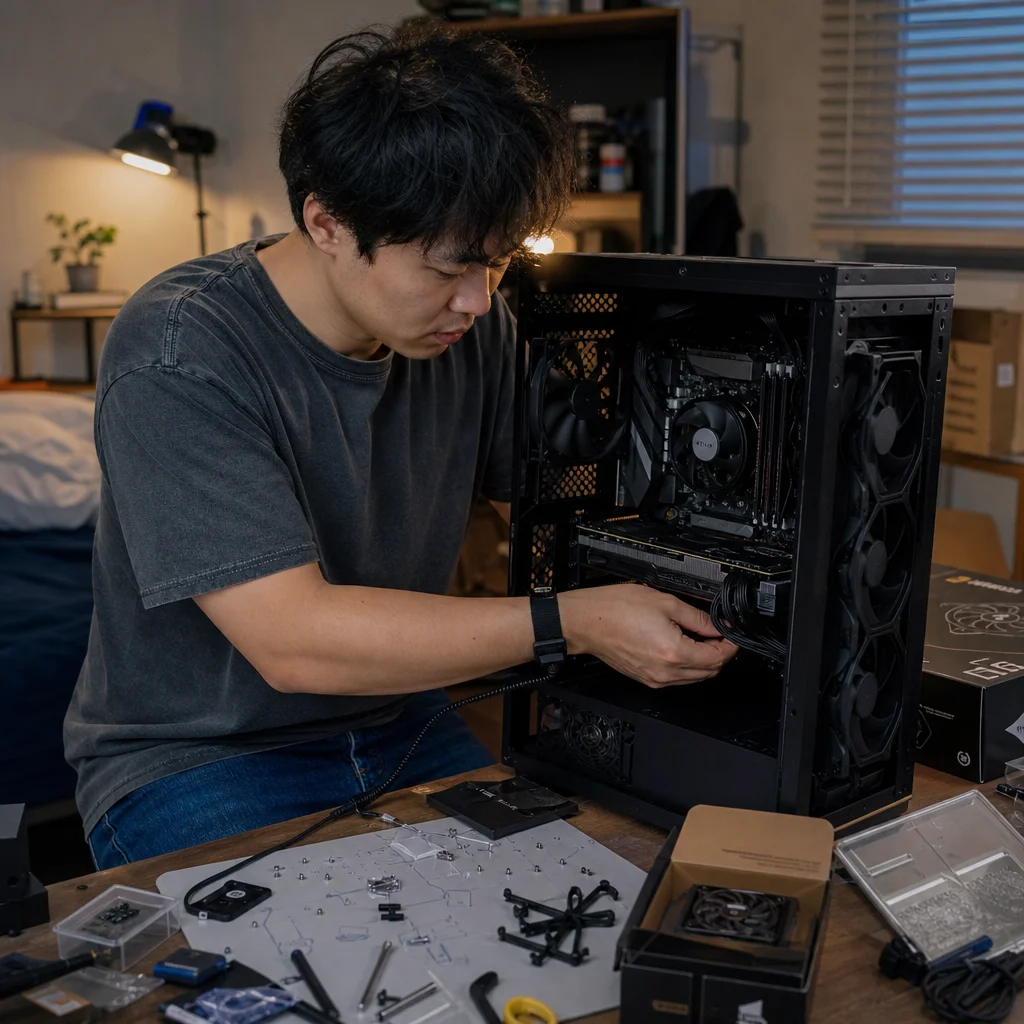
A quiet PC is possible in a room where you can’t add more ventilation, but the room itself sets an unavoidable limit. Every watt your computer uses eventually becomes heat, so a system that stays cool and nearly silent under a short benchmark may become warm and noisy during a long gaming session or render.
The practical goal isn't to eliminate heat. It’s to keep the computer’s heat output reasonable, move that heat through the case efficiently, and avoid making the fans work harder than necessary. That means choosing components and settings around your actual workload rather than treating maximum performance as the default.
Start with the room and workload
A closed room can absorb heat for a while, but its temperature will gradually rise if the computer, monitor, lights, and other equipment are all running. As the room gets warmer, the PC loses less heat to the surrounding air. Fan speeds then increase, even if the computer is doing exactly the same work.
This matters most in a bedroom or home office, where the computer may run for many hours. A system that is quiet in a cool room may be noticeably louder in the afternoon, especially if it sits under a desk with limited clearance. Before choosing parts, consider whether the PC will mostly browse, write, and make video calls, or whether it will run games, virtual machines, video exports, or other sustained workloads.
Check the room’s real workload: Think through the longest normal session, not just the brief tasks listed on a parts plan. If the computer will run a demanding application for hours, choose cooling and power settings for that sustained use.
For ordinary office work, low power consumption is usually more important than extreme cooling hardware. For gaming or content creation, you’ll have to decide how much performance you’re willing to trade for lower noise. Limiting a processor or graphics card slightly can reduce heat and fan noise without making the system feel slow in everyday use.
Choose lower heat before choosing larger cooling
Cooling hardware can move heat away from a component, but it can’t remove heat that the component generates from the room. A large cooler is useful because it can dissipate a given amount of heat at lower fan speed. It isn’t a substitute for selecting sensible power levels.
A processor with a moderate power limit is often easier to cool quietly than a higher-power model running without limits. The same principle applies to graphics cards. Two cards with similar performance may have different power requirements, and the one that uses less power will generally put less heat into the case and room.
You don’t necessarily need to choose the least powerful components available. Instead, avoid paying for performance that your monitor, applications, or schedule won’t use. For a home-office system, a modest processor with integrated graphics may be quieter and simpler than a system built around a powerful discrete graphics card. For gaming, a sensible frame-rate target and moderate resolution can make a lower-power graphics card a better fit.
Power supplies also contribute heat, although their fan behavior varies by design and load. Pick a reputable unit with appropriate capacity rather than one that is vastly oversized or operated close to its limit. A power supply that runs comfortably within its efficient range is less likely to turn excess input power into unnecessary heat.
Use a case that gives air an easy path
Quiet airflow depends more on resistance and fan speed than on the number of fans installed. A case with a clear front-to-back or bottom-to-top path lets fans move air without fighting restrictive panels, tightly packed drive cages, or a cooler pressed against a solid obstruction.
A mesh front panel can help reduce intake resistance, but it may also allow more fan and component noise to escape. A closed or sound-dampened panel can reduce certain high-frequency sounds while restricting airflow. Neither approach is automatically quieter. If the case has poor ventilation, the fans may spin faster enough to cancel out the benefit of the extra acoustic material.
A practical arrangement is usually one or two large, slow intake fans and a rear or top exhaust fan, depending on the case layout. Larger fans can move the required amount of air at lower rotational speed, which generally reduces motor noise and turbulence. More fans aren’t always better; each additional fan adds another possible source of vibration or bearing noise.
Keep filters clean and leave space around intake and exhaust areas. A PC tucked tightly against a wall or placed on thick carpet may have adequate theoretical airflow but poor real airflow. In a bedroom, raising the case off the floor can also reduce dust intake and make maintenance easier.
Make the cooling system quiet at normal temperatures
Fan curves are one of the most useful tools for balancing temperature and sound. A motherboard or graphics card can often keep fans at a low speed during light work, then increase speed gradually as temperature rises. A curve with abrupt jumps can make the computer seem more distracting than one that runs a little warmer with smoother changes.
Avoid setting every fan to respond aggressively to tiny temperature fluctuations. Modern processors can briefly boost and produce short temperature spikes during ordinary tasks. If the fan reacts instantly to every spike, you’ll hear repeated bursts of acceleration even when the average workload is light. A delay, smoothing setting, or broader temperature range can make the system sound calmer.
The quietest safe fan curve depends on the component, cooler, case, and room temperature. Watch temperatures during the workloads you actually use, not only at the desktop. If temperatures remain stable and below the component’s normal operating limits, reducing fan speed may be reasonable. If temperature continues climbing, the fan curve isn't the underlying problem; the system needs less heat, more cooling capacity, or a clearer airflow path.
CPU cooler choice matters as well. A tower air cooler with a large fan can be very quiet when the case supports it and the cooler has unobstructed intake air. A liquid cooler can move heat effectively, but it still has pump noise, radiator fans, and additional components that can fail. It may be useful for particular high-power systems, but it isn’t automatically quieter than a well-sized air cooler.
Tune power instead of accepting unnecessary heat
Power limits, undervolting, and frame-rate caps can improve the noise-to-performance balance. A processor that loses a small amount of peak performance may use substantially less power under sustained load. A graphics card can often deliver a similar gaming experience when its voltage or power target is adjusted carefully, especially if your frame rate is already limited by the display.
Frame-rate limits are particularly effective in games that can render far more frames than the monitor needs. Without a limit, the graphics card may run at full power even when extra frames aren't visible. Matching the limit to your display’s refresh rate, or choosing a lower target for quieter play, reduces both heat and fan activity.
Make one change at a time and test it with a repeatable workload. If a setting causes crashes, visual errors, application failures, or corrupted work, undo it. Stability is more important than a small reduction in noise, especially for a computer used for work or school.
Reduce noise at the source and at the desk
Electrical coil noise, pump noise, fan turbulence, and vibration have different solutions. A fan that produces a rushing sound may benefit from lower speed or less restrictive airflow. A rattling fan may need replacement. A vibrating hard drive or case panel may need isolation or repositioning. Software tuning won’t fix a mechanical noise source.
If you use a mechanical hard drive, consider whether you need it inside the primary system. Solid-state storage is silent and can remove the clicking and vibration associated with spinning disks. You can still use a larger external or secondary drive when its noise is acceptable, but placing it away from the desk may improve the perceived quietness of the room.
Placement affects what you hear. A PC at ear level can seem much louder than the same PC under a desk, though it still needs open space around its vents. Don’t place it inside a closed cabinet to hide the sound; the trapped heat will usually make the fans louder and can create a poor environment for the hardware.
Troubleshoot a PC that becomes loud
When a quiet system gets noisy, begin by identifying which fan or component is responsible. Listen at idle, then during the workload that causes the problem. Monitoring software can show whether the processor, graphics card, motherboard, or power supply is driving the temperature increase, but don’t assume the hottest reading is automatically the source of the sound.
If noise appears after several hours, check the room temperature and the case’s surroundings first. A warm room, blocked exhaust, or dusty filter can explain a gradual increase. If the system becomes loud immediately under load, review power limits, cooler mounting, thermal paste application, and the fan curve. If it pulses during light work, smooth the curve or adjust the temperature response delay.
Dust buildup can reduce cooling performance, but cleaning should be done with the computer powered down and unplugged. Hold fan blades still while cleaning them so they don’t spin freely from compressed air. If a fan has developed a grinding or clicking sound, replacement is usually more effective than trying to tune around it.
When the room remains too warm, lowering the computer’s power target is often the most direct recovery step. You can also reduce background workloads, cap game frame rates, or schedule demanding tasks for cooler parts of the day. These changes address the heat entering the room rather than merely masking it with faster fans.
Build for the quiet you can maintain
The best closed-room PC isn't necessarily the one with the largest cooler, most heavily insulated case, or highest benchmark score. It is the system whose heat output matches the room, whose airflow path is uncomplicated, and whose performance settings reflect the work you actually do.
Choose efficient components where practical, use large fans at moderate speeds, keep the case clear and clean, and test the system through a full normal session. Then tune power limits and fan curves gradually. If the room still becomes uncomfortable or the PC still needs to be loud, reduce sustained workload or performance demand before adding more cooling hardware. In a space with fixed ventilation, producing less heat is the solution that keeps working.